








Our Bureau
New York, NY
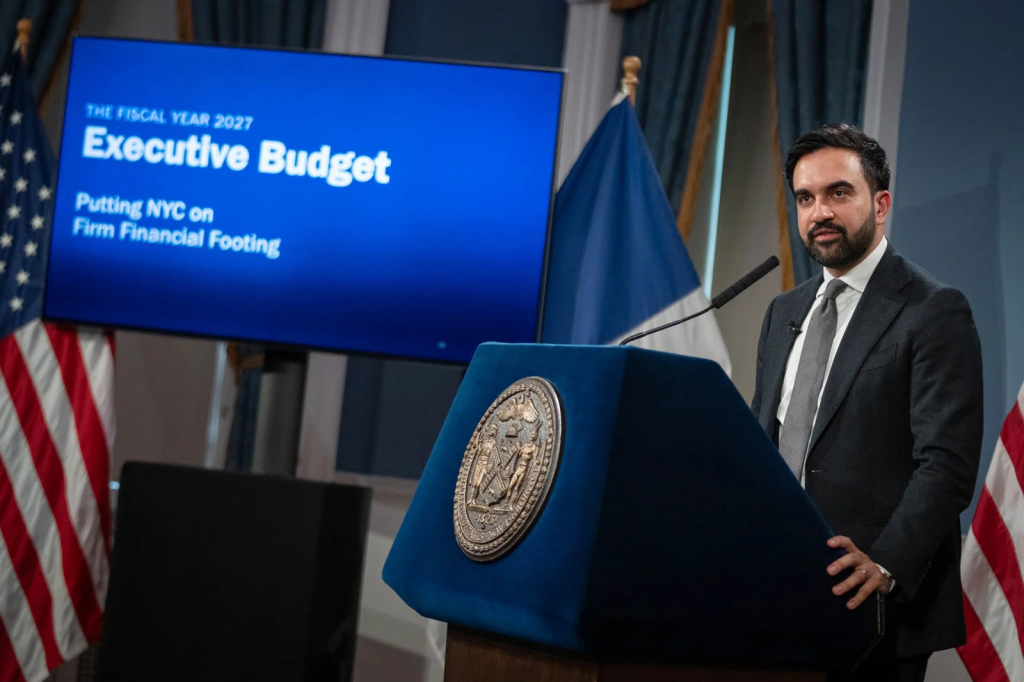
Mayor Zohran Kwame Mamdani has released a $124.7 billion FY2027 budget that closes a historic deficit while expanding social investment and shifting burden to the wealthy.
Mamdani’s first Executive Budget since taking office marks a decisive effort to restore fiscal stability after inheriting what City and State Comptrollers described as a more than $12 billion structural gap left by the previous administration. The plan balances the books without raising property taxes, cutting core services, or drawing down long-term reserves, relying instead on aggressive savings, state partnership, and targeted new revenue from higher earners.
It also delivers a $124.7 billion spending framework that preserves essential city programs while committing to the largest capital investment in New York City Housing Authority (NYCHA) in recent history, alongside expanded funding for housing, child care, education, and public safety.
Key fiscal adjustments include $1.77 billion in gap-closing savings from agency efficiency reforms, $1.2 billion from program restructuring, and $1.64 billion in debt service savings achieved through a revised repayment schedule that avoids impacting retirees or employee benefits. The administration also ordered every city agency to appoint a Chief Savings Officer to improve accountability.
State support plays a major role in closing the deficit, with Governor Kathy Hochul and the state legislature providing roughly $4 billion in new assistance, including direct aid, pension restructuring authorization, and new revenue tools such as a pied-à-terre tax on luxury second homes. In total, state actions contribute nearly $8 billion over two years, stabilizing the city’s finances.
Mayor Mamdani said the agreement reflects a rejection of austerity politics and a commitment to investing in working-class New Yorkers. He emphasized that the budget avoids property tax increases while expanding funding for libraries, parks, City University of New York, and cultural programs, alongside new initiatives like Fair Fares and expanded child care services.
It also expands safety and justice programs, including funding for the Office of Community Safety, hate crime prevention initiatives, supervised release pilots, and additional staffing for the Civilian Complaint Review Board and FDNY civilian workforce. Investments in mental health care, survivor support, and disease surveillance are also increased to strengthen public health infrastructure.
On infrastructure and housing, the Executive Five-Year Capital Plan grows to $117.1 billion, including $4 billion for HPD affordable housing development and an additional $500 million for NYCHA renovations, modernizations, and vacant unit restoration. Officials say these investments will accelerate the delivery of deeply affordable housing and improve living conditions for tens of thousands of residents.
The announcement comes alongside a renewed partnership between City Hall and Albany, with both Mayor Mamdani and Governor Hochul emphasizing cooperation after years of tension between city and state government. They described the agreement as a model for pragmatic governance focused on affordability, stability, and public investment.
Analysts say the FY2027 budget positions New York City on stronger fiscal ground while signaling a political shift toward higher taxation of the wealthy and expanded social spending.
By closing a double-digit deficit without austerity measures, the administration argues it has demonstrated that fiscal discipline and progressive investment can be pursued simultaneously in a large global city. The combination of agency savings, debt restructuring, and new revenue from state support and high-value property taxation forms the backbone of the fiscal strategy, reducing immediate pressure on services while preserving long-term investments. Supporters highlight increased funding for NYCHA, City University of New York, libraries, child care, and public safety programs as evidence of a renewed focus on working-class needs across all five boroughs. Critics of past administrations argue that underbudgeting and reliance on short-term fixes contributed to the earlier fiscal gap that the current plan now addresses through structural reforms. With the five-year capital plan expanded to $117.1 billion, the city is expected to accelerate housing construction, infrastructure renewal, and service delivery improvements.
Ultimately, the budget reflects an attempt to redefine New York’s fiscal model around three pillars: affordability for residents, accountability in government spending, and targeted investment in essential public goods that underpin urban life. City officials maintain that the combination of fiscal restraint, new progressive revenue measures, and expanded state cooperation will ensure long-term stability, even as economic uncertainty and population pressures continue to challenge municipal governance in the coming years, with the administration positioning the budget as both a financial roadmap and a political statement about the future direction of New York City going forward for long stability.