








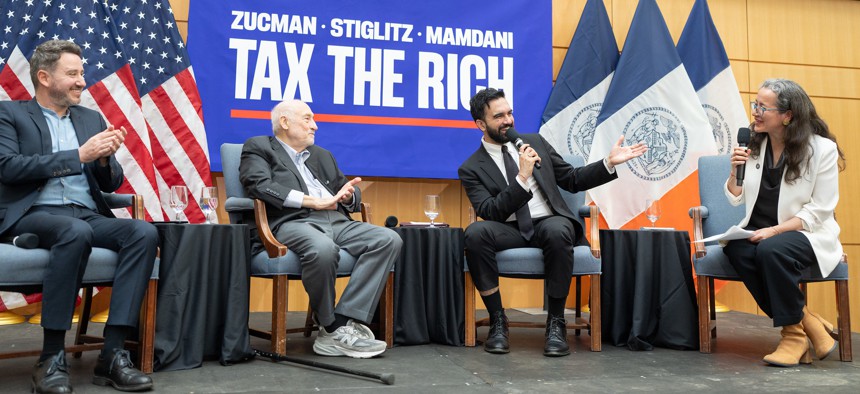
A twin policy push by New York’s leadership seeks to rebalance fiscal pressure while tackling the city’s deepening housing crisis.
Our Bureau
New York, NY
In a coordinated policy offensive, Zohran Kwame Mamdani and Kathy Hochul have unveiled two major initiatives aimed at addressing New York City’s fiscal and housing challenges—one targeting the ultra-wealthy through a first-of-its-kind pied-à-terre tax, and the other seeking to ease the burden on affordable housing through a city-backed insurance program.
At the core of the fiscal strategy is the proposed pied-à-terre tax, designed to generate $500 million annually by levying a surcharge on luxury secondary properties valued above $5 million when owned by individuals whose primary residence lies outside New York City. Framed as a corrective measure, the tax specifically targets “ultrawealthy out-of-city residents and global elites who use New York City real estate as a vehicle for wealth storage rather than as homes.”
The scale of wealth involved is underscored by examples cited in the proposal—from billionaire Ken Griffith’s $238 million penthouse in Midtown to Russian auto-dealer Alexander Varshavsky’s $20.5 million property. These holdings, often left vacant for much of the year, have long been a point of political contention in a city grappling with inequality and rising costs.
For Mamdani, the tax is both a fiscal necessity and a political statement. “We are one step closer to balancing our budget by taxing the ultra-wealthy and global elites,” he said, emphasizing that the goal is to address the deficit “fairly, where the wealthy contribute what they owe and our budget reflects our commitment to the working New Yorkers being priced out of our city.” The framing is deliberate: a redistribution of burden away from residents toward absentee wealth.
Hochul reinforced this argument with a sharper moral pitch. “If you can afford a $5 million second home that sits empty most of the year, you can afford to contribute like every other New Yorker,” she said, linking the tax to the broader principle that “the people who call it home should not be left carrying the burden alone.”
The measure, reportedly supported by 93 percent of New Yorkers, also marks a political breakthrough. While similar proposals have circulated for more than a decade, this is the first time such a tax is set to be enacted at the state level. Its passage would signal a shift in how urban wealth is taxed, particularly in global cities where real estate functions as both an investment and a status symbol.
Yet, even as the administration looks to increase revenue from the top, it is simultaneously attempting to reduce costs at the bottom—particularly in the housing sector, where rising expenses threaten affordability and stability.
The second major initiative—a city-backed insurance program—targets what officials describe as one of the fastest-growing cost drivers in housing: insurance premiums. These costs have “more than tripled since 2017,” placing significant strain on affordable and rent-stabilized housing.
The program aims to reduce premiums for approximately 100,000 homes by 2030, beginning with 20,000 homes as early as 2027. It will be managed by an interagency working group and is expected to become self-sustaining over time. By lowering insurance costs, the city hopes to reduce operating expenses for building owners, preserve affordability, and stretch public housing subsidies further.
Mamdani framed the initiative in direct terms: “We cannot take on the housing crisis without confronting one of the fastest-growing costs facing New Yorkers: insurance.” The program, he said, is intended “to help New Yorkers stay in their homes, give building owners the support they need to make repairs, and build a city that New Yorkers can actually afford.”
The economic logic behind the policy is stark. Officials noted that “every $100 increase in insurance costs requires $1,200 more in City capital in new transactions,” highlighting how rising premiums ripple through public spending. By addressing this cost, the administration aims not only to stabilize housing but also to reduce fiscal pressure on the city’s budget.
Deputy Mayor for Housing and Planning Leila Bozorg described the initiative as a “groundbreaking effort” that will “use the City’s purchasing power to lower insurance premiums,” thereby “reducing operating costs for owners of rent stabilized housing.” Similarly, Deputy Mayor for Economic Justice Julie Su emphasized the structural dimension of the problem: “Insurance is one of those costs, and it has been rising far too fast for affordable and rent-stabilized housing to absorb.”
The broader housing ecosystem has responded with cautious optimism. Housing officials and industry stakeholders repeatedly described the program as a necessary intervention in a failing market. HPD Commissioner Dina Levy called soaring insurance costs “a market failure that has gone uncorrected for too long,” adding that “it falls to government to step in.” Her assessment reflects a growing consensus that private insurance markets are ill-equipped to handle the risks associated with affordable housing.