








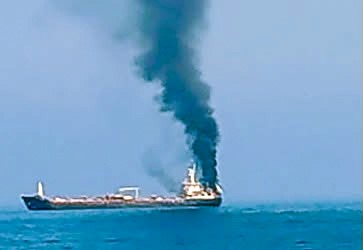
The deaths of Indian seafarers and repeated attacks on commercial vessels in the Gulf of Oman are turning one of the world’s most important shipping lanes into a dangerous flashpoint with implications for India-US relations.
Our Bureau
Muscat / New Delhi
The escalating confrontation around the Strait of Hormuz is emerging as a major challenge not only for global shipping but also for India’s relationship with the United States. As military operations linked to the US-led blockade of Iranian oil intensify, Indian seafarers are increasingly finding themselves caught in the middle of a geopolitical conflict that New Delhi has little control over but significant stakes in.
The latest incidents have highlighted the growing dangers facing commercial shipping in the Gulf of Oman and the Strait of Hormuz, a strategic maritime corridor through which a substantial portion of the world’s energy supplies pass.
India confirmed on Thursday that three Indian seafarers had died following an attack on the vessel MT Settebello. The Ministry of External Affairs (MEA) said the identification process had been completed and efforts were underway to bring their mortal remains back to India.
The deaths came amid a series of military actions by US forces enforcing a blockade against Iranian oil shipments. According to US Central Command (CENTCOM), American forces have disabled multiple commercial vessels in recent days for allegedly violating the blockade.
The dangers were further underlined on June 11 when the Guinea-Bissau-flagged tanker MT Jalveer, carrying 20 Indian seafarers, was struck in the Gulf of Oman. CENTCOM said the vessel was attempting to transport Iranian oil and failed to comply with repeated instructions from US forces.
The attack on MT Jalveer marked the third commercial vessel targeted by US forces in the Gulf of Oman within a single week. Earlier, the Palau-flagged vessels MT Marivex and MT Settebello had also been disabled.
For India, the incidents have raised concerns that ordinary commercial sailors are paying the price for a conflict that is rapidly spreading beyond military targets.
MEA spokesperson Randhir Jaiswal acknowledged that the attacks were carried out by US forces operating in the region. While noting that the ships involved were foreign-flagged vessels, he stressed that the welfare of Indian seafarers remained a matter of paramount concern.
The issue has quickly evolved into a diplomatic challenge between New Delhi and Washington.
Following the attack on MT Settebello, India lodged a strong protest with the United States and summoned US Charge d’Affaires Jason Meeks. Additional Secretary (Americas) Nagaraj Naidu conveyed India’s concerns regarding the safety of Indian citizens working on international commercial vessels.
Jaiswal said India had made its position clear to the American side.
“When this particular attack happened on the ship Settebello, we lodged a strong protest with the American side, we called in the American Charge d’Affaires,” he said.
“We conveyed that the welfare of our seafaring community is very important, and the attacks that are happening must stop,” he added.
India’s response reflects a difficult balancing act. The United States remains one of India’s most important strategic partners, particularly in areas such as defence cooperation, technology and Indo-Pacific security. At the same time, India has a large maritime workforce employed on international commercial vessels operating in the Gulf region.
Thousands of Indian seafarers work on ships passing through the Strait of Hormuz, making the security of these waters a direct national concern.
The Indian government has therefore focused its diplomatic response on principles rather than assigning blame. New Delhi has repeatedly called for de-escalation, protection of commercial shipping and restoration of safe navigation.
Jaiswal reiterated India’s long-standing position that “dialogue and diplomacy is the way forward for peaceful resolution of the conflict” and emphasised that there should be “unimpeded access through the Strait of Hormuz in keeping with international law.”
The government has also warned that attacks on commercial vessels are a direct consequence of the broader regional conflict.
Political voices in India have also reacted strongly. AIMIM chief Asaduddin Owaisi condemned the attacks following the deaths of the three Indian sailors and criticised US actions in the region.
“Just think about how many of our people are dying. They are attacking our ships. Doesn’t CENTCOM know how many vessels are operating there?” he asked.
For India, the crisis presents twin challenges. The first is protecting its large seafaring community operating in the region. The second is maintaining strong relations with the United States while simultaneously defending the principle of free and unimpeded navigation.
As military operations continue and commercial vessels remain exposed to potential attacks, the Strait of Hormuz is increasingly becoming not just a geopolitical flashpoint but also a test of how India balances its strategic partnerships with its responsibility to protect its citizens and economic interests.