








As Bangladesh’s new Prime Minister unveils a 180-day domestic agenda, early signals from Dhaka and New Delhi point to cautious recalibration in bilateral relations.
Our Bureau
Dhaka (Bangladesh)
Bangladesh’s newly sworn-in Prime Minister Tarique Rahman has outlined an ambitious 180-day priority plan focused squarely on restoring law and order, controlling prices, ensuring energy stability, improving transport connectivity and fighting corruption. While his first national address was dominated by domestic concerns, the contours of India-Bangladesh relations under the new government are beginning to take shape through early diplomatic exchanges and policy signals.
Rahman’s decision to extend the traditional 100-day roadmap to 180 days reflects both the scale of challenges at home and the political transition underway. After a landslide victory in the February 12 general elections, which saw the BNP-led alliance secure 212 of 300 parliamentary seats, Rahman returned from years in exile to lead Bangladesh through a new phase. His immediate priorities are internal stability and economic management.
“Restoring peace and security in the minds of the public by eliminating crime and strictly controlling corruption is the primary focus of our government’s agenda,” Rahman said in a national address.
The emphasis on law and order is significant not only for domestic politics but also for regional confidence. India, Bangladesh’s largest neighbour and a key economic partner, has closely watched developments following the political upheavals that culminated in the 2024 uprising. Stability in Dhaka is central to India’s eastern and northeastern strategic calculus.
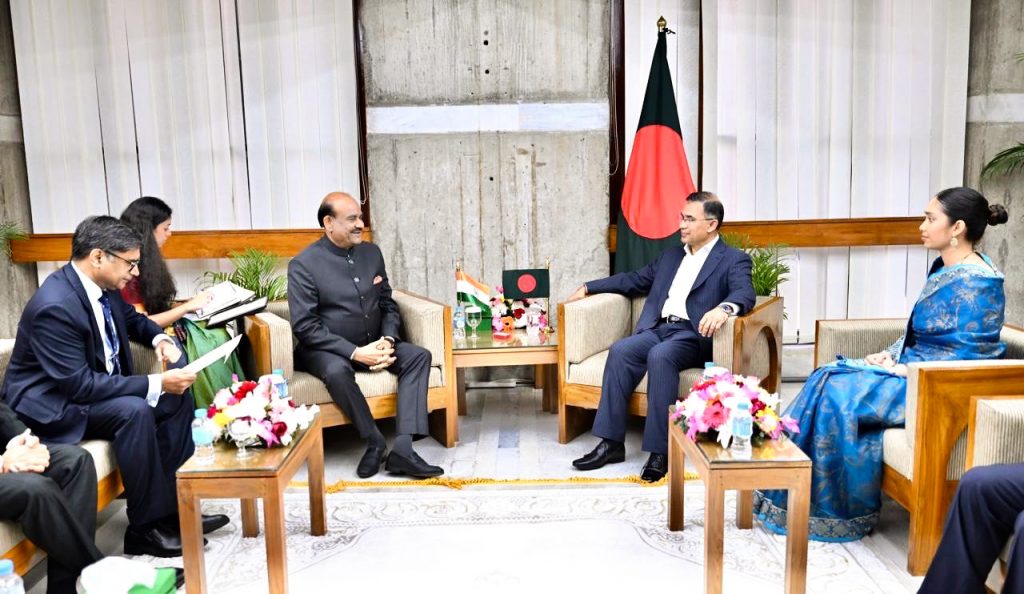
India moved quickly to engage the new leadership. Lok Sabha Speaker Om Birla attended Rahman’s swearing-in ceremony in Dhaka and conveyed a personal invitation from Prime Minister Narendra Modi to visit India at the earliest convenience. In a letter, Modi extended warm wishes and underlined the potential of the bilateral relationship.
“As two fast-growing economies and aspiring societies, India and Bangladesh can truly become catalysts for each other’s sustainable growth, work for each other’s security and enable mutual prosperity,” the letter read.
Modi also highlighted areas including connectivity, trade, technology, energy, healthcare, education and people-to-people exchanges as pillars for enhanced cooperation. The tone suggests New Delhi’s intent to preserve continuity in ties despite the political shift in Dhaka.
Interestingly, Rahman himself did not elaborate on foreign policy in his initial address. However, Bangladesh’s new Foreign Minister, Kalilur Rahman, later articulated a guiding principle: “Bangladesh First.” The formulation echoes the foreign policy line associated with former President Ziaur Rahman—prioritising national interests while maintaining friendly relations with all countries.
For India, the phrase signals a pragmatic, interest-driven approach rather than ideological alignment. It suggests that Dhaka under the BNP will seek balanced diplomacy, possibly recalibrating certain aspects of its external engagement while avoiding overt confrontation.
Sports diplomacy has already emerged as an early test case. Bangladesh’s newly appointed sports minister, former footballer Aminul Haque, expressed eagerness to repair ties with India and the Board of Control for Cricket in India (BCCI) following diplomatic complications that saw Bangladesh replaced by Scotland in the ICC Men’s T20 World Cup 2026.
“From sports to all other sectors, we want to build a sincere and cordial relationship [with India],” Aminul said, noting that he had met India’s deputy high commissioner and described the discussions as cordial. “We want to resolve this issue quickly through discussions because we want to maintain friendly relations with all our neighbouring countries.”
The episode, which involved disagreements over match venues and broader diplomatic sensitivities, underscored how quickly political tensions can spill into other domains. That Dhaka is keen to resolve the matter suggests an awareness of the symbolic importance of maintaining cooperative ties with India.
At the structural level, economic and connectivity projects will likely define the trajectory of relations. Over the past decade, India and Bangladesh have deepened cross-border infrastructure, energy trade and transport linkages. Rahman’s domestic focus on improving railways and public transport aligns with these priorities, potentially opening space for continued collaboration on cross-border rail corridors and transit agreements benefiting India’s northeastern states.
Energy cooperation may also remain central. Rahman has pledged to ensure uninterrupted electricity and gas supplies while reducing the cost of living—areas where cross-border power trade with India has previously played a stabilising role.
At the same time, the BNP’s return to power marks the end of two decades of Awami League dominance, introducing uncertainties. The exclusion of key parties like the Awami League from the recent elections and lingering political tensions mean that domestic stability cannot be taken for granted. Any internal unrest could complicate bilateral engagement.
Rahman’s message of inclusivity—addressing citizens across religious and regional lines—will also be closely observed in India, given sensitivities surrounding minority issues.
Whether the relationship deepens or drifts will depend on how effectively both sides translate early diplomatic goodwill into tangible cooperation during Rahman’s extended 180-day honeymoon period.