








As India signs historic Free Trade Agreements with countries like the UK, the future of a trade deal with the United States remains uncertain. But New Delhi is moving ahead, redrawing its global trade map sector by sector
Our Bureau
London/New Delhi / Male / Washington, DC
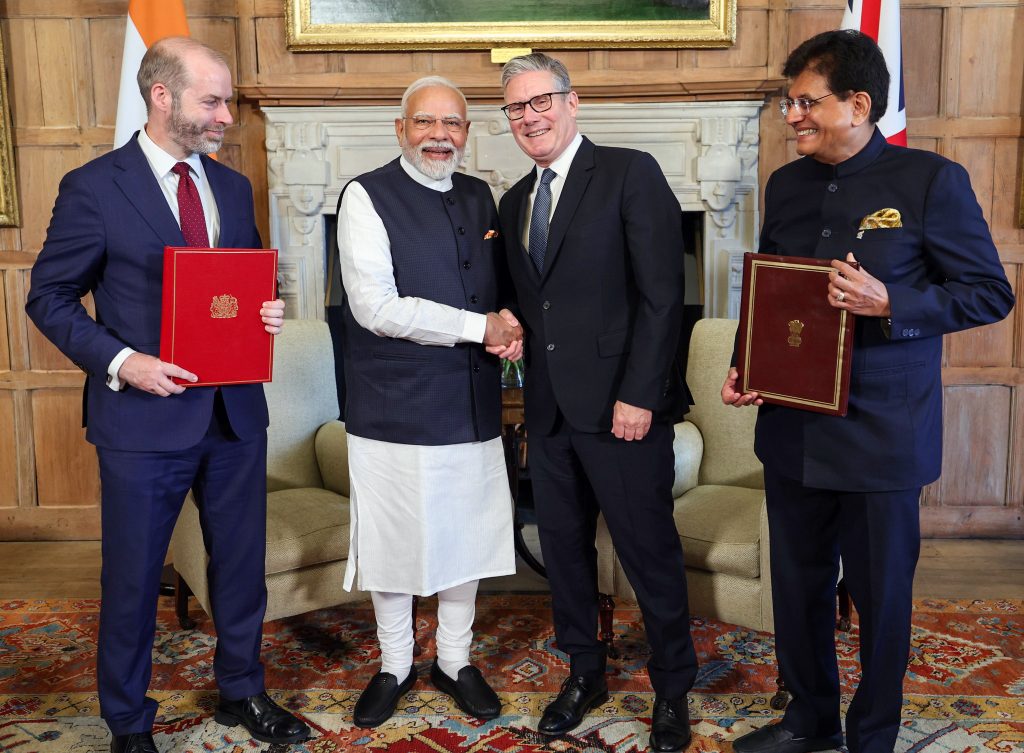
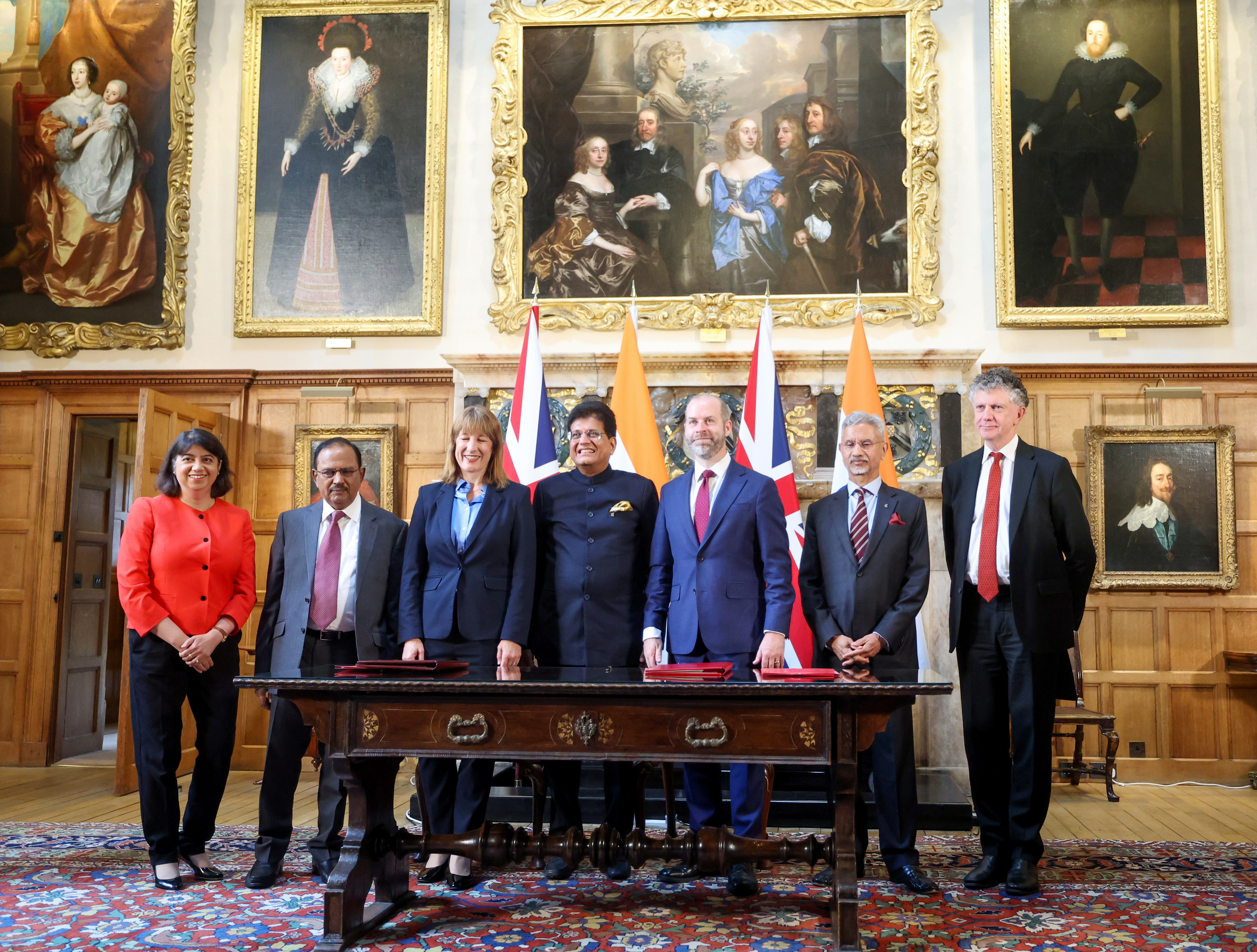
In a landmark moment for bilateral ties, Prime Minister Narendra Modi and UK Prime Minister Keir Starmer signed the much-anticipated Free Trade Agreement (FTA) in London on July 24, 2025. The agreement, hailed as a transformative step, not only reduces tariffs but also marks India’s increasing willingness to liberalize sectors that were previously off-limits.
Modi described the agreement as the “foundation stone of a new history,” underscoring its importance in enhancing trade, investment, and skilled mobility. Under the FTA, India gains duty-free access for 99% of its exports to the UK, including key labor-intensive sectors such as textiles, gems and jewellery, footwear, and processed foods. Meanwhile, British exporters benefit from significant tariff reductions—especially in alcoholic beverages and luxury automobiles.
The agreement also includes provisions on digital trade, critical minerals, skills mobility, and government procurement, while launching the Vision 2035 roadmap to deepen strategic partnerships in defence, education, and sustainable development. For India, this is not just about boosting exports—it is about writing a new trade playbook for a globalized future.
Industry leaders across sectors hailed the deal as a game-changer. From engineering goods to startup capital, the India-UK FTA promises to catalyze innovation and growth. Pankaj Chadha of EEPC India expects exports to double, while investors like Archana Jahagirdar point to opportunities in climate tech, semiconductors, and digital infrastructure.
Opening the Gates
The India-UK FTA is part of a broader trend. New Delhi has recently inked FTAs with the UAE, Australia, and Switzerland, and is currently negotiating similar deals with the European Union, New Zealand, and even the Maldives. Each agreement goes a little deeper—offering more market access, easing rules of origin, or liberalizing services sectors.
With the UK, India made a historic first by reducing duties on large-engine UK-made luxury cars under a Tariff Rate Quota (TRQ) system. It also opened 40,000 high-value government contracts in sectors like infrastructure and green energy to UK firms. In the gems and jewellery sector, Indian exports are projected to surge to $2.5 billion within three years, thanks to zero-duty access and India’s edge over countries like Thailand, UAE, and Hong Kong.
India’s textile exports to the UK, already at 6.6% of total UK imports, are expected to double. Production hubs like Tirupur, Ludhiana, and Surat stand to benefit immensely, generating employment and stimulating local economies. Similarly, in agriculture and marine products, the FTA unlocks huge markets with zero-duty access for high-value exports.
The leather and footwear sector is also poised for a major boost, with Indian exports expected to double to $1 billion. Zero duty on exports makes Indian goods more price-competitive than those from China, Vietnam, and Bangladesh. Farmers and fishers, too, are set to gain from the UK’s $5.4 billion marine import market and preferential access to agriculture exports.
Farmers in India are among the major winners as they are set to get preferential access to UK’s agricultural market — pegged to be around USD 37.5 billion — with the signing of the landmark India-UK Free Trade (FTA) Agreement.
Post the formalisation of the FTA, it is expected to open premium markets in the UK for Indian produce, offering similar or even better benefits than those enjoyed by exporters from European countries like Germany and the Netherlands.
Indian staples such as turmeric, pepper, and cardamom, along with processed products like mango pulp, pickles, and pulses, will get duty-free access, improving their margins and market reach. Over 95 per cent of India’s agricultural and processed food tariff lines will face zero duties once the agreement is enforced.
These include fruits, vegetables, cereals, spice mixes, fruit pulps, ready-to-eat meals, and more. This move will reduce the landed cost of these goods in the UK and enhance their competitiveness.
The FTA will help Indian agriculture sector transition from focus on high volume to high value products, and from catering to local markets to expanding globally.
India has also ensured that the FTA fully protects sensitive sectors like dairy, vegetables, apples, cooking oils, oats. There will be no tariff concessions on these commodities.
Further, in what could be termed as a “big catch” for Indian fish farmers, the USD 5.4 billion UK market also got opened up for marine exports as UK import duty on marine products are set to fall to zero from up to 20 per cent.

Both nations desire to increase their trade to USD 120 billion by 2030.
Strategic Shift?
Amid this expansion, one deal remains elusive—the long-discussed India-US Free Trade Agreement. Despite multiple rounds of talks and high-level meetings over the past decade, a comprehensive agreement has yet to materialize. The reasons are manifold.
Firstly, India and the US have divergent expectations. While Washington pushes for broader liberalization in areas like digital trade, data localization, intellectual property rights, and agriculture, New Delhi remains cautious. Concerns over data sovereignty, domestic regulatory flexibility, and farmer protections have slowed progress.
Moreover, the US is no longer aggressively pursuing bilateral FTAs. Its trade strategy has shifted toward regional frameworks like the Indo-Pacific Economic Framework (IPEF), which emphasizes standards, digital governance, and supply chain resilience over tariff reduction.
India, for its part, has grown increasingly wary of asymmetric trade deals. Officials cite the lopsided outcomes of past FTAs, particularly with ASEAN and South Korea, as a reason for their cautious stance. As a result, India pulled out of RCEP in 2019 and has since recalibrated its approach to trade—prioritizing ‘fair and balanced’ agreements that serve domestic interests.
Political dynamics further complicate the India-US trade equation. While the two nations have strengthened ties in defense and technology under strategic initiatives like QUAD, friction remains on e-commerce regulations, visa norms, and pharmaceutical pricing.
In addition, domestic political resistance in both countries has played a role. In the US, bipartisan concerns over labor rights and environmental standards have made FTAs a hard sell. In India, vocal industry lobbies and political groups remain skeptical of opening sensitive sectors to foreign competition.
Still, business leaders and trade experts argue that a US-India trade deal remains essential. With bilateral trade nearing $200 billion, the absence of a formal agreement leaves several sectors—especially services and digital commerce—exposed to uncertainties and non-tariff barriers.
The Road Ahead What the India-UK FTA represents, then, is a turning point—not just diplomatically, but philosophically. India is shedding its protectionist shell and engaging with the global trade system on more confident terms. At the same time, it is drawing clear red lines.
Sensitive sectors like dairy, wheat, apples, and cooking oils have been kept out of the UK FTA. In intellectual property, India accepted language aligning with global norms, but avoided commitments that could compromise its public health safeguards. In services, India has selectively liberalized key sectors like telecom, insurance, and auditing, while protecting legal services and domestic employment standards.
The government insists that each deal it signs will be a “win-win.” As Commerce Minister Piyush Goyal recently said, “India is open to the world—but on our terms.”
This strategic duality—openness with caution—will likely define India’s trade trajectory in the coming years. FTAs with the EU, New Zealand, and others are already on the horizon. And while the US deal remains on ice, India is not waiting.
By methodically unlocking market access, India is not only building bridges to new economies—it is building confidence at home. The message is clear: India is ready to lead, not just participate, in shaping the global trade agenda.
From manufacturing to mobility, agriculture to artificial intelligence, India is embedding itself into the world’s economic bloodstream. And in doing so, it is not just negotiating trade agreements—it is negotiating the terms of its own rise.