








New Delhi sees the India-UK trade agreement as a near-term economic win while a broader deal with Washington remains complicated by tariffs, trust issues and geopolitical concerns.
Our Bureau
London / Mumbai / Washington, DC
India is entering a crucial phase in its trade diplomacy, with policymakers expressing confidence about the benefits of the newly concluded trade agreement with the United Kingdom even as negotiations with the United States continue to face significant obstacles.
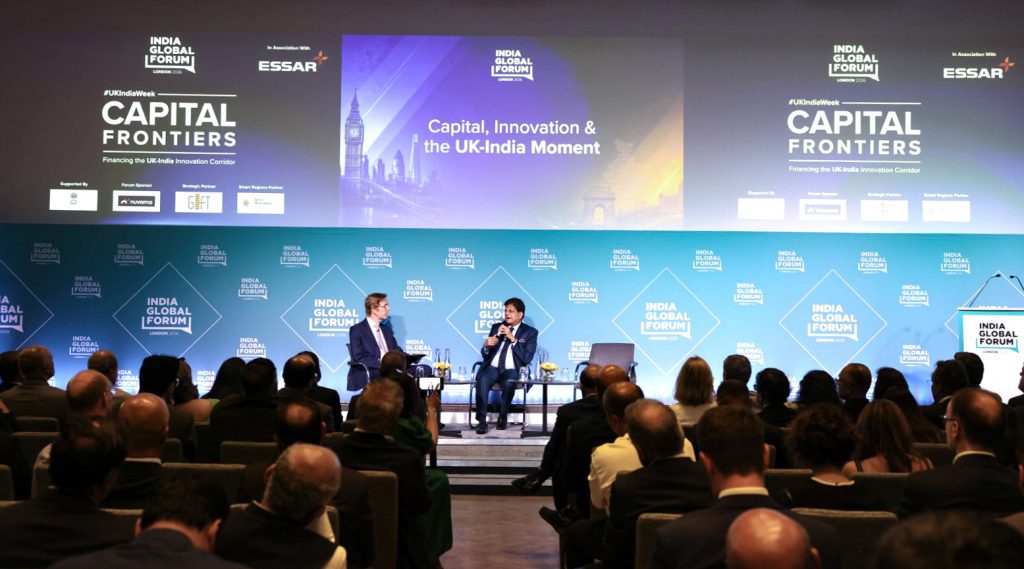
Speaking during the India Global Forum’s UK-India Week 2026 in London, Union Commerce and Industry Minister Piyush Goyal described the India-UK Comprehensive Economic and Trade Agreement (CETA) as a landmark pact that would deepen economic engagement between the two countries and open fresh opportunities for businesses.
The agreement comes at a time when India is actively expanding its network of economic partnerships to strengthen supply chains, attract investment and diversify export markets. According to Goyal, the trade pact will further advance the Comprehensive Strategic Partnership between India and the United Kingdom while fostering greater trade, investment, innovation and collaboration.
“Highlighted how the India-UK Comprehensive Economic and Trade Agreement (CETA) will further advance the Comprehensive Strategic Partnership between our two nations and unlock new opportunities across sectors,” Goyal said.
The minister noted that the agreement would allow businesses in both countries to deepen partnerships, expand commercial opportunities and contribute to shared growth and prosperity.
Goyal is in London on a three-day visit aimed at finalising preparations for the implementation of the India-UK CETA and the Double Contribution Convention (DCC), both of which are scheduled to come into force on July 15, 2026.
While optimism surrounds the UK agreement, India’s trade discussions with the United States present a more complex picture.
Recent meetings between Union Commerce Minister Piyush Goyal and US Trade Representative Jamieson Greer in New Delhi produced what both sides described as significant progress. However, trade experts caution that major differences remain unresolved and could delay the conclusion of a comprehensive agreement.
Wendy Cutler, Senior Vice President at the Asia Society Policy Institute (ASPI), said the negotiations have reached a difficult stage despite recent advances.
“Despite substantial progress made in recent meetings, concluding a trade deal with India is proving illusive,” Cutler said.
According to Cutler, both countries continue to defend their own priorities and red lines. She pointed to a growing trust deficit that has complicated efforts to bridge remaining gaps.
“Each side has its own priorities and redlines which continue to prevent a successful conclusion. Moreover, developments over the last year have produced a serious trust deficit on the part of Delhi, which makes wrapping things up more complicated,” she said.
One of the biggest sticking points remains tariffs. India is seeking greater certainty regarding future tariff arrangements and wants preferential treatment compared with competing exporters. New Delhi is also seeking assurances that Washington will refrain from imposing additional tariff increases after an agreement is signed.
“India very much wants a preferential tariff edge over its competitors, so it is in no hurry to conclude until there is further clarity on tariff rates and product exclusions,” Cutler said. “Moreover, it is seeking assurances from Washington on no further tariff hikes, which most likely is a bridge too far for the Trump team.”
Even so, analysts believe both governments remain committed to reaching at least an interim arrangement. Farwa Aamer, Director of South Asia Initiatives at ASPI, said sustained engagement indicates that an agreement remains achievable despite lingering uncertainty.
“The sustained effort from both sides shows promise toward the deal, but not without a fair share of speed bumps and lingering uncertainty,” Aamer said.
She also noted that geopolitical considerations have influenced India’s negotiating posture. According to Aamer, New Delhi has become more assertive while facing domestic pressure to secure a balanced and fair agreement.
If an interim agreement is reached, it could help revive momentum in a relationship that has faced strains in recent months. “It would certainly help the otherwise strained US-India ties and lend some momentum to other areas of cooperation,” Aamer said. “Both countries will benefit from a comprehensive deal.”
The contrast between the two negotiations highlights India’s evolving trade strategy. While the UK pact is poised for implementation and promises immediate commercial gains, discussions with the United States remain tied up in disputes over tariffs, market access and policy certainty. As India broadens its trade partnerships, the successful rollout of the UK agreement may offer a model for future economic engagements even as negotiators continue the harder task of securing a breakthrough with Washington.