








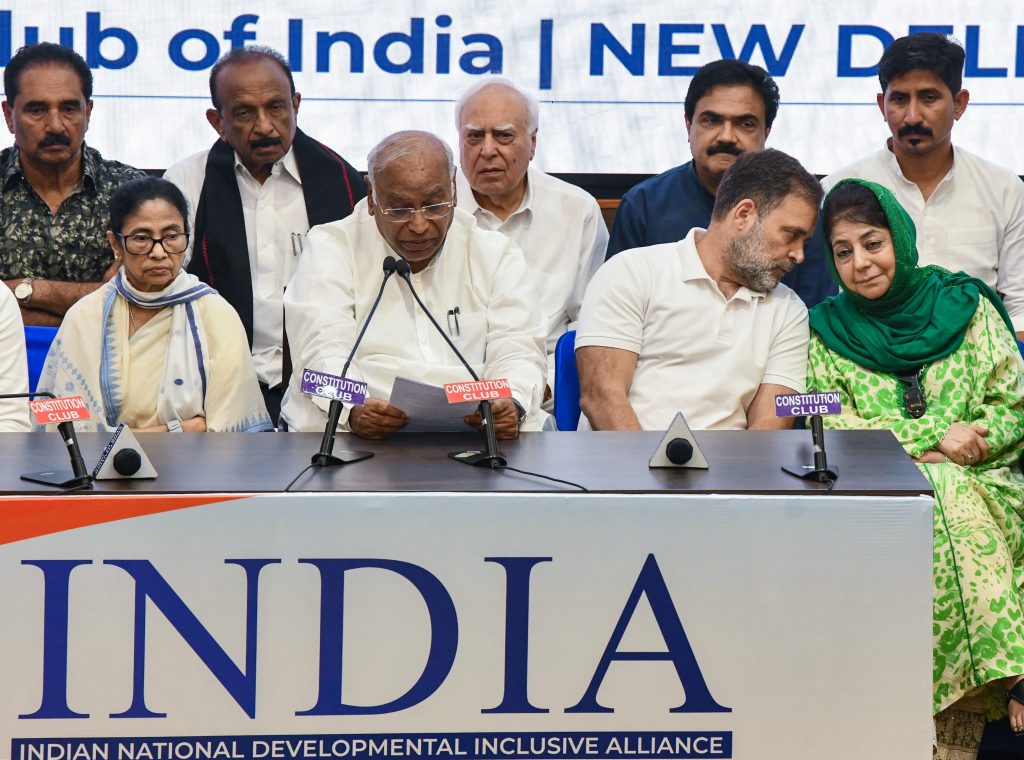
As opposition parties seek to sharpen their attack on the Modi government over economic and electoral issues, questions about cohesion within the INDIA alliance continue to pose a major challenge.
Our Bureau
New Delhi / Kolkata
The INDIA bloc has sought to project renewed unity by adopting a common strategy on issues ranging from the economy and unemployment to electoral reforms and parliamentary coordination. However, developments within some of its key constituent parties, particularly the Trinamool Congress (TMC), as well as continued criticism from rivals, underline the challenge of maintaining cohesion within the diverse opposition alliance.
At a meeting attended by leaders of 23 opposition parties in New Delhi, the Indian National Developmental Inclusive Alliance (INDIA) attempted to present a united front against the Narendra Modi-led government. Congress president Mallikarjun Kharge said the alliance had unanimously agreed on five broad points and would immediately begin coordinated action.
Among the key decisions was a joint move to write to the Chief Justice of India regarding concerns related to the Special Intensive Revision (SIR) of electoral rolls, alleged vote manipulation and what opposition leaders described as the “stealing of elections.” The alliance also demanded the resignation of the Union Education Minister over examination-related issues affecting students and their families.
The opposition grouping further called on the Union government to convene an all-party meeting to discuss what it described as the country’s precarious economic situation, rising unemployment, inflation, farmers’ concerns and issues affecting marginalised communities.
Perhaps most significantly, the alliance decided to institutionalise regular consultations among member parties. Meetings will now be held every two months, with the next gathering scheduled in Hyderabad in August. The bloc also agreed to continue parliamentary strategy meetings throughout the upcoming Monsoon Session to ensure coordination on legislative and political issues.
In his opening remarks, Kharge emphasised the need for greater unity among alliance partners. He urged opposition parties to intensify collective efforts against what he described as political, economic, social and foreign policy challenges confronting the country.
Kharge pointed to the alliance’s performance in Parliament on April 17, 2026, when opposition parties united to oppose and defeat the Centre’s proposed delimitation-related legislation in the Lok Sabha. He argued that the bloc should build on that success and continue working together in the months ahead.
Yet even as the INDIA bloc discussed strengthening coordination, one of its most important constituents was grappling with internal turbulence.
In West Bengal, senior TMC leader Kunal Ghosh sought to reassure party workers and alliance partners that the party remained committed to both organisational stability and opposition unity.
“We have to further strengthen the INDIA bloc. Congress and TMC will work unitedly against the BJP and the Central government and their anti-people policies,” Ghosh said.
His remarks came amid growing turmoil within the Trinamool Congress. The party has been hit by multiple resignations, allegations of factionalism and public disagreements among senior leaders.
The latest controversy erupted after senior TMC MP and advocate Kalyan Banerjee publicly criticised the party’s national general secretary Abhishek Banerjee and accused him of displaying an “arrogant attitude.” Kalyan Banerjee also reportedly issued an ultimatum to party chief Mamata Banerjee, asking her to choose between him and her nephew Abhishek Banerjee, while announcing that he would no longer represent Abhishek Banerjee in legal matters.
The tensions have been accompanied by a series of resignations from the Rajya Sabha. TMC MP Prakash Chik Baraik resigned from the Upper House, becoming the third party MP to step down within a week after Sushmita Dev and Sukhendu Sekhar Ray.
Kunal Ghosh criticised the rebellion and defended the party leadership. “What has happened is not right. These people won on the TMC symbol, and these people should be asked to go to party offices in their respective constituencies and face the TMC workers there,” he said.
The difficulties faced by the INDIA bloc are not limited to internal disputes within constituent parties. The alliance also faces persistent criticism from the ruling NDA and its allies, who argue that opposition parties lack a common agenda beyond opposing Prime Minister Narendra Modi.
Janata Dal (United) MP and National Working President Sanjay Kumar Jha launched a sharp attack on the opposition grouping, claiming that it was driven by individual interests rather than a coherent national programme.
“The INDIA alliance is not an alliance at all. In their alliance, everyone speaks and fights against each other,” Jha said.
According to him, the alliance has been rejected by the public because it has “no agenda for the country” and exists primarily to oppose the NDA and Prime Minister Modi.
For the INDIA bloc, therefore, the central challenge remains balancing diversity with unity.