








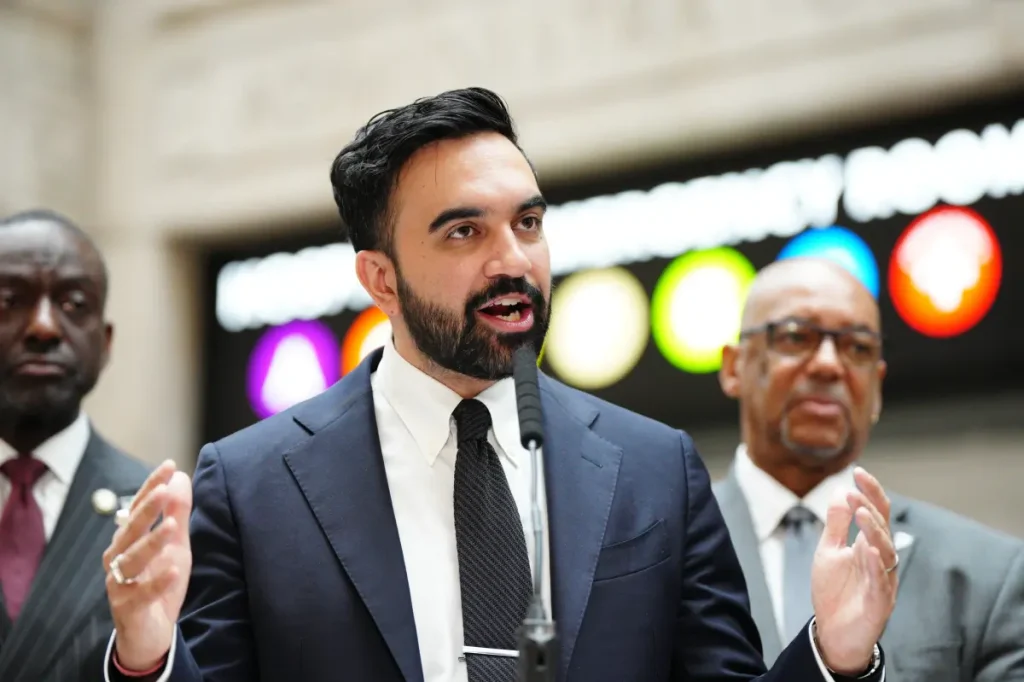
New York mayor pairs aggressive worker protections with ambitious childcare expansion in early policy push
Our Bureau
New York, NY
In his first 100 days in office, Zohran Kwame Mamdani has moved to combine economic enforcement with social policy expansion, securing $9.3 million in restitution for workers and consumers while launching a sweeping overhaul of early childcare aimed at easing the city’s affordability crisis.
Announcing the measures alongside Deputy Mayor Julie Su and Department of Consumer and Worker Protection Commissioner Samuel A.A. Levine, the administration framed its early record as a direct intervention in rising living costs and what it described as corporate overreach.
“New Yorkers have lived too long with one set of rules for the wealthy and well-connected, and another for everyone else,” Mamdani said. “We are putting money back in people’s pockets and holding corporations accountable.”
The $9.3 million recovered since January 1 reflects a broader enforcement push that includes settlements, litigation and regulatory action. Among the most significant outcomes were agreements with companies that will deliver more than $1.8 million to fast food and retail workers for violations of the Fair Workweek Law, building on a $5 million settlement with delivery platforms including Uber Eats, Fantuan and HungryPanda.
The administration also moved aggressively against what it described as exploitation in the gig economy. In addition to financial settlements, authorities secured the reinstatement of up to 10,000 delivery workers and filed a lawsuit against delivery platform Motoclick. Data released by the city claimed that major platforms Uber and DoorDash were responsible for $550 million in lost wages for delivery workers, underscoring the scale of alleged violations.
At the same time, enforcement actions extended across sectors. The city filed lawsuits against a Bronx tow truck operator, a solar panel company and a publicly traded self-storage firm, while issuing nearly 60,000 compliance notices to businesses. These included warnings targeting so-called “subscription traps” at gyms and deceptive practices in the tax preparation industry.
Deputy Mayor Su said the administration’s approach was deliberately interventionist. “We are not a neutral actor in the fight against corruption and exploitation – we have the power and the will to take on these fights, and win,” she said, adding that the measures aim to restore public faith in government’s ability to deliver tangible benefits.
Regulatory changes have accompanied enforcement. The administration introduced what it called a nation-leading ban on hotel junk fees and strengthened debt collection rules, measures projected to save consumers tens of millions of dollars annually. Economists estimate that the crackdown on hidden hotel charges alone could save New Yorkers more than $46 million in 2026.
Commissioner Levine highlighted the direct impact of these steps. “Restitution checks, one less junk fee, free income tax preparation—make a real difference in people’s lives,” he said, adding that the agency would continue to use “every rulemaking and enforcement tool” to prevent exploitation.
Complementing these actions is an expansion of the city’s Free Tax Prep program, expected to process more than 100,000 returns this year and save residents tens of millions of dollars. The service is available both in-person and virtually across more than 140 locations for eligible households.
Alongside economic enforcement, Mamdani has placed childcare at the centre of his affordability agenda. In a parallel announcement, the mayor confirmed that most 2-K seats will transition to a full-day, full-year model beginning this fall, operating from 8:00 a.m. to 6:00 p.m., 260 days a year.
“For many families working nine to five, an eight to three program isn’t going to cut it,” Mamdani said. “For too long, parents have been forced to choose between their livelihood and their children… That ends now.”
The move marks a significant shift from the traditional 180-day school calendar and is designed to align early childhood education with the needs of working families. Representing a majority of the first 2,000 seats available this fall, the new model is expected to reduce reliance on patchwork childcare arrangements that often strain household finances.
Schools Chancellor Kamar Samuels described the rollout as a structural reform. “This is a historic moment… to build an early child care and education system that is truly universal, equitable, and tailored around the real needs of the families we serve,” he said.
The 2-K initiative is part of a broader push to guarantee childcare for children aged six weeks to five years. The administration has already taken steps in that direction, including a $1.2 billion investment in Pre-K and 3-K announced with Governor Hochul, the addition of 1,000 new 3-K seats, and the acceleration of an early childhood education centre on the Upper East Side.
As his administration crosses the 100-day mark, the early record suggests a strategy that blends regulatory activism with social investment—an approach that seeks not only to return money to residents but also to reduce the costs they face in the first place.