








By Vijay Singh
Aviation Correspondent
It’s a bird; it’s a plane; but to a growing community of flight enthusiasts, it’s something far more intriguing. The gyroplane—a machine that looks like a cross between a helicopter and a fixed-wing aircraft—is experiencing a significant global resurgence, promising a future of accessible, safe, and cost-effective personal aviation.
A Century of “Auto Gyro” Innovation
The gyroplane phenomenon is far from new. Its roots trace back to the early 1920s and the visionary Spanish pioneer, Juan de la Cierva. Driven by a desire to create a safer flying machine, Cierva developed the “Autogyro.” His breakthrough was the unpowered, free-spinning rotor. Unlike a traditional airplane, which can stall if it loses forward speed, the Autogyro’s blades act like a permanent parachute. This allows the machine to descend slowly and safely to Earth without forward motion, providing a level of security that traditional fixed-wing aircraft cannot match.
While the mid-20th century saw attempts to scale these machines for commercial city-to-city transit, those dreams were grounded by noise concerns and the economic hurdles of the 1960s.
Breaking the Training Barrier
In the recent past, the gyroplane’s revival was hampered by a critical lack of standardized instruction. However, the industry has finally addressed its “missing link”: Professional Training.
In the United States, the landscape has shifted. Experienced Certified Flight Instructors (CFIs) are now widely available to provide the technical ground and flight training necessary for both novices and transition pilots. This educational infrastructure is supported by the FAA’s “Sport Pilot” category, which encompasses gyroplanes and offers a streamlined certification path for new applicants and existing pilots seeking an “add-on” rating.
Modern Machines, Modern Comforts
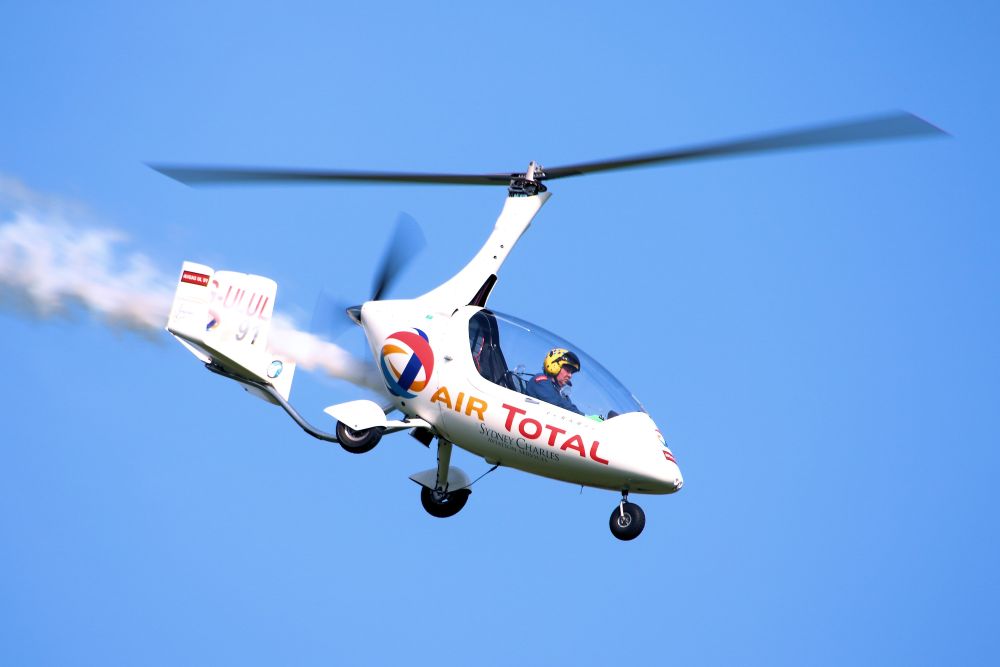
Today’s gyroplanes are a far cry from the skeletal frames of the past. Looking more like sleek spacecraft than vintage flyers, they are available in both kit forms and fully assembled models. Pilots can choose between:
Seating: Tandem (one behind the other) or Side-by-Side configurations.
Environment: Open-air cockpits for the ultimate “wind in your face” experience, or fully enclosed cabins with removable doors.
Under the hood, these machines are typically powered by reliable Rotax 900 series engines, ranging from 100 hp to the newer, more powerful 130 hp variants. Despite their compact size, they can be outfitted with state-of-the-art avionics and comforts previously reserved for much larger aircraft.
A Call to Action for India
The U.S. market is already seeing a spike in sales as these “fun machines” capture the imagination of the flying public. But for India, the implications go beyond recreation.
As gyroplanes prove their utility worldwide, India must take a closer look at their reappearance. With their low operating costs, short takeoff requirements, and unique safety features, gyroplanes represent a massive opportunity for:
Civil Applications: Agricultural spraying, traffic monitoring, and rural connectivity.
Military/Paramilitary: Border surveillance and rapid reconnaissance.
The “spaceship” of the skies is no longer a historical curiosity—it is a viable, modern solution for the future of Indian aviation.