








As the global trading system comes under pressure, India’s partnership with EFTA offers a model of market access, investment and economic diversification
Our Bureau
New Delhi / Milwaukee, WI
India’s trade relationship with the European Free Trade Association (EFTA) has completed its first year at a time when the global trading system is undergoing profound change. The India-EFTA Trade and Economic Partnership Agreement (TEPA), which came into force on October 1, 2025, is therefore more than another free trade agreement. It is part of India’s effort to build a wider and more diversified network of economic partnerships as the old rules of global commerce come under increasing pressure.
Commerce and Industry Minister Piyush Goyal has described the first year of TEPA as an important milestone, highlighting wider market access for Indian exporters and EFTA’s commitment to promote $100 billion in investments in India over the next 15 years. The agreement is also expected to help create one million direct jobs.
The timing could hardly be more significant.
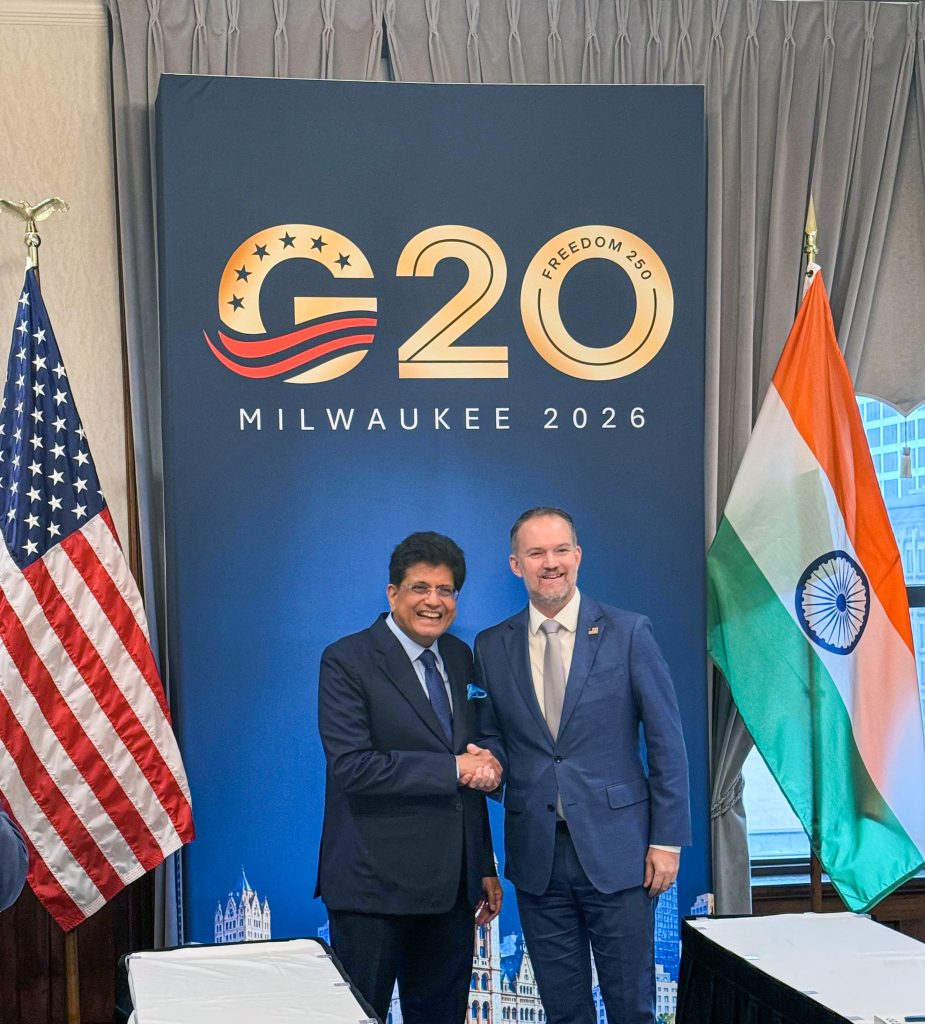
The global trading environment is increasingly moving away from the relatively predictable system that dominated international commerce for decades. At the G20 Trade Ministers’ meeting in Milwaukee, US Trade Representative Jamieson Greer argued that the existing international trading architecture was designed for another era and called for a “new international economic order”.
Greer pointed to structural excess capacity, forced labour, food security, economic coercion and the future of the Most-Favoured-Nation principle as issues exposing the limitations of the existing framework. Washington has itself increasingly relied on tariffs and bilateral agreements to restructure trade relationships and make supply chains more resilient.
Against this backdrop, India’s approach of expanding bilateral and plurilateral trade partnerships assumes greater importance.
EFTA comprises Switzerland, Norway, Iceland and Liechtenstein. India signed TEPA with the four countries in March 2024, making it the country’s first free trade agreement with these developed European economies. The pact covers 14 chapters, including trade in goods, services, investment promotion, intellectual property, trade facilitation and sustainable development.
Its market-access provisions are substantial. EFTA has committed to provide access on 92.2 per cent of its tariff lines, covering 99.6 per cent of India’s exports, including all non-agricultural products. India, meanwhile, has covered 82.7 per cent of tariff lines accounting for 95.3 per cent of EFTA exports, while keeping sensitive sectors such as dairy, soya, coal and sensitive agricultural products outside or protected.
That asymmetry reflects an important feature of India’s trade strategy: opening markets while retaining safeguards for sectors considered strategically sensitive.
The investment commitment may ultimately prove even more consequential. EFTA’s target of $100 billion in investment over 15 years, alongside the employment target, links trade liberalisation directly with India’s manufacturing and investment ambitions.
For India, the objective is not simply to sell more goods abroad. The larger goal is to attract capital, technology and expertise that can strengthen domestic production and services.
TEPA also seeks to expand Indian services exports through digital delivery, commercial presence and professional mobility. Mutual Recognition Agreements in areas such as nursing, accountancy and architecture could help Indian professionals gain greater access to EFTA markets.
There are already signs of increased trade activity. According to Goyal, exports of motor cars and other motor vehicles, heavy waters and moulding patterns have grown significantly since implementation.
But the real test of TEPA will be whether these early gains develop into deeper economic integration.
That question is particularly relevant as India moves simultaneously towards a broader trade agreement with the European Union. Negotiations for the India-EU FTA were completed earlier this year after talks that began in 2007 and were relaunched in 2022. The agreement is now moving towards formal signing and implementation.
Taken together, the EFTA and EU agreements could significantly expand India’s economic engagement with Europe. They also fit into a broader strategy of reducing excessive dependence on individual markets and integrating Indian companies more deeply into global supply chains.
For India, this diversification is becoming increasingly important. The emerging trading environment is characterised not only by tariffs but also by technology competition, supply-chain vulnerabilities, industrial policy and geopolitical considerations.
That makes the investment and technology components of TEPA especially important.
India’s challenge will be to ensure that foreign investment translates into stronger domestic manufacturing capabilities, technology transfer, skills and globally competitive Indian companies. The agreement can provide opportunities, but businesses will have to use them effectively.
The first year of TEPA is therefore best seen as a beginning rather than an outcome.
In a global economy where established trade rules are being questioned and major economies are increasingly turning towards tariffs, bilateral deals and strategic supply chains, India’s growing network of trade partnerships gives it additional room to manoeuvre.