








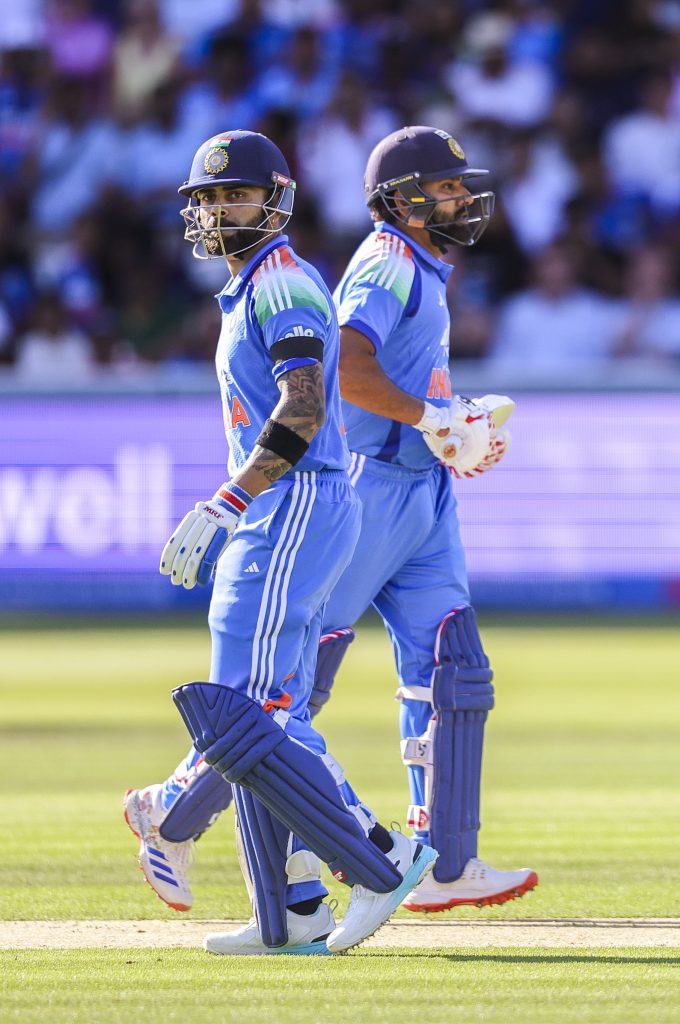
Even as Shubman Gill takes over the spotlight, India’s two modern greats continue to set the standard
Our Bureau
New Delhi
Indian cricket may be looking towards a new generation, with Shubman Gill firmly establishing himself as captain and the leading light of the next era. But the latest numbers from the ODI series against the West Indies offer a reminder that two of the game’s old war horses are still very much in command.
Rohit Sharma, 39, has just crossed 12,000 ODI runs. Virat Kohli has responded with a magnificent 139 not out and climbed to second place in the latest ICC ODI batting rankings. Between them, they continue to demonstrate why experience remains such a formidable weapon in international cricket.
Rohit’s 12,000-run landmark is another extraordinary chapter in a career that began in 2007. He reached the mark in 282 innings, making him the second-fastest batter to do so. Only Kohli, who reached 12,000 in 242 innings, got there faster. Sachin Tendulkar required 300 innings.
The significance of Rohit’s achievement goes beyond the number itself. He has joined an exclusive Indian club containing Tendulkar and Kohli, two names that have defined batting excellence for generations. For a player who has spent years transforming himself from a gifted stroke-maker into one of the most destructive ODI batsmen in history, the milestone is another reminder of his extraordinary longevity.
Rohit now has 12,000 ODI runs from 290 matches, including 34 centuries and 62 fifties. His unbeaten 264 against Sri Lanka in Kolkata in 2014 remains the highest individual score in men’s ODI cricket. He is also the only batter to have three double centuries in the format.
Those numbers explain why Rohit remains such a difficult player to write off.
His batting has always been built around timing and an almost effortless ability to accelerate. But age has brought another dimension: experience. Rohit has seen virtually every situation international cricket can produce. He knows when to attack, when to absorb pressure and how to construct an innings.
His latest landmark came during the same series in which Kohli produced another reminder of his enduring class.
Kohli’s 139 not out in the first ODI was his 55th ODI century and his 86th international hundred across formats. The innings pushed him up to second in the latest ODI batting rankings, with a rating of 796, behind only Gill at 816.
That ranking tells its own story. India now have three batsmen occupying the top two positions and fourth place in the ODI rankings: Gill at No. 1, Kohli at No. 2 and Rohit at No. 4. New Zealand’s Daryl Mitchell is the only player preventing an all-Indian top three.
For Kohli, the latest century was another statement of his remarkable consistency. His international career has already produced a mountain of records, but his ability to continue scoring heavily after more than a decade at the highest level remains striking.
What makes the Rohit-Kohli story particularly interesting is that they are now operating alongside Gill rather than competing with him for the future of Indian cricket. Gill represents the transition, while Rohit and Kohli represent the extraordinary generation that came before it.
Yet the transition has not meant disappearance.
Instead, the older generation continues to contribute heavily when India needs them. Rohit’s 101 in the second ODI came from 75 balls, with 10 fours and six sixes, while Gill produced his breathtaking double century in the same chase. The partnership between generations helped India chase 406, their highest successful ODI chase.
Rohit has another major ambition ahead: the 50-over World Cup winners’ medal that has eluded him. After leading India to the final in 2023, that remains a significant unfinished chapter in his ODI career.
For Kohli, the motivation is different but the hunger remains visible in the runs.
The arrival of Gill has inevitably changed the conversation around Indian cricket. The spotlight increasingly falls on the young captain and his extraordinary performances. But the latest evidence suggests that Indian cricket is not simply moving from one generation to another.
For now, the old war horses are still running.
Rohit and Kohli may no longer represent India’s future, but they remain a powerful part of its present. Their records, experience and ability to produce decisive innings mean that the next generation has not been handed the stage. It is having to share it with two of the finest batsmen Indian cricket has produced.
And judging by the numbers, Rohit and Kohli are not yet ready to leave.