








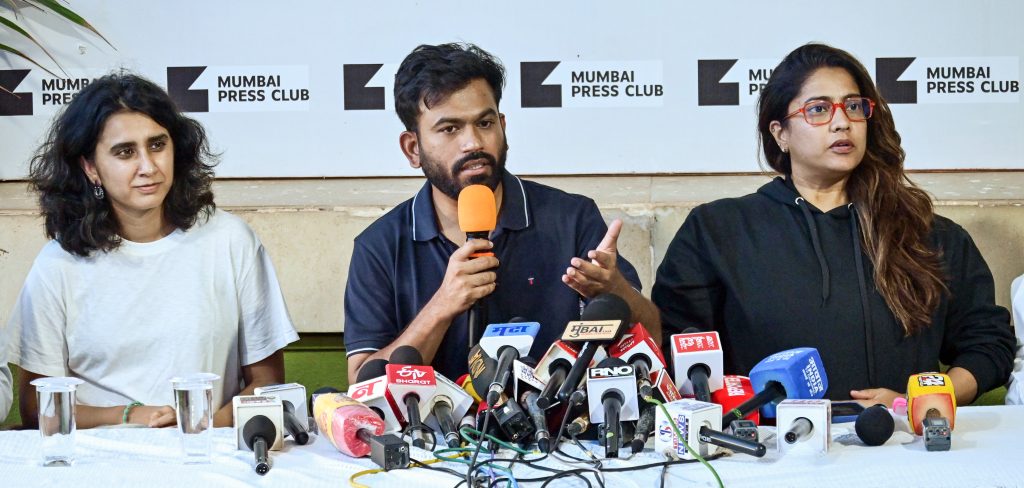
With a nationwide protest planned and support from Maharashtra’s opposition leaders, the Cockroach Janta Party is testing whether anger over the Election Commission can be converted into a broader street movement.
Our Bureau
New Delhi / Mumbai
The Cockroach Janta Party (CJP), a political pressure group that has emerged around allegations concerning the functioning of the Election Commission and the electoral process, is preparing for its biggest mobilisation yet. Its founder Abhijeet Dipke has announced a nationwide “Jail Bharo Andolan” from Mumbai on October 2, raising a larger question: can the relatively new organisation turn its campaign into a mass movement?
The timing is significant. The CJP’s announcement comes amid a widening political dispute over the Special Intensive Revision (SIR) of electoral rolls and demands for the resignation of Chief Election Commissioner Gyanesh Kumar. The issue has already moved beyond the CJP, with opposition parties raising questions about the Election Commission and the electoral process.
Dipke said the protest would begin at Mumbai’s Shivaji Park on Gandhi Jayanti and appealed to political parties to join the agitation. He alleged that the Election Commission’s functioning was not in the national interest and argued that collective action was needed to bring about change.
The CJP’s immediate challenge, however, is not simply to organise a protest but to demonstrate that it can attract people beyond its existing network of supporters.
It has received an important boost in Maharashtra. Maharashtra Navnirman Sena chief Raj Thackeray and Shiv Sena (UBT) chief Uddhav Thackeray announced a joint protest march against the Election Commission on October 4, from Byculla to the BMC headquarters. Raj Thackeray also said the MNS would support the CJP’s proposed “Jail Bharo” movement.
That support gives the CJP an opportunity to connect its campaign with a wider opposition mobilisation. But the two protests are separate events, and their ability to draw large numbers will depend on organisational capacity, participation by political parties and the extent to which electoral concerns resonate with ordinary voters.
The CJP has been attempting to build that organisation outside Maharashtra. Its recent experience in Assam illustrates both its ambitions and the difficulties ahead.
Several CJP leaders and volunteers were detained in Guwahati shortly before a planned regional meeting. CJP spokesperson Ashutosh Ranka alleged that the detentions were intended to intimidate the organisation and claimed that police officials did not provide a reason for the action. Assam Police has not, in the material provided, offered a detailed public explanation for the detentions.
Ranka subsequently said the organisation would expand its activities across Assam and other northeastern states, taking up student, youth and local issues alongside its campaign concerning elections.
That shift could be crucial. A movement built entirely around the Election Commission would have to persuade people that electoral issues are sufficiently important to bring them onto the streets. By linking its campaign with local concerns, the CJP appears to be attempting to broaden its appeal.
The organisation has already made strong claims about the electoral process. Ranka alleged that more than 13 crore people had been removed from electoral rolls and questioned the process of redrawing electoral boundaries in Assam. Those claims have not been independently established in the material available.
The dispute over permission for the Mumbai protest has added another dimension. Dipke had earlier said Mumbai Police had denied permission for the October 2 gathering and threatened a “Jail Bharo Andolan”. Mumbai Police subsequently clarified that, under a Bombay High Court order, it was not empowered to grant permission for gatherings at Shivaji Park and advised the organisers to seek an alternative venue.
For the CJP, therefore, October 2 will be about more than slogans or arrests. It will be an early test of whether its campaign can move from social-media visibility and political controversy to sustained public participation.
India has a long history of political movements that have combined electoral issues with street mobilisation. But large protests require more than a prominent announcement. They need local organisers, networks, sustained messaging and participation across social and political groups.
The CJP has secured one important ingredient: political attention. It now has to establish whether that attention can be converted into people on the streets.
The October 2 mobilisation may provide the first clear indication of whether the CJP can build a broader public movement—or whether its campaign will remain largely confined to its existing supporters and political allies.