








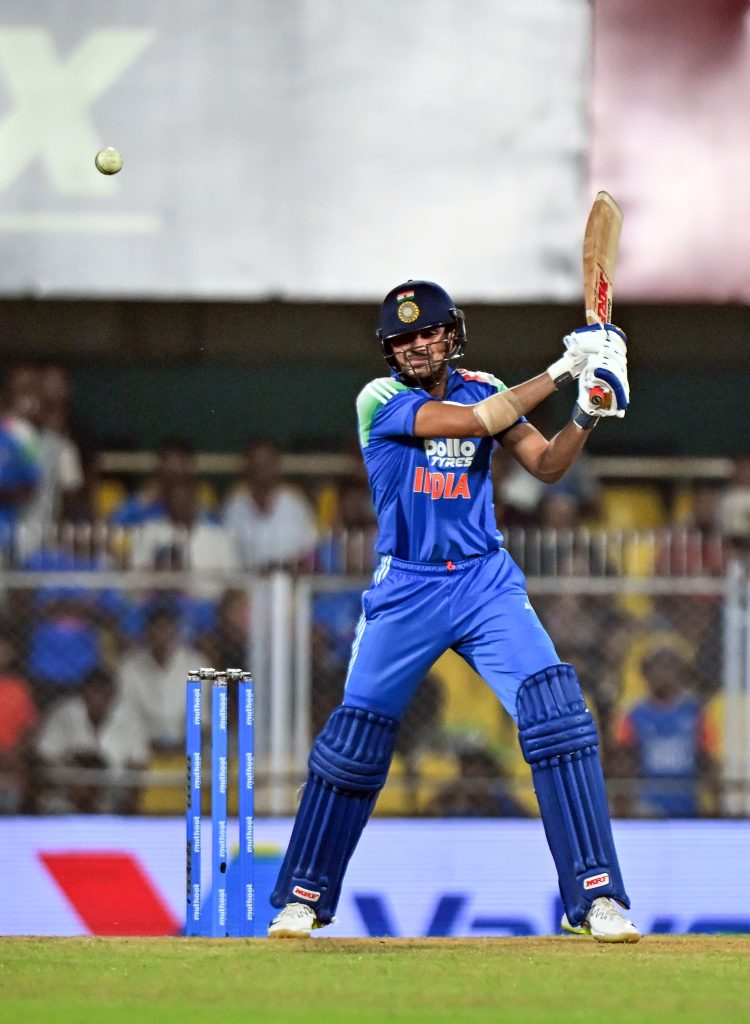
India’s young captain produces a breathtaking double century to turn a daunting 406-run chase into a historic victory
Our Bureau
Guwahati
Shubman Gill’s unbeaten 223 against the West Indies was not merely a record-breaking innings. It was a powerful demonstration of the class, talent and growing maturity of India’s young captain.
Chasing a formidable 406 in the second ODI at Guwahati, India needed something special. Gill delivered it in spectacular fashion, smashing the fastest double century in ODI history and remaining unbeaten as India completed their highest-ever ODI chase with eight wickets in hand.
What made the innings remarkable was not just the numbers, extraordinary though they were. Gill had already spent 50 overs on the field, captaining the side and watching the West Indies pile up 405/7. He then walked out to open the innings and proceeded to bat for almost 40 overs.
Rohit Sharma, who shared a massive 255-run opening partnership with Gill, summed up the quality of the performance. He pointed to Gill’s determination and concentration after a physically demanding day in the field and said the young captain was in control “from ball number one till the end”.
That ability to combine aggression with control was the defining feature of Gill’s innings.
He reached his century in only 62 balls, the fastest ODI hundred by an Indian captain, and raced to 150 in 89 balls, the fastest such mark by an Indian in an ODI. Then came the double century in just 117 balls, eclipsing Ishan Kishan’s previous record of 126 balls.
Gill eventually finished on 223 not out from 133 balls, with 26 fours and eight sixes, striking at more than 167. It was the third-highest individual score in ODI cricket, behind Rohit Sharma’s 264 and Martin Guptill’s 237 not out.
But statistics alone do not explain why the innings stood out.
The West Indies had set India a huge target and the pressure was obvious. Yet Gill did not appear overwhelmed by either the score or the responsibility of leading the chase. Instead, he built the innings intelligently, initially benefiting from Rohit’s aggression before taking control himself.
Gill explained the approach afterwards. The plan was to reach around 70-80 without losing a wicket during the Powerplay. Once Rohit began attacking, Gill adapted, and when he found his rhythm, he targeted the shorter boundary and took on the bowlers.
That adaptability is perhaps the most encouraging aspect of his batting.
Gill is no longer simply the talented young opener who emerged through India’s Under-19 system. He is now captain, an established international batter and increasingly one of the central figures in Indian cricket. Former India spinner Harbhajan Singh, who has watched Gill since his Under-19 days, said the batter has continued to improve as experience has grown.
The numbers support that progression. Gill has now scored 3,712 runs in 69 ODIs at an average of 65.12 and a strike rate above 103, with 11 centuries and 20 fifties. This year alone, he has accumulated 894 runs in 11 ODIs at an average of 127.71.
His latest achievement also placed him in several exclusive clubs.
Gill became only the second batter after Glenn Maxwell to score an ODI double century while chasing. He then surpassed Maxwell’s 201 not out to register the highest individual score in an ODI chase. He also became the first cricketer to score a double century while captaining in both Tests and ODIs, having made 269 against England at Edgbaston last year.
And in another significant milestone, he overtook Virender Sehwag’s 219 against the West Indies in 2011 to record the highest ODI score by an Indian captain.
Yet perhaps the most telling compliment came from Harbhajan. He credited Gill’s hard work and his father’s contribution to his journey, saying the results he is now delivering for India are “outstanding”.
India have long had batsmen capable of producing extraordinary ODI innings. Rohit and Virat Kohli have set extraordinary standards. Gill’s performance suggests that he is beginning to create his own space among them.
The manner of the innings matters as much as the records. There was no panic in a 406-run chase, no visible burden from captaincy and no sign of fatigue after a full day in the field.
There was simply class, timing, aggression and extraordinary concentration.
For Gill, the double century may eventually become another entry in a remarkable statistical record. For Indian cricket, however, it could represent something more significant: the arrival of a captain who is increasingly capable of carrying both the responsibility and the expectations that come with leading one of the world’s most demanding cricket teams.