

Our Bureau
Merritt Island, FL
The Axiom Mission 4 launched aboard a SpaceX Dragon spacecraft from Launch Complex 39A at NASA’s Kennedy Space Centre in Florida at 2:31 am Eastern Time (12 Noon IST).
This is the fourth private astronaut mission to the International Space Station (ISS). The crew is traveling to the orbiting laboratory on a new SpaceX Dragon spacecraft. The targeted docking time is approximately 7 am Eastern Time (4pm IST) on Thursday, June 26.
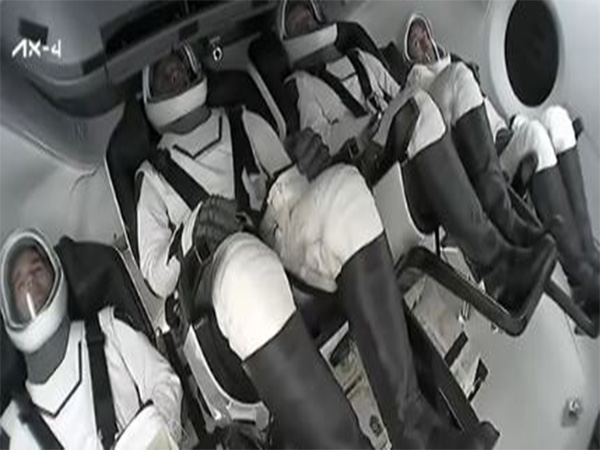
Once docked, the astronauts plan to spend up to 14 days aboard the orbiting laboratory, conducting a mission comprised of science, outreach, and commercial activities. Peggy Whitson, former NASA astronaut and director of human spaceflight at Axiom Space, is in command of the mission, while Indian Space Research Organization Astronaut Group Captain Shubhanshu Shukla serves as pilot. The two mission specialists are European Space Agency project astronaut Slawosz Uznanski-Wisniewski of Poland and Tibor Kapu of Hungary.
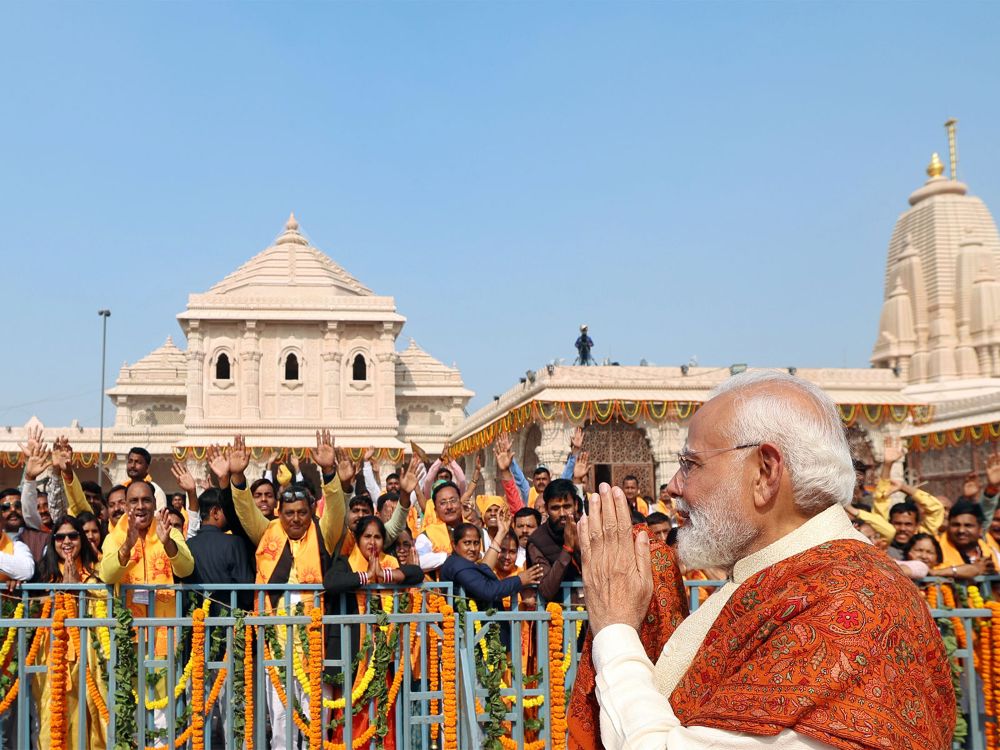
Meanwhile, Prime Minister Narendra Modi hailed the successful launch of the Axiom 4 mission and stated that Group Captain Shubhanshu Shukla is carrying the wishes, hopes and aspirations of 1.4 billion Indian citizens.
PM Modi said that Group Captain Shukla will be the first Indian to go to the International Space Station and also lauded the astronauts from Hungary, Poland and the US.
“We welcome the successful launch of the Space Mission carrying astronauts from India, Hungary, Poland and the US. The Indian Astronaut, Group Captain Shubhanshu Shukla is on the way to become the first Indian to go to International Space Station. He carries with him the wishes, hopes and aspirations of 1.4 billion Indians. Wish him and other astronauts all the success!” PM Narendra Modi’s ‘X’ post read.
Group Captain Shubhanshu Shukla, who is piloting the Axiom-4 mission that launched from Florida on Wednesday, said that India is returning to space after 41 years and called it an “amazing ride.” Stating that the journey is the beginning of India’s human space programme, he said the chest of Indians “should swell with pride.”
The astronauts are using the new Axiom Extravehicular Mobility Unit (AxEMU) spacesuit which provides them with advanced capabilities for space exploration while providing NASA with commercially developed human systems needed to access, live and work on and around the Moon. The advanced spacesuits ensure astronauts are equipped with high-performing, robust equipment and are designed to accommodate a wide range of crew members.
The Ax-4 mission is going to be conducting major research. The research complement includes around 60 scientific studies and activities representing 31 countries, including the U.S., India, Poland, Hungary, Saudi Arabia, Brazil, Nigeria, UAE, and nations across Europe.
This will be the most research and science-related activities conducted on an Axiom Space mission aboard the International Space Station to date.
NASA and ISRO (Indian Space Research Organisation) are collaborating to launch several scientific investigations.
These studies include examining muscle regeneration, growth of sprouts and edible microalgae, survival of tiny aquatic organisms, and human interaction with electronic displays in microgravity.
The first private astronaut mission to the station, Axiom Mission 1, lifted off in April 2022 for a 17-day mission aboard the orbiting laboratory. The second private astronaut mission to the station, Axiom Mission 2, also was commanded by Whitson and launched in May 2023 with four private astronauts who spent eight days in orbit. The most recent private astronaut mission, Axiom Mission 3, launched in January 2024; the crew spent 18 days docked to the space station.
The International Space Station is a convergence of science, technology, and human innovation that enables research not possible on Earth. For more than 24 years, NASA has supported a continuous human presence aboard the orbiting laboratory, through which astronauts have learned to live and work in space for extended periods of time.