








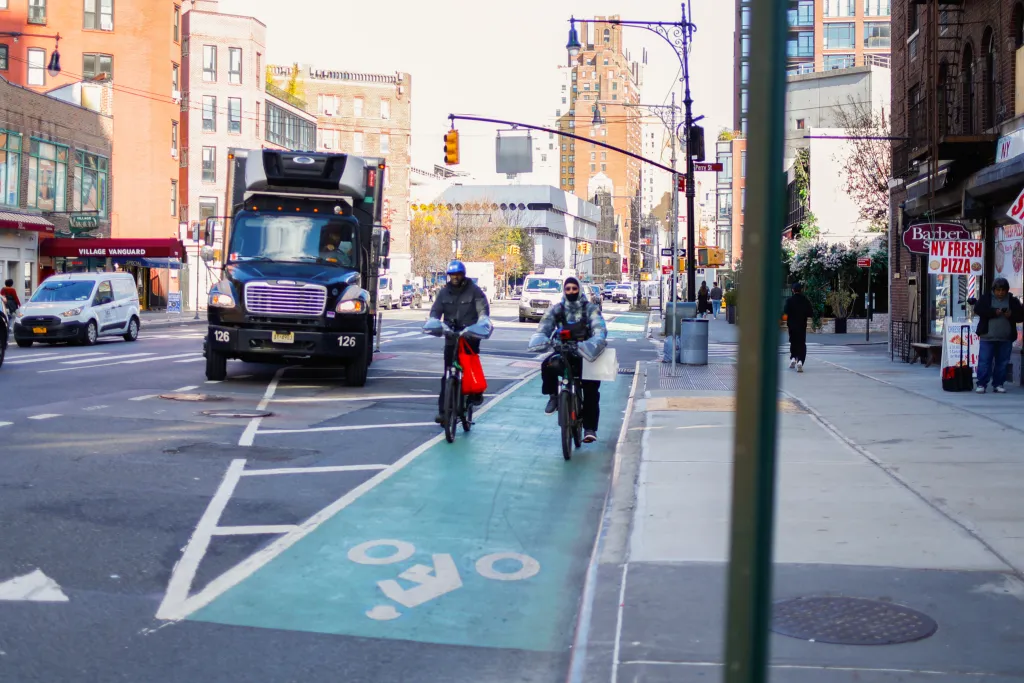
City says long-delayed street redesigns will speed up buses for 130,000 daily riders and improve safety for pedestrians and cyclists
Our Bureau
New York, NY
Mayor Zohran Mamdani announced that New York City will restart construction on four previously stalled bus and bike lane projects in the Bronx and Brooklyn, signaling a renewed push to expand dedicated bus infrastructure and protected cycling routes across the city.
Standing in the Bronx, Mamdani said the projects — which had been halted amid political disputes and delays — will now move forward this spring. The redesigns are expected to benefit approximately 130,000 daily bus riders while improving safety for pedestrians, cyclists and drivers.
“For too long, New Yorkers have been told to wait as long overdue improvements to our transit system were blocked time and again. That ends now,” Mamdani said. “Today, we’re moving forward with faster, more reliable buses for the 130,000 New Yorkers who depend on them every single day. Today, we build safer streets for New Yorkers who walk, bike, or drive in their own neighborhoods.”
The projects include a major redesign of Fordham Road in the Bronx, the completion of a key protected bike lane segment in Fort Greene, and new bike infrastructure in Central Brooklyn and the neighborhoods of Midwood, Flatbush and East Flatbush.
City officials framed the restart as part of a broader effort to prioritize public transit riders and street safety. NYC Department of Transportation Commissioner Mike Flynn said the projects had languished due to politics rather than policy concerns.
“New Yorkers deserve fast, reliable bus service and to feel safe when they’re traveling with their families and loved ones on city streets,” Flynn said. “These projects will improve the quality of life for so many New Yorkers — but until today many were stalled because of politics. This is just the beginning.”
The largest of the initiatives is the Fordham Road Bus Lane project. Fordham Road is the busiest bus corridor in the Bronx, serving an average of 130,000 daily riders across four routes: the Bx12, Bx9, Bx17 and Bx22. The corridor runs through neighborhoods where a majority of residents rely on public transportation. According to the city, 62 percent of households in the area do not have access to a private vehicle, and 71 percent of residents rely on transit, biking or walking.
Under the plan, DOT will install offset bus lanes along Fordham Road between Sedgwick Avenue and Boston Road. Unlike curbside lanes, offset lanes are placed away from the curb, reducing conflicts with double-parked vehicles and loading activity. Traffic analysis by DOT indicates that offset lanes provide greater improvements in speed and reliability. A similar conversion on Hillside Avenue in Queens increased bus speeds by up to 28 percent.
Designs for the Fordham Road project will be finalized in the coming months with community engagement, and construction is expected to be completed this year. DOT says it will monitor bus speeds following implementation.
MTA Chair and CEO Janno Lieber praised the move, calling it a boost for transit riders. “This project is a Valentine to the tens of thousands of bus riders who cross Fordham Road every day,” Lieber said, adding that pro-transit leadership at City Hall is critical to improving service.
In Brooklyn, the city will complete the final block of the protected bike lane on Ashland Place in Fort Greene — a stretch informally known as “Crashland” due to past safety concerns. The redesign will convert the southernmost block from a two-way to a one-way street and add a two-way protected bike lane.
Once completed, the segment will create a continuous protected bike route stretching from Sunset Park to DUMBO, with connections to Greenpoint and Queens. The project also includes converting the last block of Hanson Place into a “shared street,” expanding pedestrian space and enhancing the public realm.
Advocates say the Ashland Place connection is critical to building a fully protected cycling network. Ben Furnas, executive director of Transportation Alternatives, said the city is “unsticking stalled projects” and delivering long-promised improvements.
“Bus riders in the Bronx deserve the best possible streets to get buses moving faster,” Furnas said. “We are very excited to see vital new connections and protections for people on foot and on bikes in the Brooklyn network.”
Additional bike infrastructure will be rolled out across Midwood, Flatbush and East Flatbush, neighborhoods represented by Brooklyn Community Boards 14 and 17. Despite high cycling rates, these areas have limited dedicated bike infrastructure.
This spring, DOT will implement a long-delayed network that includes parking-protected bike lanes on Cortelyou and Dorchester roads in Ditmas Park, running from Coney Island Avenue to Flatbush Avenue. Standard bike lanes will be added to 14 additional streets across Flatbush, East Flatbush and Midwood, along with intersection upgrades designed to improve visibility and reduce crashes.
Protected bike lanes have been shown to reduce traffic deaths and serious injuries by 18 percent for all street users, according to city data.
In Central Brooklyn, DOT will install parking-protected bike lanes along Brooklyn and Kingston avenues between East New York Avenue and Wingate Park at Winthrop Street. The corridors are located near more than 10 schools, and between 2021 and 2025 recorded 65 injuries, with pedestrians and cyclists accounting for 60 percent of serious injuries.
A protected bike lane loop will also be built around Wingate Park, along with conventional bike lanes on Rutland Road and Fenimore Street in Prospect-Lefferts Gardens.