








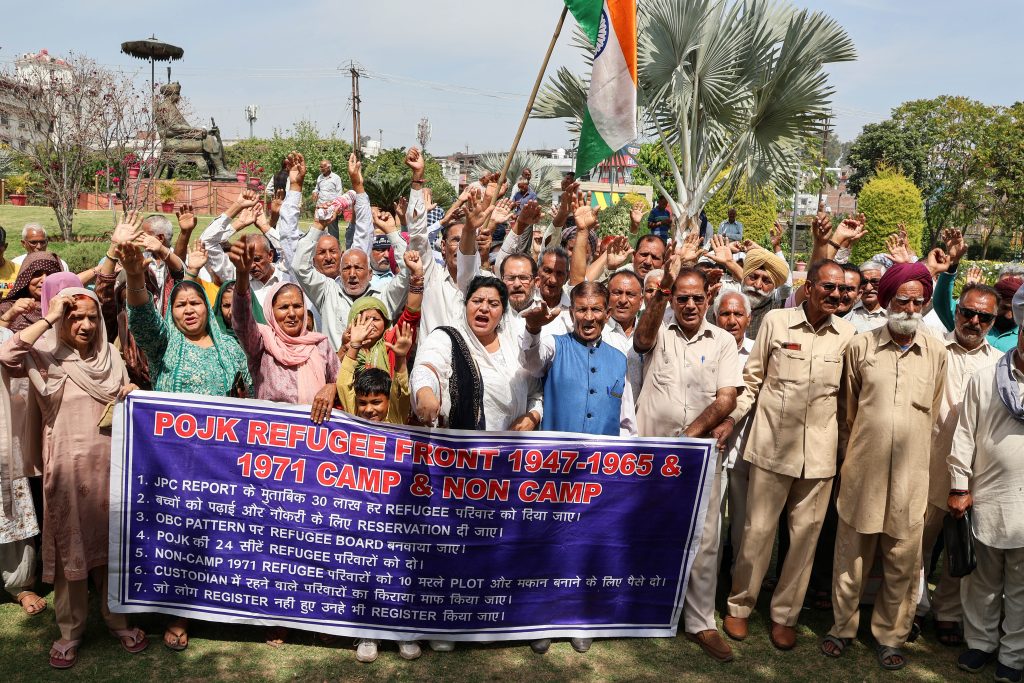
As protests intensify in Pakistan-occupied Jammu and Kashmir (PoJK), Islamabad’s brutal response and hollow “peace deals” have laid bare the deep resentment simmering against decades of military domination and economic neglect
Our Bureau
New Delhi
For more than seven decades, Pakistan-occupied Jammu and Kashmir (PoJK) has lived under a shadow of neglect, repression, and false promises. This month, that long-suppressed anger erupted into the open as violent protests swept across Muzaffarabad and other towns, leaving at least eight people dead in just four days. What began as a local movement for economic justice has transformed into one of the most significant uprisings against Pakistan’s control in years—an unmistakable sign that Islamabad’s grip over the region is weakening.
Shops and markets in Muzaffarabad, the so-called capital of PoJK, remained shuttered through the week. Demonstrators marched through deserted streets, chanting slogans for justice, dignity, and freedom. Videos circulating online showed protesters facing baton charges, tear gas, and gunfire from Pakistani security forces. Local leaders accused the authorities of using “brutal tactics to crush the voice of the oppressed,” as public outrage spilled into nearly every district.
The immediate spark came from deep frustration over inflation, corruption, and economic deprivation. For months, the Joint Awami Action Committee (JAAC)—an umbrella group of traders, students, and civil society members—had been pressing for fair taxation, equitable resource sharing, and an end to elite privileges in PoJK. But when negotiations with the Pakistani government collapsed late last month, the anger burst into the streets.
Despite repeated attempts to portray the unrest as “under control,” Islamabad has been forced into crisis management mode. Two rounds of emergency talks were held between federal ministers and the JAAC leadership. Yet, while Pakistani officials like Parliamentary Affairs Minister Tariq Fazal Chaudhry claimed that “most demands had already been accepted,” the ground reality told a different story. Protesters accused the government of stalling, saying “cosmetic gestures” could no longer hide the systemic exploitation and military stranglehold over the region.
Facing global scrutiny and domestic outrage, Pakistan’s government hurriedly announced a so-called “peace deal” with the protesters—a move widely seen as an act of desperation rather than reconciliation. Human rights activists, including Tasleema Akhter, have called the deal “a hollow exercise designed to mislead the world and buy time.”
“For years, residents of PoJK and Gilgit-Baltistan have endured Pakistan’s illegal occupation, political marginalisation, and denial of basic human rights,” Akhter wrote on X. “The army’s violence and intimidation are systematic, not isolated. What we are seeing today is a people reclaiming their voice after decades of fear.”
This “peace deal,” activists argue, does little to address the root causes of discontent. Pakistan has long exploited PoJK’s abundant water and natural resources—hydropower, minerals, and forests—while leaving its residents impoverished. Basic infrastructure, education, and healthcare remain neglected, even as the Pakistan Army and political elites benefit from the region’s revenues.
The recent protests are thus not merely about electricity tariffs or taxation—they are a rejection of Pakistan’s decades-long colonial-style governance. “These are the demands of oppressed people,” said Raja Shoaib, leader of the JAAC. “A time will come when the poor and oppressed across Pakistan will rise with one voice.” His words, echoing through the streets of Muzaffarabad, captured a growing sense of solidarity that now transcends PoJK’s borders.
Islamabad’s heavy-handed response to the protests—mass arrests, curfews, and intimidation—has only deepened the sense of alienation. For Pakistan, which has long projected itself as the self-appointed defender of “Kashmiri rights,” the scenes from PoJK are a public relations disaster.
The uprising in PoJK has drawn cautious attention from human rights groups and the Indian government, which maintains that the territory is an integral part of India under illegal Pakistani occupation. Indian analysts argue that the protests expose the “reality behind Pakistan’s rhetoric” and could become a turning point in the discourse over Kashmir.
Internationally, there are growing calls for scrutiny of Pakistan’s actions. Human rights organisations have urged the United Nations and global powers to demand accountability for extrajudicial killings and arbitrary detentions in PoJK. “The people of PoJK are not asking for charity—they are demanding freedom, dignity, and justice,” said Akhter.
Whether the current unrest subsides or grows into a larger independence movement, one thing is certain: the façade of Pakistan’s benevolent control has cracked. The violent suppression of protesters has only emboldened the demand for self-determination.
In the streets of Muzaffarabad, amid shuttered shops and slogans for liberation, a new chapter of resistance is being written—one that no “peace deal” or propaganda campaign can easily erase.