








Our Bureau
New Delhi
India’s ambitious Gaganyaan mission, the country’s first human spaceflight project, has entered its final phase, with the historic crewed launch scheduled for the first quarter of 2027. The announcement was made by Union Minister of State for Science and Technology, Dr. Jitendra Singh, marking a significant milestone in India’s journey toward becoming one of the select nations capable of independent human spaceflight.
The Gaganyaan programme, spearheaded by the Indian Space Research Organisation (ISRO), aims to send a crew of Indian astronauts into low-Earth orbit aboard a domestically developed LVM3 rocket. This mission will cement India’s status as a major player in global space exploration, following extensive preparations that include a series of successful uncrewed test missions such as the TV-D1 and the Test Vehicle Abort Mission (TVAM), which validated critical safety and crew escape systems.
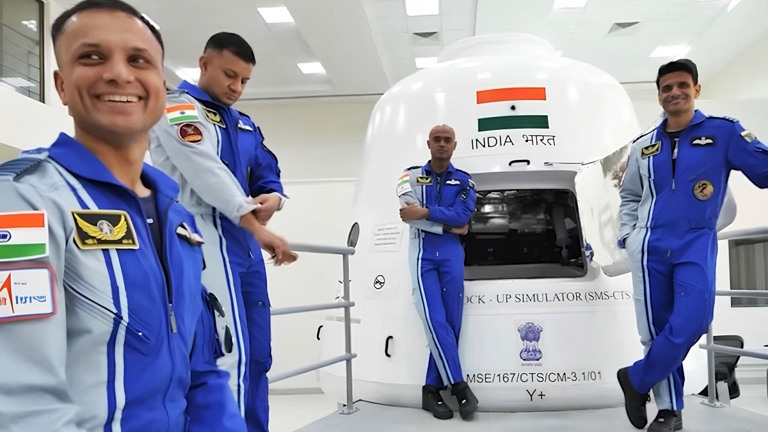
According to Dr. Singh, the upcoming TV-D2 test in 2025 and subsequent unmanned orbital flights will further simulate conditions for the eventual human mission. The astronauts, selected from the Indian Air Force, have completed rigorous training in Russia and are now undergoing mission-specific preparation at India’s state-of-the-art astronaut training centre.
Key technologies for the mission, including a human-rated LVM3 launch vehicle, an advanced Crew Escape System, and robust Crew and Service Modules, are in the final stages of integration and testing. Recovery protocols, developed in collaboration with the Indian Navy, have been successfully trialed to ensure the safe return of astronauts.
Beyond its technological feats, the Gaganyaan mission is expected to drive innovation in robotics, materials science, electronics, and medicine, while fostering public-private partnerships and economic growth. The programme also lays the groundwork for future milestones, including the proposed Bharatiya Antariksh Station by 2035 and a crewed lunar mission by 2040.