








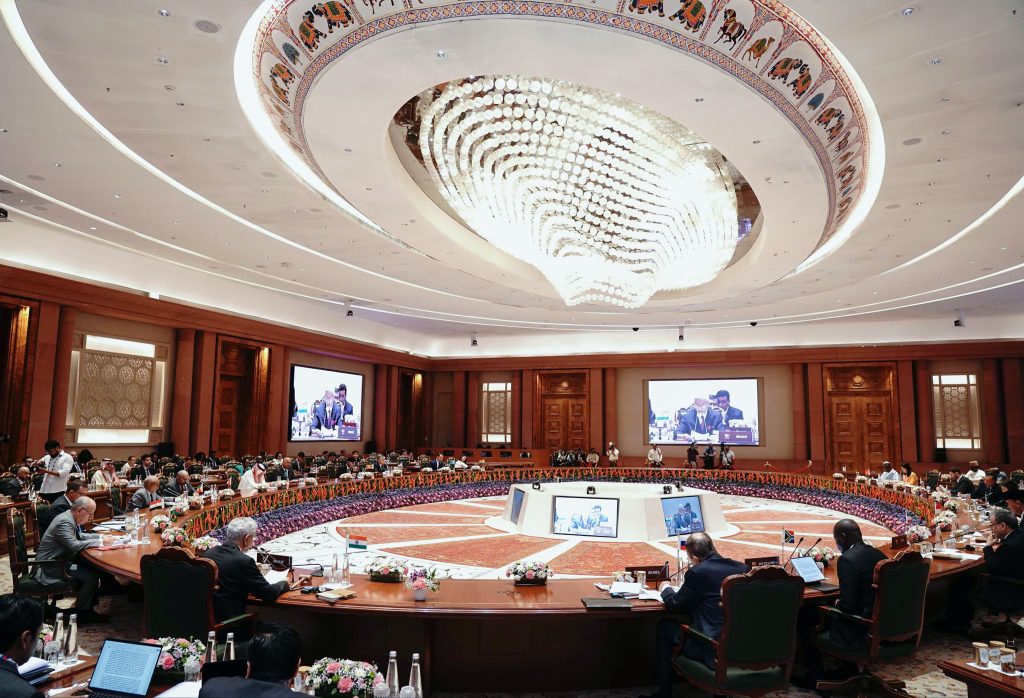
The BRICS foreign ministers’ meeting in New Delhi highlighted both the growing influence of the bloc and the deep internal contradictions that could shape its future in an increasingly fractured global order
Our Bureau
NEW DELHI
The BRICS Foreign Ministers’ Meeting in New Delhi was meant to showcase the growing confidence of the expanded grouping as a leading voice of the Global South. Instead, it ended up revealing something far more complicated: BRICS is simultaneously becoming more influential and more divided.
Over two days of discussions in the Indian capital, foreign ministers and senior representatives from BRICS members and partner countries spoke repeatedly about multipolarity, fair global governance, economic cooperation and resistance to protectionism. The official language was optimistic, ambitious and forward-looking. The Chair’s Statement described BRICS as “an important platform for dialogue, diplomacy and cooperation in advancing practical solutions to common challenges.”
Yet behind the carefully crafted diplomatic language, the meeting also exposed major tensions within the bloc — tensions driven by wars, rival regional ambitions, economic competition and conflicting geopolitical priorities.
The sharp public confrontation between Iran and the United Arab Emirates during the meeting became the clearest example of the contradictions BRICS now faces as it expands rapidly and attempts to transform itself from an economic grouping into a major geopolitical platform.
The New Delhi gathering therefore offered a glimpse into the future of BRICS: a bloc with enormous potential but also one that may struggle to maintain coherence as its membership expands and global crises deepen.
A Fragmented World
The New Delhi meeting took place at a time when the international system is under extraordinary stress. The Ukraine war continues to divide major powers. The conflict involving Iran has destabilised West Asia and disrupted energy markets. Global supply chains remain vulnerable. Protectionism is rising across advanced economies.
It is precisely this atmosphere of uncertainty that has strengthened the appeal of BRICS for many developing countries.
Originally formed by Brazil, Russia, India, China and South Africa, the bloc has evolved from an economic acronym into a broader political coalition representing emerging economies dissatisfied with Western-dominated institutions. Expansion has accelerated this transformation. Countries from West Asia, Africa and Asia increasingly view BRICS as an alternative diplomatic space where developing nations can assert their interests more forcefully.
The Chair’s Statement reflected this ambition clearly. Ministers noted that “current global challenges are complex and interlinked” and agreed that developing countries must strengthen efforts to promote “more just and equitable global governance.”
This language has become central to BRICS diplomacy. The bloc increasingly positions itself as a voice for a multipolar world where power is more widely distributed and where Western dominance over financial, political and strategic institutions is reduced.
India’s role as host was especially significant because New Delhi has sought to present BRICS as a practical platform focused not only on political rhetoric but also on economic cooperation, trade resilience and technological collaboration.
Commerce Secretary Rajesh Agrawal highlighted the bloc’s growing economic importance by pointing out that intra-BRICS merchandise trade had increased from USD 84 billion in 2003 to USD 1.17 trillion in 2024 — a thirteen-fold rise.
Yet he also acknowledged the limitations. Intra-BRICS trade still accounts for only around 5 per cent of global trade, revealing both the bloc’s current weakness and future potential.
This duality — impressive growth but unrealised ambition — defines BRICS today.
Economic Promise
One of the strongest themes emerging from the New Delhi meeting was economic resilience.
The BRICS countries are increasingly trying to reduce dependence on Western-controlled financial systems, supply chains and trade mechanisms. The repeated references to “resilient supply chains,” “technology transfer,” and “equitable participation” reflected growing concerns about global fragmentation.
Agrawal stated that BRICS had grown stronger despite “rising protectionism, geopolitical tensions, supply chain disruptions, inflationary pressures and growing uncertainty.”
This is one reason why BRICS has become more attractive to developing countries. Many economies in the Global South feel vulnerable to external shocks created by great-power rivalry, sanctions regimes and disruptions in global trade. BRICS offers the possibility — at least theoretically — of creating alternative networks for trade, finance and investment.
India used the meeting to emphasise sectors where such cooperation could deepen. Discussions focused on strengthening MSMEs, expanding services trade, diversifying value chains and supporting innovation.
Delegates also visited Gujarat International Finance Tec-City (GIFT City), which India hopes to develop into a major global financial hub. The symbolism was important. India is attempting to present itself not merely as a participant in BRICS but as a central driver of the bloc’s economic future.
There is also a larger strategic calculation behind India’s approach. New Delhi sees BRICS as a platform that can amplify the voice of developing countries without forcing India into rigid geopolitical alignments.
Unlike formal military alliances, BRICS offers flexibility. India can cooperate economically with China and Russia within BRICS while simultaneously maintaining close ties with Western powers through other forums such as the Quad and G20.
This strategic flexibility partly explains why India remains deeply invested in BRICS despite its tensions with China.
The Iran-UAE Clash
However, the New Delhi meeting also demonstrated the dangers of rapid expansion.
The most dramatic moment came when the ongoing Iran-West Asia conflict spilled directly into the BRICS platform.
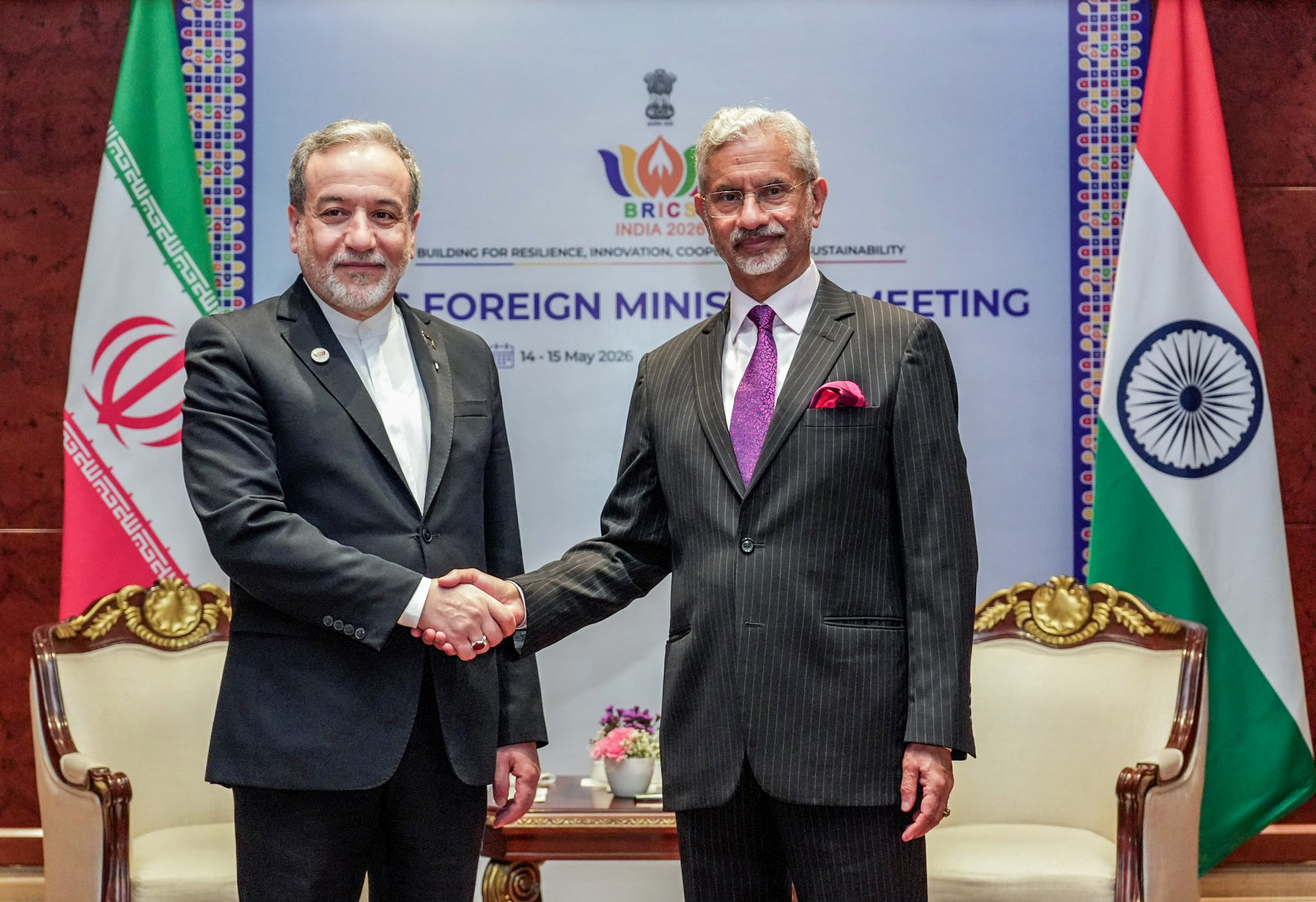
Iranian Foreign Minister Abbas Araghchi accused the UAE of being “directly involved in the act of aggression” against Iran. He alleged that the UAE had allowed its territory to be used for attacks against Tehran and described Abu Dhabi as “an active partner in this aggression.”
The UAE responded sharply.
Minister of State Khalifa Shaheen Al Marar categorically rejected the allegations and accused Iran of threatening regional stability. Abu Dhabi stated that Iranian attacks had targeted civilian infrastructure, ports, airports and energy facilities, while also accusing Tehran of attempting the “de facto closure” of the Strait of Hormuz.
The UAE described the targeting of commercial shipping and the use of Hormuz as “economic coercion or blackmail.”
This exchange revealed a fundamental challenge for BRICS: how can a bloc function effectively when some of its members are directly accusing each other of aggression and destabilisation?
The confrontation exposed the limits of BRICS solidarity. Unlike NATO or the European Union, BRICS has no common security framework, no unified strategic doctrine and no institutional mechanisms for conflict resolution between members.
Instead, it is a coalition built on shared dissatisfaction with the existing global order rather than shared ideological or geopolitical alignment.
As BRICS expands, these contradictions are likely to grow.
The bloc now includes countries with competing regional ambitions, different political systems and conflicting strategic partnerships. India and China remain geopolitical rivals despite economic cooperation. Iran and the UAE are on opposing sides of major regional conflicts. Russia’s confrontation with the West creates additional complications for countries trying to balance relations across multiple power centres.
The New Delhi meeting therefore highlighted a difficult reality: BRICS can no longer avoid geopolitical disputes simply by focusing on economics.
India’s Balancing Act
For India, hosting the BRICS foreign ministers’ meeting was an exercise in strategic balancing.
New Delhi sought to project itself as a bridge between competing geopolitical camps. Jaishankar held meetings not only with Russia and China but also with representatives from the UAE, Saudi Arabia, Kazakhstan, Uzbekistan, Vietnam and Nigeria.
This diplomatic outreach reflects India’s broader foreign policy philosophy — maintaining engagement across rival power centres rather than aligning exclusively with any one bloc.
The BRICS platform suits this strategy because it allows India to strengthen ties with emerging economies while preserving its strategic autonomy.
India also benefits from BRICS politically. The bloc gives New Delhi greater influence in debates over global governance reforms, trade rules, climate finance and development priorities.
At the same time, India remains cautious about the organisation’s future trajectory. New Delhi does not want BRICS to evolve into a China-dominated geopolitical alliance.
This explains why India repeatedly emphasised practical cooperation during the New Delhi meeting rather than ideological confrontation.
The Chair’s Statement itself reflected this careful balancing. It stressed dialogue, diplomacy, sustainable development and inclusive growth rather than aggressive anti-Western rhetoric.
The Future of BRICS
The New Delhi meeting demonstrated that BRICS is entering a new phase.
The bloc is no longer simply an economic forum of emerging powers. It is becoming a broader geopolitical platform where developing countries seek alternatives to existing global structures.
Its influence is clearly growing. The expansion of membership, rapid growth in intra-BRICS trade and increasing interest from Global South countries all point toward rising relevance.
But the meeting also showed that BRICS faces major structural weaknesses.
The bloc lacks institutional cohesion. Its members have competing strategic interests. Regional conflicts are increasingly spilling into BRICS diplomacy. Economic cooperation remains far below potential levels. Political trust between key members remains fragile.
The Iran-UAE confrontation in New Delhi symbolised these contradictions perfectly. BRICS today contains both the promise of a more multipolar world and the instability that such a transition can produce.
Its future will likely depend on whether the grouping can evolve beyond symbolic declarations and develop stronger mechanisms for cooperation despite internal differences.
For now, BRICS remains a coalition united more by shared dissatisfaction with the current global order than by a common vision of what should replace it.
That may still be enough to ensure its continued growth. But as the New Delhi meeting showed, managing diversity inside an expanded BRICS will become increasingly difficult as global tensions deepen.
The bloc’s greatest strength — its diversity and flexibility — may also become its greatest challenge.