








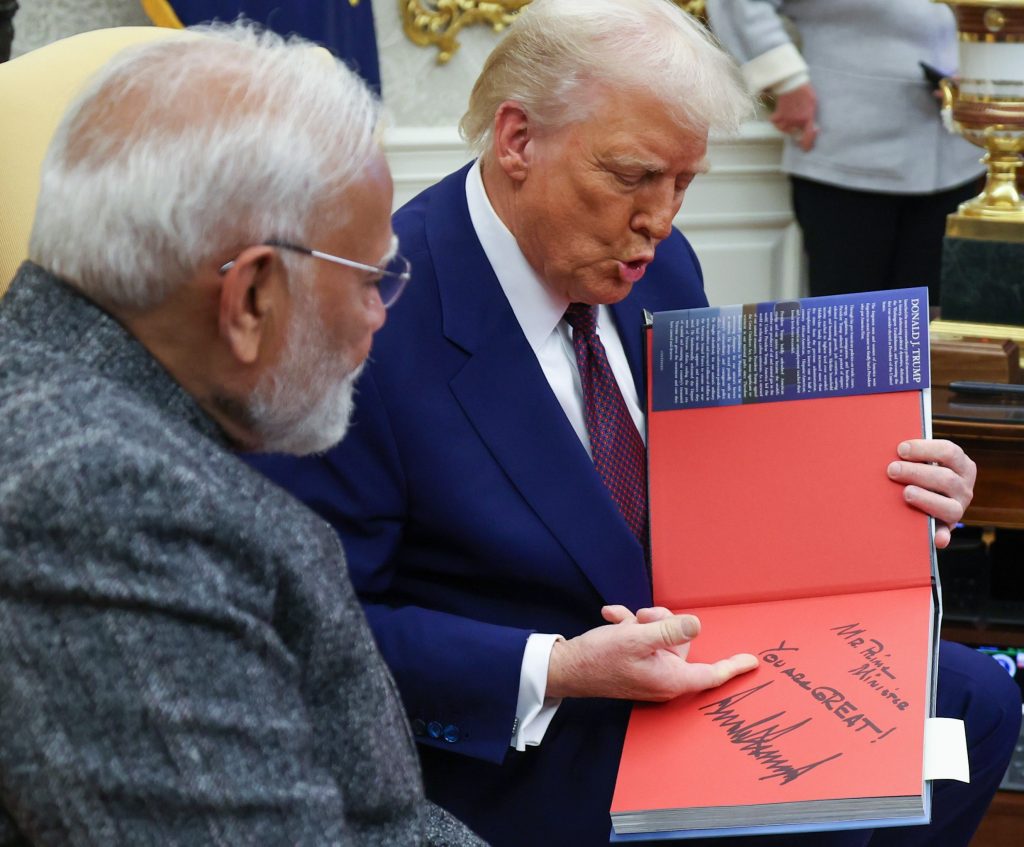
As Washington navigates crises from West Asia to South Asia, Donald Trump’s outreach to both India and Pakistan signals a careful, calculated diplomatic balancing act.
Our Bureau
Washington, DC / NEW DELHI
In a week marked by intense diplomatic activity, Donald Trump has struck a notably calibrated tone toward both Narendra Modi and Pakistan’s leadership, raising a critical question: is the United States attempting to rebalance its South Asia policy, or merely hedging its bets amid wider geopolitical uncertainty?
Trump’s remarks following his conversation with Modi were warm, even personal. Calling the Indian Prime Minister “a friend” and describing their exchange as “a very good talk,” Trump reinforced the narrative of a strong and enduring US-India partnership. Modi echoed this sentiment, referring to Trump as “my friend” and highlighting “substantial progress” in bilateral cooperation. Both leaders emphasized shared concerns, particularly maritime security and stability in West Asia, including the strategic importance of keeping the Strait of Hormuz “open and secure.”
These statements are consistent with the trajectory of US-India relations over the past decade, where defense, trade, and strategic alignment—especially in the Indo-Pacific—have deepened ties. India remains central to Washington’s broader strategy of countering China’s influence, and Trump’s reaffirmation of this relationship fits within that framework.
Yet, almost simultaneously, Trump’s outreach toward Pakistan suggests a more nuanced approach. In a striking comment, he expressed willingness to visit Islamabad if a US-Iran deal were finalized there, stating, “I would go to Pakistan, yeah… They want me to go.” This is not merely rhetorical flourish. Trump went further, praising Pakistan’s role in facilitating negotiations with Iran, saying intermediaries “have been so great.”
This dual engagement is not accidental. Pakistan has emerged as a potential intermediary in the sensitive and stalled US-Iran negotiations. With its geographic proximity, historical ties to Tehran, and strategic importance in regional security dynamics, Islamabad offers Washington a valuable diplomatic channel. Trump’s acknowledgment of Pakistan’s “constructive” role signals a willingness to re-engage with a country that had, in recent years, seen strained ties with the US.
The timing of these overtures is significant. West Asia is witnessing renewed volatility, and the United States is actively working to prevent escalation. Trump’s announcement of a 10-day ceasefire agreement between Israel and Lebanon—following “excellent conversations” with leaders including Benjamin Netanyahu—demonstrates Washington’s broader push to stabilize the region. In this context, both India and Pakistan become relevant, albeit in different ways.
India’s role is tied to economic and strategic stability. As a major energy consumer, it has a direct stake in the security of maritime routes like the Strait of Hormuz. Any disruption would have cascading effects on global oil prices and supply chains. Trump’s emphasis on keeping these routes secure aligns with India’s interests, reinforcing the partnership.
Pakistan, on the other hand, is being positioned as a diplomatic facilitator. Its engagement with Iran—evident in meetings between Army Chief Asim Munir and Iranian officials—suggests Islamabad is actively trying to broker a breakthrough. Trump’s openness to visiting Pakistan if a deal is signed there underscores the importance Washington now places on this channel.
What emerges, then, is not a contradiction but a strategy of parallel engagement. Trump appears to be leveraging relationships with both India and Pakistan to serve distinct but interconnected objectives. With India, the focus is on long-term strategic alignment and economic cooperation. With Pakistan, it is on immediate diplomatic utility in resolving the Iran issue.
However, this balancing act is not without risks. India has historically been wary of any US tilt toward Pakistan, particularly given Islamabad’s complex security dynamics and its ties with China. Any perception that Washington is elevating Pakistan’s role could create unease in New Delhi. Conversely, Pakistan may view renewed US engagement as transactional, tied primarily to the Iran negotiations rather than a broader reset in relations.
Trump’s own rhetoric reflects this transactional approach. His comments linking a potential Iran deal to “free oil” and lower energy prices highlight the economic motivations underpinning US diplomacy. “If it happens… your oil price will go down to lower than what it was before,” he said, framing the negotiations in terms of tangible benefits.
In this light, Trump’s outreach to both countries can be seen as part of a larger effort to manage multiple crises simultaneously. By maintaining strong ties with India while re-engaging Pakistan for specific diplomatic purposes, the US is attempting to maximize its leverage across regions.
Whether this approach succeeds will depend on execution. Balancing two historically rival nations requires careful signaling and consistent policy. Any misstep could alienate one side or the other, undermining broader strategic goals.