

The Bill has ignited a fiery debate in Parliament, with the ruling BJP emphasizing moral accountability for leaders in custody, while opposition parties allege the move is a partisan tool to weaken democracy
Our Bureau
New Delhi
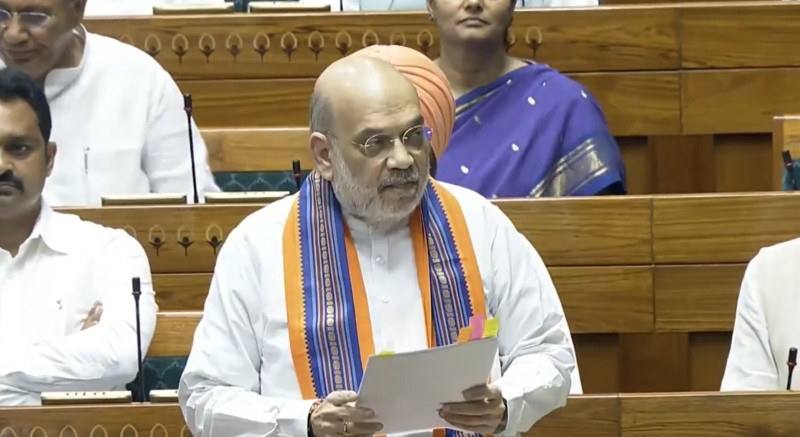
Union Home Minister Amit Shah introduced the Constitution (130th Amendment) Bill, 2025, in the Lok Sabha on Wednesday, along with the Government of Union Territories (Amendment) Bill, 2025, and the Jammu and Kashmir Reorganization (Amendment) Bill, 2025. According to Shah, the legislation is aimed at ensuring that no Prime Minister, Chief Minister, or Union or State Minister can continue in office while detained in jail for serious criminal charges.
“This move reflects the Modi government’s commitment against political corruption,” Shah said, stressing that the bill seeks to elevate moral standards in public life and bring integrity to politics. The legislation also mandates that an accused politician must obtain bail within 30 days; failure to do so would automatically make their position legally ineligible, though reappointment is permitted upon release.
Shah framed the bill as a response to instances in recent years where elected leaders allegedly continued to govern from jail, bypassing moral accountability. “Now the people of the country will have to decide whether it is appropriate for a minister, Chief Minister, or Prime Minister to run the government while in jail,” he wrote on X.
Ruling Party’s Narrative
For the BJP, the amendment is a symbolic and practical step to assert the party’s zero-tolerance stance on political corruption. Shah repeatedly highlighted the contrast between the NDA’s approach and what he described as the opposition’s history of shielding corrupt leaders.
He cited examples from Congress’s past, referencing the 39th Constitutional Amendment under Indira Gandhi and alleging double standards by leaders like Rahul Gandhi. “On one hand, Prime Minister Narendra Modi introduces a constitutional amendment to bring himself and ministers under the ambit of law. On the other, the opposition resists in order to remain above the law,” Shah said.
The Home Minister also addressed criticism from Congress MP KC Venugopal regarding his personal record, asserting that he had resigned from office on moral grounds when falsely accused in the past, underscoring the party’s commitment to ethical governance. Shah called the opposition’s united stance “shameless” and argued that it revealed their intent to protect corrupt practices rather than ensure accountability.
Opposition Pushback
Opposition parties, however, reacted sharply, describing the bill as “undemocratic, anti-federal, and a tool for political vendetta.” AIMIM MP Asaduddin Owaisi called it a violation of the separation of powers, warning that executive agencies could act as “judge and executioner based on flimsy allegations.”
Congress leaders, including KC Venugopal and Ghulam Ahmad Mir, accused the BJP of weaponizing central agencies such as the CBI, ED, and Income Tax Department against opposition leaders. They cited cases where chief ministers like Hemant Soren and Arvind Kejriwal were jailed but later acquitted, asserting that the bill could unfairly penalize leaders facing politically motivated charges.
RJD leader Tejaswi Yadav echoed these concerns, calling the amendment a tactic to “blackmail and intimidate” specific state leaders, naming Bihar CM Nitish Kumar and Andhra Pradesh CM Chandrababu Naidu. Manoj Jha, also from the RJD, argued that the legislation blurs the line between accused and convicted individuals, enabling the central government to destabilize state administrations where the BJP lacks electoral strength.
Karnataka CM Siddaramaiah criticized the bill as “deeply anti-federal,” warning that it grants the Centre and its appointed governor’s disproportionate power to interfere in state governance. The opposition highlighted that such legislation could set a precedent where political leverage, rather than legal merit, determines the fate of elected officials.
Parliamentary Tensions
The introduction of the bills sparked immediate uproar in the Lok Sabha, leading to an adjournment amid verbal spats between Shah and opposition MPs. The bills were subsequently referred to a Joint Parliamentary Committee for detailed scrutiny, which includes 21 members from the Lok Sabha and 10 from the Rajya Sabha.
The debate over the 130th Amendment reflects a broader contest between two visions of governance: the BJP portraying itself as a moralizing force seeking accountability, and the opposition framing the legislation as a partisan tool undermining democratic norms and federal autonomy.