

With Bihar heading for assembly polls in November, a furious political storm has erupted over the decision to revise electoral rolls, triggering allegations of “election theft” and raising concerns over voter disenfranchisement and institutional bias
Our Bureau
Patna/New Delhi
As Bihar inches closer to its high-stakes assembly election, a controversy surrounding the revision of the electoral rolls has snowballed into a national political issue. At the heart of the storm is the Election Commission of India’s (ECI) Special Intensive Revision (SIR) drive—an exercise meant to update the voter list but now mired in allegations of bias, suppression, and political manipulation.
Congress MP Rahul Gandhi has led the charge, accusing the ECI of “hatching a conspiracy for chunav chori (election theft)” and acting as “a BJP wing.” Drawing a parallel with Maharashtra, where he claims over one crore dubious voters were added between the Lok Sabha and assembly elections, Gandhi warned that a similar “theft” is underway in Bihar. “We told the EC to share voter lists and videography. They didn’t. Now they are doing the same thing in Bihar,” he alleged during a rally in Bhubaneswar.
The allegations, though dismissed by the ECI, have found support among opposition leaders and civil society organisations. A batch of petitions challenging the ECI’s move has reached the Supreme Court, with petitioners including RJD MP Manoj Jha, Trinamool MP Mahua Moitra, and activist Yogendra Yadav. They argue that the sudden documentation requirements—particularly proof of citizenship—are excessive and may disenfranchise marginalised communities.
At the heart of the opposition’s concern is the ECI’s decision to not accept widely held documents like Aadhaar and ration cards as valid proof during the SIR process. Although the Supreme Court stopped short of staying the revision, it urged the ECI to reconsider its stance and provide reasons if it refuses to accept commonly used IDs. The court observed that Aadhaar is already used widely for identity verification and called the timeline “very short” for such a critical exercise.
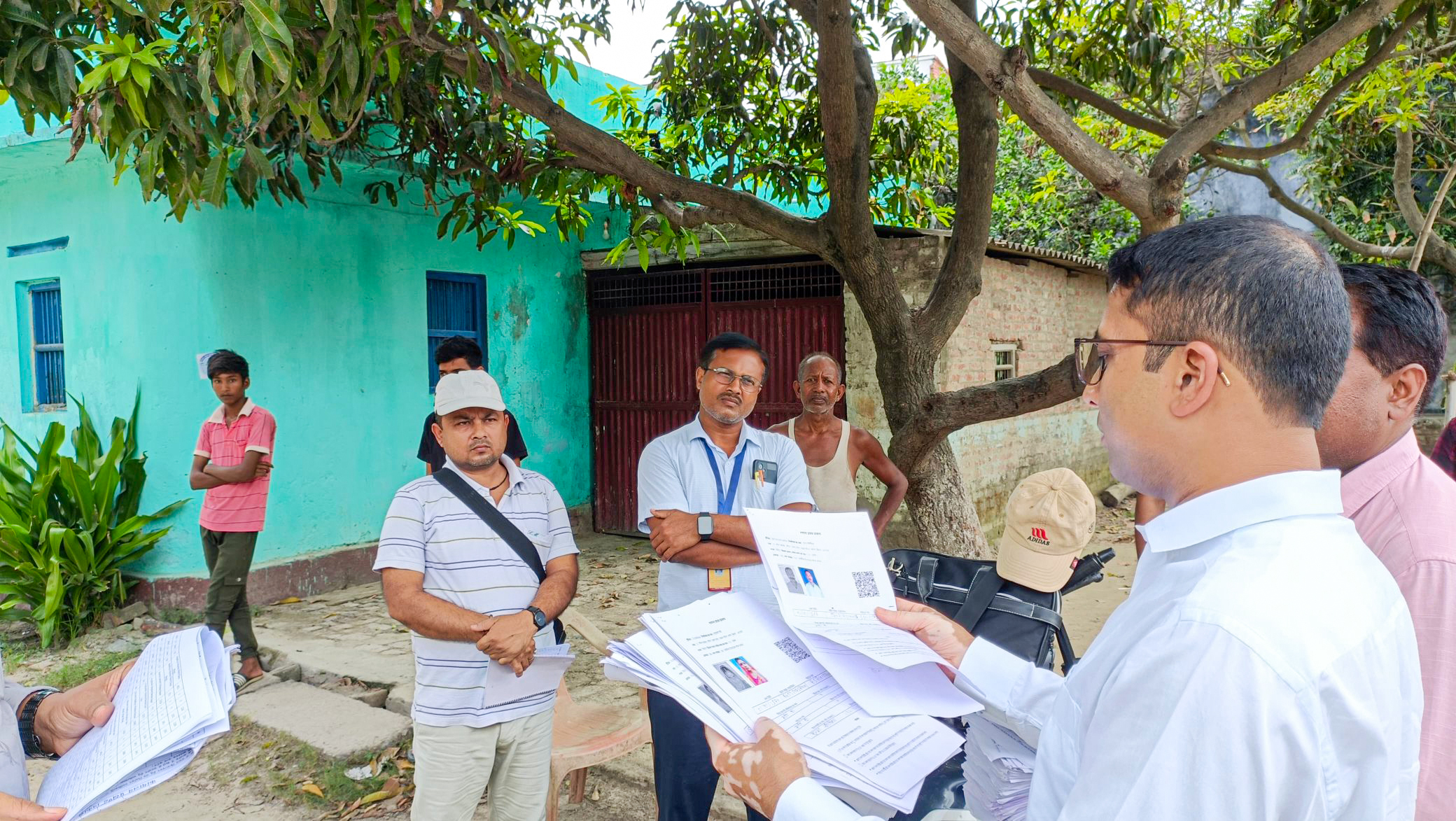
Despite mounting criticism, the ECI insists that the revision is a constitutional necessity and is being conducted transparently. According to its latest data, more than 74% of Bihar’s 7.9 crore voters have already submitted Enumeration Forms. Over 77,000 Booth Level Officers (BLOs), assisted by more than 4 lakh volunteers and 1.56 lakh Booth Level Agents (BLAs) from all major parties, are on the ground verifying voter data. The digitisation of these forms through the ECINet platform is reportedly progressing smoothly.
Still, the scale and timing of the revision raise important questions. Why is such a massive update being undertaken just months before the election? Critics argue that past experiences point to a pattern of errors and selective inclusion or deletion of voters. For instance, in Maharashtra, opposition parties had alleged that unverified voters mysteriously appeared on rolls, swinging the outcome in key seats. Though never conclusively proven, those allegations still haunt the credibility of the electoral process.
In Bihar, the risks are even higher. The state’s electorate is not only vast but also socio-economically vulnerable. ADR and PUCL, in their petition, warned that the new requirements could disproportionately affect the poor, Dalits, Adivasis, and women—many of whom may lack access to land or birth documents demanded by the ECI. “This is not revision; this is exclusion by design,” one petitioner argued in court.
The implications are significant. Bihar is not just another poll-bound state—it is a crucial battleground in the run-up to the 2026 general elections. A skewed voter list could affect hundreds of seats and influence the national narrative around electoral integrity. For the opposition-led INDIA bloc, any perceived manipulation of the voter rolls strikes at the core of democratic legitimacy.
Even as the ECI maintains that the process is routine and within its constitutional mandate, the perception of partiality continues to grow. The Supreme Court’s upcoming hearing on July 28 could be pivotal. If the court finds the ECI’s procedures wanting, it could mandate changes or even delay the implementation of the revised rolls—an outcome that may significantly alter the electoral calendar.
For now, the ECI is racing against time to complete the exercise by July 25. But the larger question remains: can an electoral process be considered free and fair when the very list of voters is under such intense scrutiny and suspicion?
As political temperatures rise and legal battles intensify, Bihar’s voters may find themselves caught in the crossfire of a larger war—one over the very soul of India’s democratic process.