








A pre-election survey offers compelling evidence that Indian Americans continue to solidly favor the Democratic Party. However, one in three survey respondents intended to vote for Donald Trump
Our Bureau
Washington, DC
Six Indian Americans have won the elections to the House of Representatives, increasing their number from five in the current Congress.
Indian-American lawyer Suhas Subramanyam created history by becoming the first from the community to be elected from Virginia and the entire East Coast. Subramanyan defeated Mike Clancy of the Republican Party. He is currently a Virginia State Senator.
There is a possibility that the number of Indian Americans in the House of Representatives increased to seven as Dr Amish Shah was leading by a slender margin against his Republican incumbent in the first Congressional District of Arizona.
“I am honored and humbled that the people of Virginia’s 10th District put their trust in me to take on the toughest fights and deliver results in Congress. This district is my home. I got married here, my wife Miranda and I are raising our daughters here, and the issues our community faces are personal to our family. It is an honor to continue serving this district in Washington,” Subramanyam said.
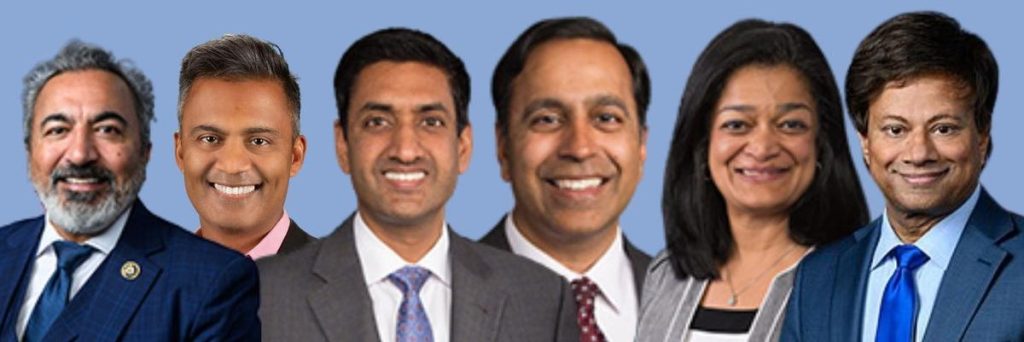
Subramanyam, who previously served as a White House Advisor to President Barack Obama, is a Hindu by faith and is popular among Indian Americans nationwide. He joins the ‘Samosa Caucus’ in the Congress that currently comprises five Indian Americans – Ami Bera, Raja Krishnamoorthi, Ro Khanna, Pramila Jayapal and Shri Thanedar.
All the five existing Indian American members were re-elected to the House of Representatives.
Shri Thanedar was re-elected for the second consecutive term from the 13th Congressional District of Michigan. He won it for the first time in 2023. Raja Krishnamoorthi won the seventh Congressional District of Illinois for the fifth consecutive term.
While the battles for control of the White House and Congress remain close, I am honored that the people of Illinois’ 8th District have extended my contract to represent them in Congress,” Krishnamoorthi said.
“My parents came to this country with little more than a dream for their family’s future and the faith that they could achieve it here in America,” Krishnamoorthi concluded. “Despite some hard times, we did.”
“My mission in Congress is to fight for all the other families that are pursuing their dreams, no matter where they come from, how they worship, or the number of letters in their names… there are 29 in mine.”
So did Ro Khanna who represents the seventeenth Congressional District of California and Congresswoman Pramila Jayapal, who represents the seventh Congressional District of Washington State. A physician by profession, Dr Ami Bera is the senior-most Indian American Congressman representing the sixth Congressional District of California since 2013. He was re-elected for the seventh consecutive term. In Arizona, Shah from the Democratic Party was slightly ahead of his Republican Party’s incumbent David Schweikett.
There are more than 5.2 million people of Indian origin residing in the United States today. Indian Americans are now the second-largest immigrant group in the United States and have emerged as an important political actor thanks to the community’s rapid demographic growth, the close margins in modern presidential elections, and the diaspora’s remarkable professional success.
Although Indian Americans have historically favored the Democratic Party in overwhelming numbers, the Republican Party has long felt that the community’s votes are up for grabs, touting the party’s policies on the economy, social issues, and stewardship of the U.S.-India bilateral relationship, according to a report by Carnegie Endowment.
Despite the rising political profile of Indian Americans, their political attitudes have not been the subject of extensive empirical analysis. To remedy this, in 2020, the authors conducted the Indian American Attitudes Survey (IAAS), one of the first nationally representative surveys designed to analyze the political, social, and foreign policy attitudes of the Indian American community, says the report.
The data offer compelling evidence that Indian Americans continue to solidly favor the Democratic Party. However, one in three survey respondents intends to vote for Donald Trump. This modest drift toward Trump appears to be driven by Indian American men, particularly young men born in the United States. Overall, the diaspora views Harris and other Democratic politicians favorably while possessing more unfavorable views of leading Republicans. But the parties’ respective policy platforms, not personalities alone, shape the voting behavior of this increasingly influential demographic, according to the Carnegie report.