








From Rafale co-production to missile manufacturing, New Delhi and Paris deepen a defence partnership built on technology transfer and strategic autonomy.
Our Bureau
Mumbai
France and India have significantly expanded their defence partnership, with French President Emmanuel Macron hailing the relationship as a “sovereign alliance” in which the two nations have “chosen each other on land, at sea, and in the sky.”
The statement comes amid a series of high-level defence engagements, including the signing of Memorandums of Understanding (MoUs) on the production of HAMMER missiles in India and the renewal of a 10-year defence cooperation agreement. At the heart of the evolving partnership, however, lies a deepening collaboration around the Rafale fighter jet programme — a symbol of India-France strategic convergence.
Addressing the India-France Innovation Forum, Macron described France as a steadfast partner in India’s ‘Make in India’ initiative, particularly in the defence sector.
“In the field of defence, France is a steadfast partner of Make in India. Our high-level cooperation allows us to develop next-generation engines, multi-role helicopters, advanced combat aircraft, submarines, etc. And I want to thank you warmly for the extraordinary confidence you’ve placed in this partnership. And this is not just a defence contract, but a series of defence contracts. We speak about what a sovereign alliance is. Two great nations choosing each other on land, at sea, and in the sky, not by default but by conviction,” Macron said.
The Rafale programme exemplifies this approach. Prime Minister Narendra Modi and President Macron recently commended the contract to procure 26 Rafale Marine fighter jets for the Indian Navy, further expanding India’s Rafale fleet. In parallel, India’s Defence Acquisition Council (DAC), led by Defence Minister Rajnath Singh, has approved the acquisition of 114 Rafale Multi-Role Fighter Aircraft (MRFA) for the Indian Air Force — a move that could transform India’s combat aviation landscape.
Significantly, the next phase of the Rafale partnership goes beyond procurement. Macron acknowledged India’s ambition to co-produce Rafale jets and handle more maintenance domestically, calling it a “legitimate” aspiration aligned with “the direction of history.”
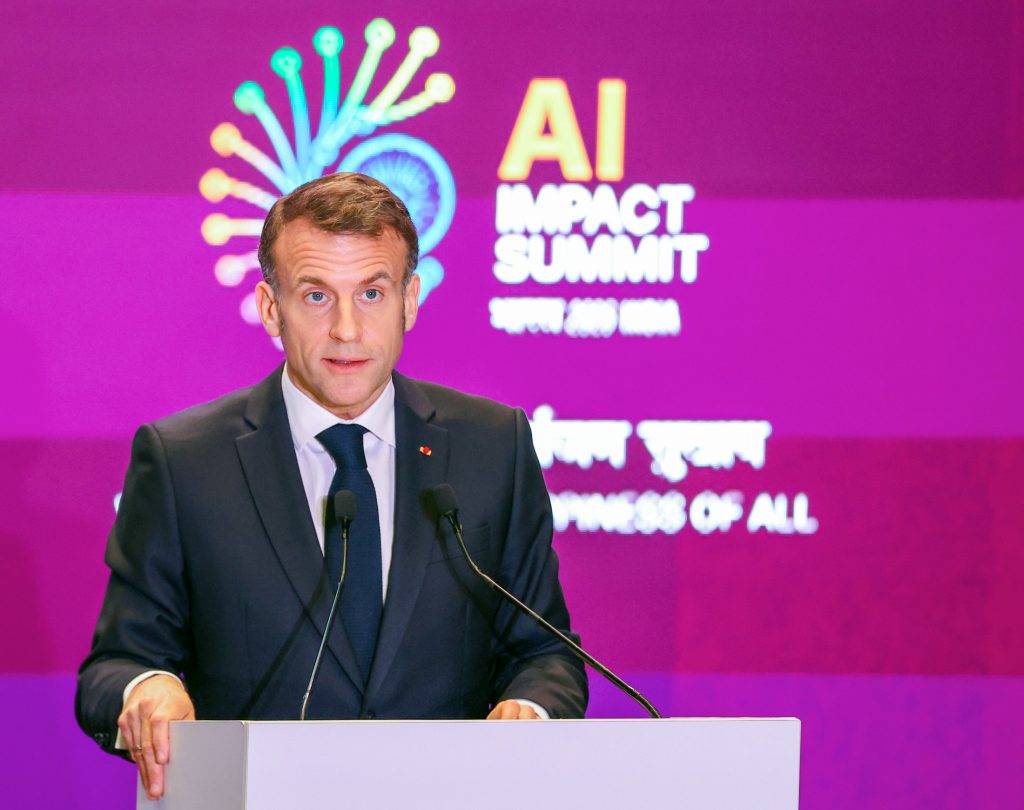
“The Indians, who are currently customers, want to co-produce with us; we have seen the Rafale here, but they want to co-produce combat aircraft in India. They want to handle more of the maintenance, which is legitimate,” Macron said while speaking to French media on the sidelines of the AI-India Impact Summit.
Looking ahead to 2040 and 2050, he stressed that India’s need for advanced combat aviation would only grow, particularly amid evolving regional dynamics. “India will need combat aviation. This is the direction of history,” he added.
For New Delhi, co-production is not merely about numbers but about strategic autonomy. Defence Secretary Rajesh Kumar Singh earlier noted that the MRFA programme would mark the first time Rafales are manufactured outside France, with 40 to 50 per cent localisation under the ‘Make in India’ framework. The government-to-government agreement model, he said, ensures transparency and allows integration of Indian weapons and systems onto the aircraft — a key capability in strengthening indigenous defence ecosystems.
Beyond Rafale, the defence partnership spans submarines, missiles, helicopters and engine development. The two sides renewed their defence cooperation agreement for another decade during the 6th India-France Annual Defence Dialogue in Bengaluru, co-chaired by Defence Minister Rajnath Singh and French Armed Forces Minister Catherine Vautrin.
The leaders also welcomed the continuation of submarine cooperation following the delivery of the sixth Scorpène-class submarine under the Kalvari (P75) programme in January 2025. The programme stands as a flagship example of technology transfer and local manufacturing in India’s naval modernisation.
In aerospace manufacturing, the partnership is expanding through joint ventures and maintenance facilities. The inauguration of Maintenance, Repair and Overhaul (MRO) facilities for LEAP engines and M-88 engines mounted on Rafale aircraft strengthens India’s self-reliance in lifecycle support. The Safran-HAL collaboration on the Indian Multi-Role Helicopter (IMRH) and the establishment of a Joint Venture with Bharat Electronics Limited to produce HAMMER missiles in India further underscore the industrial depth of cooperation.
Strategically, the India-France defence axis reflects a shared belief in autonomy in a multipolar world. Macron spoke of forging a roadmap “distinct from hegemony,” while also urging European nations to consolidate their defence industries and develop common standards to remain globally competitive.
For India, the Rafale and broader defence engagements signal a calibrated balance: diversifying partnerships, enhancing indigenous manufacturing, and embedding technology transfer into every major acquisition. For France, India represents not just a major market, but a long-term strategic partner with growing geopolitical weight.
As both countries launch the Year of Innovation 2026 and deepen ties across AI, space and defence, the Rafale programme stands as the centrepiece of a partnership that increasingly defines not just military cooperation, but a shared vision of strategic sovereignty.