








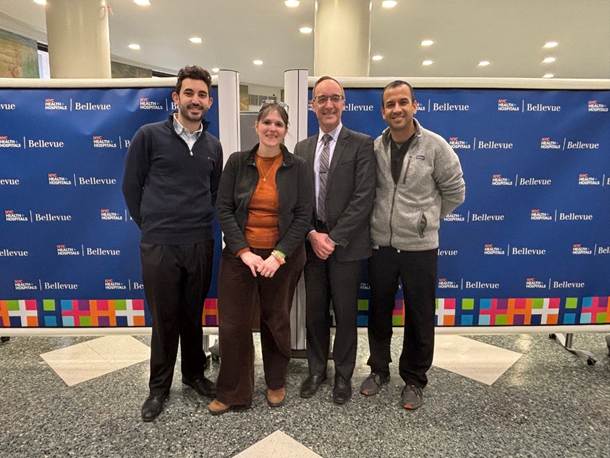
Bellevue Hospital will lead emergency preparedness program to support coordinated readiness and cross-sector collaboration
Our Bureau
New York, NY
NYC Health + Hospitals/Bellevue has announced it was awarded $100,000 to support the development and implementation of an Extension for Community Healthcare Outcomes (ECHO) program for emergency preparedness. The funding is provided by the University of New Mexico, which received a grant from the Robert Wood Johnson Foundation to build regional, case-based virtual learning networks that strengthen infectious disease and all-hazards emergency preparedness and response across the region. The award for Bellevue Hospital will provide support for training across U.S. Department of Health and Human Services (HHS) Region 2, which includes New York, New Jersey, Puerto Rico, and the U.S. Virgin Islands.
“This award reflects Bellevue Hospital’s long-standing leadership in emergency preparedness and our commitment to strengthening readiness across our region,” said Eric Wei, MD, MBA, Chief Executive Officer of NYC Health + Hospitals/Bellevue. “Emergency preparedness is not limited to one type of threat — it’s about ensuring that we are equipped to respond to whatever our communities face. Through this program, we will strengthen regional collaboration and expand practical, real-world learning through shared cases and cross-sector dialogue that improves response capabilities across the region.”
As a leader in emergency preparedness, Bellevue Hospital will help establish a trusted, multidisciplinary virtual community of practice grounded in the Project ECHO model. The program will bring together public health officials, emergency managers, health care organizations, and community-based organizations to co-design equitable, coordinated, and resilient emergency preparedness and response systems.
“Project ECHO gives us the opportunity to learn from one another across disciplines and strengthen preparedness across our region,” said Margaret L. Aldrich, MD, Assistant Professor of Pediatrics and Pediatric Hospital Epidemiologist, and Project ECHO Principal Investigator at Bellevue Hospital. “Through shared learning and community, we can build greater resilience together.”
Bellevue Hospital will lead an Emergency Preparedness ECHO program from January 15, 2026 to October 31, 2026, delivering 18 virtual sessions to strengthen regional readiness through shared learning and collaboration. The series will include brief workshops and trainings, participant case presentations, and facilitated discussion, with guidance and support from the ECHO Institute. Participants will also have access to session recordings and resource materials.
The Emergency Preparedness ECHO program will include two complementary cohorts: A High Consequence Infectious Diseases (HCID) Preparedness cohort and an All-Hazards cohort. The HCID Preparedness cohort will focus on foundational topics such as personal protective equipment, staffing, waste management, infection prevention and control best practices, and EMS considerations. The All-Hazards cohort will address key emergency preparedness priorities — including hurricane preparedness, tsunami preparedness, exercises and drills, mass casualty events, and pediatric considerations — that support comprehensive readiness across a range of threats.
“Emergency preparedness includes readiness for special pathogens, and that is a core part of Bellevue Hospital’s role as the Regional Emerging Special Pathogens Treatment Center,” said Vikramjit Mukherjee, MD, Chief, Critical Care and Chief, Special Pathogens Program, Bellevue Hospital. “This ECHO program supports that work by extending shared learning across the region.”
Bellevue Hospital serves as the Regional Emerging Special Pathogens Treatment Center (RESPTC) for HHS Region 2, a designation that positions the hospital as a regional leader in preparedness for HCIDs. Through its RESPTC role, Bellevue provides clinical expertise, training, and coordination to support health care systems across the region in preparing for and responding to special pathogen threats, including the recent training of over 500 health care and public health professionals across four jurisdictions in 2025 to respond to regional high-consequence infectious disease threats.