








Public assertions of unity mask growing tensions over seat-sharing and power-sharing ahead of the 2026 Assembly polls
Our Bureau
Chennai / New Delhi
As Tamil Nadu moves towards the 2026 Assembly elections, the Congress–DMK alliance — a key pillar of the broader INDIA bloc — is entering a delicate phase. While leaders on both sides insist that negotiations are “very, very smooth,” recent remarks from Congress MP Manickam Tagore suggest that beneath the surface, questions of seat-sharing and power-sharing are far from settled.
The immediate flashpoint was an indirect swipe by Tagore at a remark attributed to Tamil Nadu Minister Raja Kannappan about the DMK winning 160 seats while contesting 170 constituencies. Tagore responded by invoking hard numbers from the last election. “In 2021, we contested in 173 places and won 133 .. What we’re asking is about the places where you faced defeat. Power-sharing is essential. Governance share is our right. The people will decide,” he wrote on X.
The subtext is unmistakable. In 2021, the DMK contested 173 seats and won 133, leading the Secular Progressive Alliance to victory in the 234-member Assembly. The DMK–Congress alliance secured 151 seats overall. While the arithmetic delivered power, the current debate suggests Congress is unwilling to accept a diminished role in the next round of negotiations.
Tagore’s emphasis on “governance share” signals that this is not merely about seat allocation but about political space and influence within government. For Congress, which has struggled nationally, Tamil Nadu remains one of the few states where it is part of a stable ruling alliance. Any perception of marginalisation in seat-sharing could have symbolic as well as electoral consequences.
At the same time, Tamil Nadu Congress Committee (TNCC) president K Selvaperunthagai has projected calm. “The election process is going very, very smoothly. Negotiations are ongoing, and we are going to start on February 22,” he told reporters in Chennai. He dismissed speculation of cracks, asserting, “Nothing the BJP is thinking will happen. The BJP wants to pull someone out of the INDIA alliance to split the vote bank, but it will not happen. We are intact with the alliance.”
Yet, the need to publicly reaffirm unity often indicates internal strain. Seat-sharing in Tamil Nadu has historically been a sensitive exercise, shaped by local caste equations, constituency-level strengths and leadership calculations. The DMK, as the dominant partner with 133 seats in 2021 compared to the AIADMK’s 66, enters negotiations from a position of strength. Congress, however, is seeking leverage by pointing to constituencies where the DMK “faced defeat.”
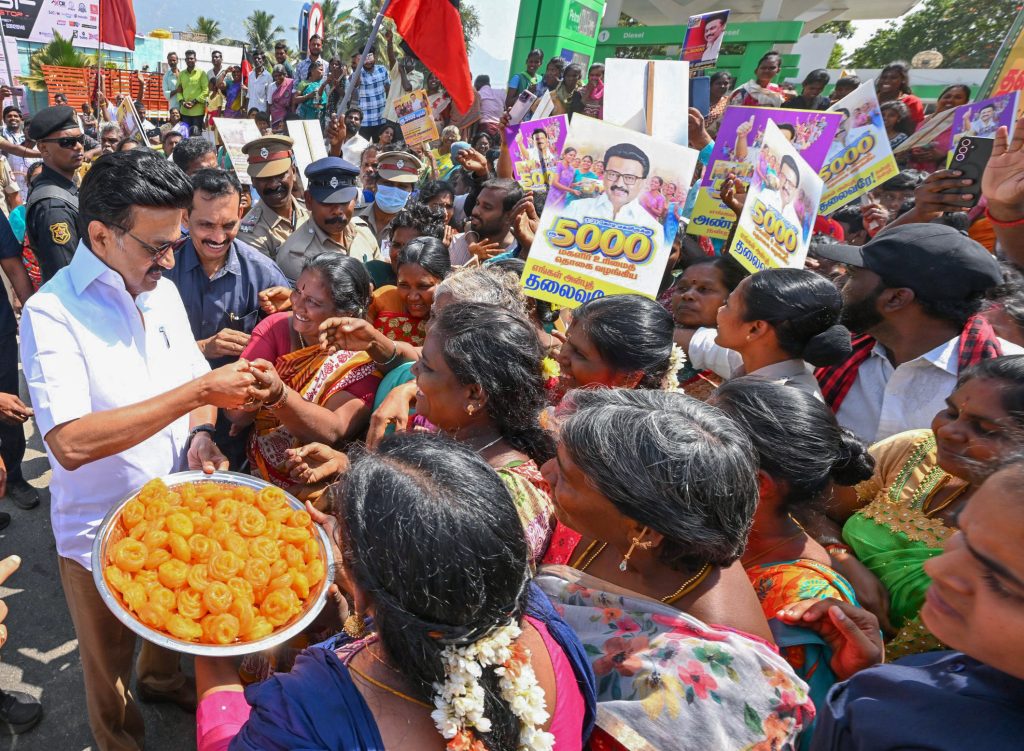
Complicating matters further is the political backdrop created by Chief Minister MK Stalin’s recent welfare announcements. On Friday, Stalin said that Rs 3,000 had been deposited in advance for February, March and April, along with a Rs 2,000 “summer special package,” totalling Rs 5,000 for 1.31 crore women beneficiaries this month. He added that under “Dravidian Model 2.0,” the Rs 1,000 monthly assistance would be doubled to Rs 2,000 if re-elected.
Selvaperunthagai welcomed the move, saying, “Definitely. People are welcoming it. Most rural people are in deep poverty; there is drought and no proper rain. So this gift will be very helpful to poor people.” He also supported the proposed hike to ₹2,000 per month, stating, “We welcome what our Honourable Chief Minister announced – ₹2,000 per month as ‘Women’s Rights Money.’ Rural women’s empowerment should be increased.”
However, Opposition parties have criticised the timing, calling it poll-driven. Stalin defended the advance disbursal as pre-emptive, saying his government acted ahead of attempts to “block” the scheme due to the upcoming polls. The debate over welfare versus “election fear” adds another layer to alliance dynamics. As the dominant party, the DMK is shaping the narrative with high-visibility welfare measures, potentially limiting Congress’s ability to differentiate itself within the coalition.
Meanwhile, Selvaperunthagai has sought to keep the focus on broader alliance unity and governance. Referring to Rahul Gandhi’s proposed visit, he said, “We accepted the SOP. Everyone should accept it because the people’s security and safety are very, very important.” He also criticised the BJP for straying into personal commentary, asking, “Why are they talking about Trisha, about personal life? It is not fair.”
These remarks indicate that Congress is keen to portray itself as responsible and aligned with governance priorities, even as it negotiates harder behind closed doors.
The central question is whether the Congress–DMK partnership can balance asymmetry with accommodation. The DMK’s dominant performance in 2021 gives it confidence; Congress’s insistence that “power-sharing is essential” reveals its anxiety about relevance. If seat allocation tilts heavily in favour of the DMK without proportional space for Congress, murmurs could grow louder.