








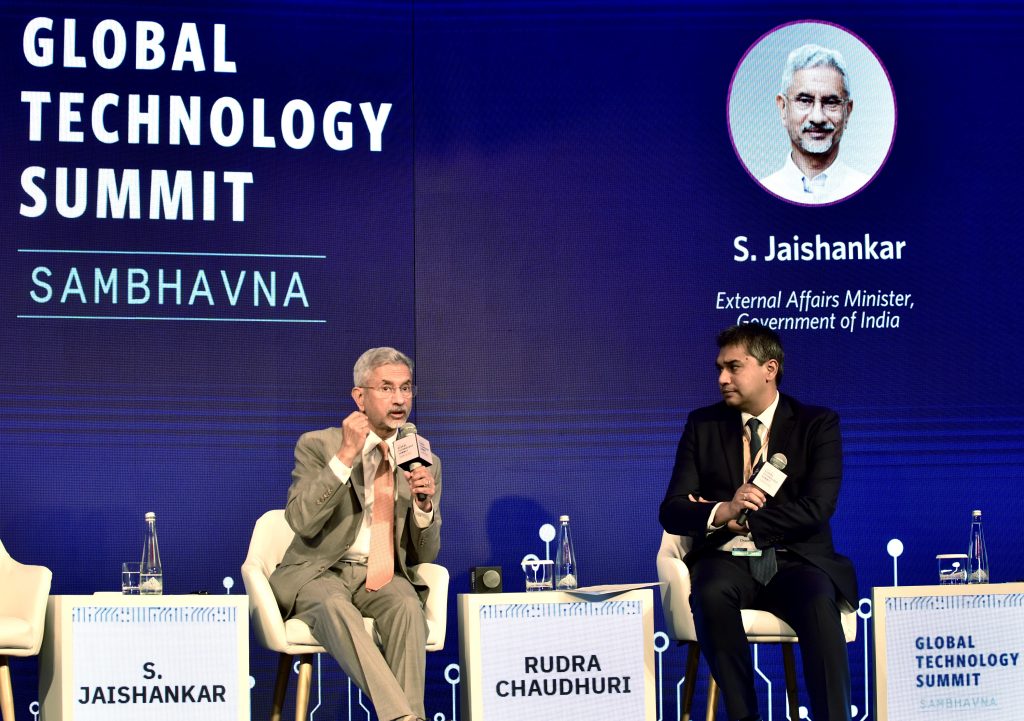
As India prepares to host the AI Impact Summit in 2026, policymakers, global institutions and industry leaders see the country emerging as a pragmatic AI hub for the Global South—focused less on futuristic fears and more on real-world impact
Our Bureau
New Delhi
With India set to host the AI Impact Summit in 2026, global attention is increasingly turning to how the country is shaping an alternative vision for artificial intelligence—one rooted in adoption, inclusion and public benefit rather than fear-driven regulation.
Speaking on the sidelines of the Global Technology Summit’s Innovation Dialogue 2025, UNDP’s Director of AI Hub and Head of Digital & AI Programmes, Keyzom Ngodup Massally, described India as uniquely positioned to test, pilot and scale AI solutions relevant to developing economies. Hosting the first global AI summit in the Global South, she said, will itself mark a departure from technology discussions dominated by the Global North.
“There’s a strong focus on innovation, adoption and solving challenges that people and our planet face,” Massally said. “India’s diversity—linguistic, cultural and geographical—makes it a fertile ground to test and scale solutions that can then travel globally.”
A key pillar of India’s growing AI influence lies in its digital public infrastructure. Platforms such as UPI and initiatives like Bhashini and AI for Bharat are increasingly cited as global models for how technology can be deployed at scale while remaining people-centric. According to Massally, the lesson is not technological sophistication alone, but intent. “It’s not about technology for its own sake. It’s about making technology work in service of people,” she said, adding that this philosophy aligns closely with UNDP’s broader human development goals.
India’s approach is also shaping conversations on governance and ethics. Rather than viewing regulation as a one-time exercise, Massally emphasized that India is pushing a dynamic, contextual framework. “Policies must evolve constantly to help solutions that improve a farmer’s life or a woman’s life to scale,” she said, calling for inclusive governance involving governments, civil society, communities and the private sector.
This pragmatic focus was echoed by Rudra Chaudhuri, Director of Carnegie India, who contrasted India’s AI discourse with that of major powers. “While discussions in the US and China often revolve around superintelligence, India’s focus is on AI’s real-world impact today,” he said, pointing to AI-driven agricultural advisories already reaching over 16 million farmers across nearly 20 languages.
Chaudhuri noted that India has adopted a pro-innovation regulatory stance, allowing AI use cases to mature before imposing tighter controls. At the same time, he highlighted parallel progress in semiconductors, with more than 10 projects underway across fabrication, assembly and testing—countering earlier skepticism about India’s manufacturing ambitions.
Experts at the summit also highlighted India’s strategic position between competing AI models. CK Cheruvettolil of DGA–Albright Stonebridge Group described India as a “middle way” between US-led frontier model development and China’s rapid expansion of open-source AI. “India is very well positioned to bring AI to the masses and to be a leader for the Global South,” he said, particularly as access to AI compute remains uneven globally.
Concerns around cultural relevance and safety were also central to discussions. UC Berkeley researcher Rodolfo Corona warned that benchmarks and evaluation models designed in the Global North often fail in southern contexts. “Involving regional actors is essential,” he said, noting India’s growing role as a convenor across policy, academia and industry. David Joseph Menezes of People+AI stressed that reliability is not theoretical in emerging markets. “If a farmer receives wrong advice and acts on it, it could mean crop failure for a year,” he said.
From an industry perspective, AmCham India Director Pranav Mishra highlighted India’s open regulatory environment as a major advantage for US–India AI cooperation. He noted that India’s AI infrastructure is currently powered largely by American technology firms, with compute demand expected to surge as data centers expand. “The essence of the AI Impact Summit is in the name—the impact,” Mishra said. “AI’s effect across sectors, states and languages will be on full display.” As preparations for the 2026 summit gather pace, India is increasingly positioning itself not just as an AI market, but as a laboratory for inclusive innovation—one that could help define how artificial intelligence serves the Global South in the decades ahead.