








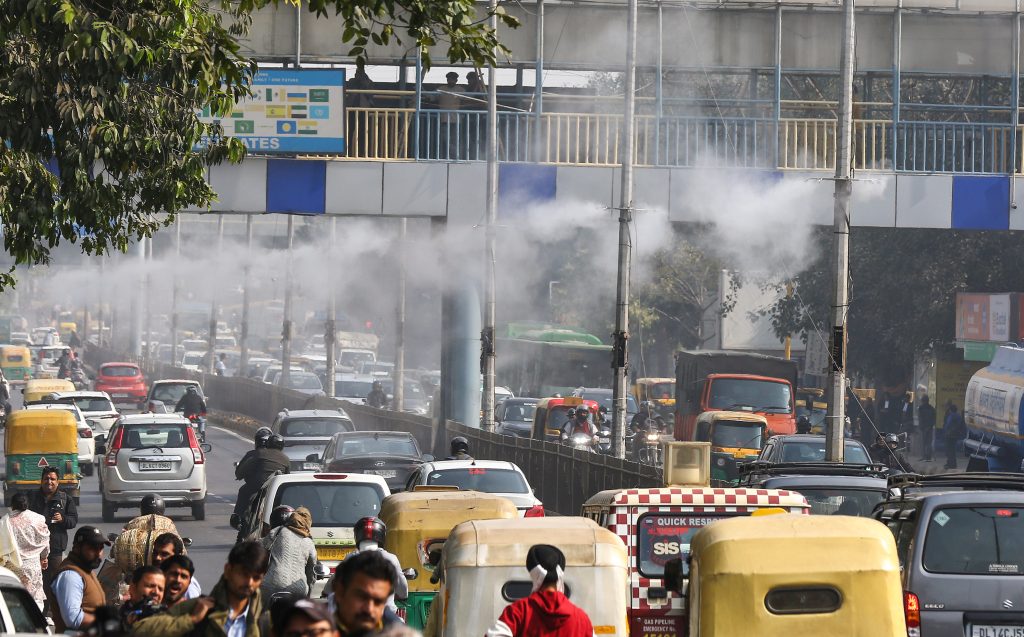
As toxic smog blankets Delhi-NCR and northern India, Padma awardee doctors, opposition leaders, and government agencies sound the alarm over a spiralling public health crisis that experts say demands urgent nationwide action.
Our Bureau
New Delhi
Delhi’s annual winter pollution crisis has once again triggered national concern, with air quality plummeting to hazardous levels across the National Capital Region and several northern cities. Even as a brief improvement pushed the overall AQI to around 300 on Thursday morning, doctors, legislators and environmental authorities warned that India is in the middle of a severe public health emergency that requires immediate, coordinated intervention.
A group of more than 80 Padma awardee doctors issued a rare national health advisory, calling the pollution levels “a significant public health emergency” affecting every age group. The advisory emphasised that India is now witnessing health impacts far beyond seasonal respiratory issues. It warned that toxic air is triggering severe asthma attacks, increasing the risk of heart attacks and strokes, and affecting diabetes and hypertension control. Long-term exposure, doctors cautioned, may cause irreversible lung damage in children.
Clean air, the advisory stressed, is a basic human necessity. “Urgent collective action is vital to protect public health,” the doctors stated, asking citizens and policymakers to act swiftly.
The medical community recommended practical measures to reduce exposure: using air purifiers where possible, wearing N95 masks outdoors, avoiding strenuous outdoor activity during peak pollution hours, and keeping indoor environments clean through wet-mopping and limiting sources of indoor smoke. Vulnerable groups — including children, pregnant women, the elderly, and people with chronic heart or lung disease — were advised to take extra precautions, with recommendations to suspend outdoor school activities during severe pollution spells.
Even as health concerns mounted, political fault lines widened. Opposition MPs staged a protest at Makar Dwar on Parliament premises on Thursday, wearing oxygen masks and holding banners that mocked Prime Minister Narendra Modi’s recent remark, “Mausam ka maza lijiye” (enjoy the weather). The MPs demanded that Parliament hold a full-fledged discussion on air pollution, with several leaders accusing the government of failing to treat the crisis with the seriousness it deserves.
Congress President Mallikarjun Kharge and Congress Parliamentary Party Chairperson Sonia Gandhi also joined the demonstration. Congress MP Pramod Tiwari described Delhi and other polluted cities as “gas chambers,” saying both the Centre and state governments were responsible for the situation. “People outside cannot understand this… Citizens are being kept in gas chambers,” he said.
In Parliament, Congress MPs Manickam Tagore, Manish Tewari and Vijay Vasanth moved notices demanding that the government declare air pollution a national health emergency. Tagore argued that the government remained “paralysed,” relying on “advisories instead of action” and “committees instead of solutions.” He called for a legally backed national clean air mission, strict liability for polluters, and emergency health protocols for exposed populations.
The government, however, pointed to significant measures already underway. In a statement to the Rajya Sabha, Minister of State for Environment Kirti Vardhan Singh outlined extensive steps taken to curb one of the major contributors to winter pollution — paddy stubble burning. Singh said air quality in the NCR is affected by multiple factors, from vehicular and industrial emissions to biomass and municipal waste burning. Stubble burning, he said, is an episodic but important contributor.
Since 2018-19, the Centre has implemented a Central Sector Scheme on Crop Residue Management (CRM), providing 50 percent financial assistance to farmers for machinery and 80 percent support to cooperatives and SHGs for setting up Custom Hiring Centres. A total of ₹4,090.84 crore has been released to states for CRM initiatives, resulting in more than 3.45 lakh crop residue machines and over 43,000 Custom Hiring Centres across Punjab, Haryana, Uttar Pradesh, Delhi and Madhya Pradesh.
The Centre has also backed pelletisation and torrefaction plants, promoted co-firing of biomass pellets in power plants, and supported waste-to-energy and biofuel projects under various ministries. According to Singh, coordinated efforts in Punjab and Haryana have led to a 90 percent reduction in stubble burning incidents this year compared to 2022.
“These initiatives address not only environmental pollution but also provide farmers with income opportunities and strengthen India’s energy security,” Singh told Parliament.
Despite these claims, Delhi continues to face severe smog conditions. Several neighbourhoods, including Ghazipur and Akshardham, woke up on Thursday to dense haze and reduced visibility. Many monitoring stations recorded AQI levels in the “very poor” category, indicating dangerous levels of particulate matter.
For residents, the crisis has become an annual ordeal. Schools have repeatedly shifted to hybrid formats, emergency health advisories are now routine, and households across the region are increasingly investing in purifiers and masks as essential winter expenses.
As the winter session of Parliament continues, pressure is mounting on the government to present a national, long-term, and legally enforceable strategy. For now, Delhi remains shrouded in toxic air, and the country faces a clear reminder that the fight for clean air is far from over.