








Our Bureau
New Brunswick, NJ
A panel discussion at Rutgers University titled “Hindutva in America: A Threat to Equality and Religious Pluralism” stirred immediate backlash after students and advocacy groups claimed the event excluded practising Hindus while making broad assertions about Hindu identity.
The controversy began when the panel convened without a single practising Hindu and featured scholars who the Coalition of Hindus of North America (CoHNA) accused of advancing “uninformed” judgments about Hinduism. CoHNA said attendees from Hindu backgrounds were effectively shut out from voicing their perspectives.
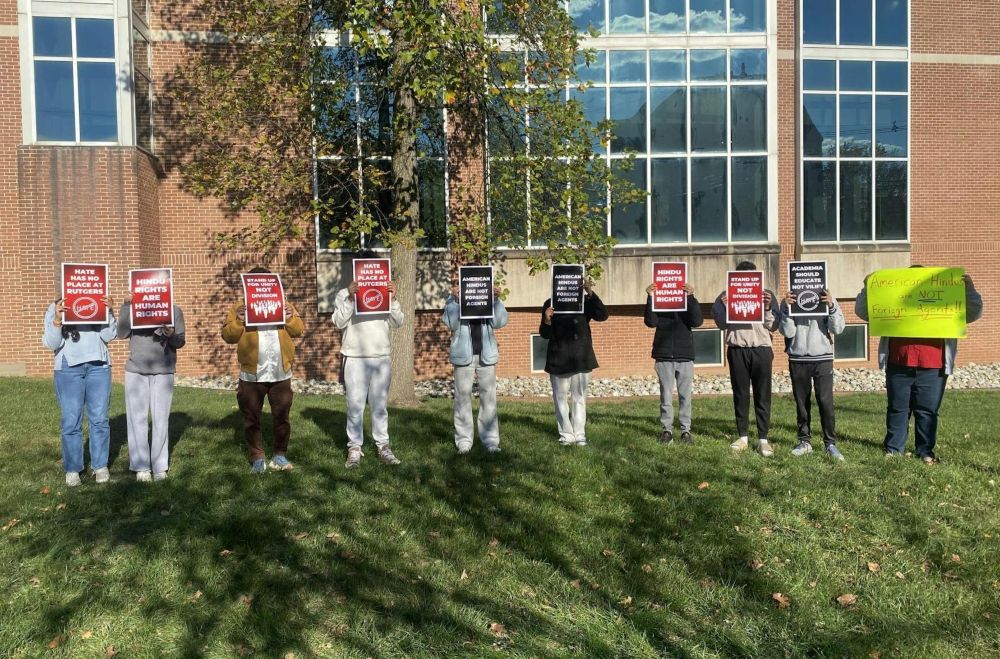
Outside the venue on Rutgers’ College Avenue campus, Hindu students organised a silent protest. They carried signs reading slogans such as “Hindu rights are human rights” and “American Hindus are not foreign agents.” According to reports, some said they feared being publicly identified during the protest.
Faculty members joined the demonstration, adding to the pressure on the university’s leadership. Meanwhile, four members of the U.S. House of Representatives—including two of Indian origin—sent a bipartisan letter to Rutgers on October 24, raising concerns that the discussion appeared “politically motivated and unfairly targeting Hindu students.” The Indian lawmakers named were Suhas Subramanyam and Shree Thanedar.
In their statement, CoHNA pointed to several grievances: the omission of recent US hate-crime data involving Hindu-temple vandalism, the alleged conflation of the Nazi Hakenkreuz with the Hindu symbol, and a lack of acknowledgement of Hinduphobia in the United States. They said the event had “shut down” questions from practising Hindus when panellists attempted to separate Hinduism from Hindutva.
A student described the chilling effect: “It was scary to see an adult trying to dox us.” The student said many peers were reluctant even to attend the rally, citing concerns over safety and the university’s response to their prior letters.
University chaplain Hitesh Trivedi told that the students were not calling for the event’s cancellation — rather they wanted clarity that Rutgers did not endorse the anti-Hindu rhetoric they believed the panel represented.
According to CoHNA, the high volume of emails—over 10,000 sent to administrators from students, parents and community members shows the level of concern.
The episode highlights the fraught intersection of academic freedom, campus climate and identity politics. Rutgers now faces larger questions about how to balance open debate with respectful inclusion of minority faith communities on its campus.