








Archan Mehta

They say T20 is like fast food, ODI is like a buffet, and Test cricket is a seven-course meal—but Cheteshwar Pujara always insisted on chewing every bite slowly, turning “Thichuk Thichuk” into a fashion statement in Test cricket. On August 24, 2025, Indian cricket bid farewell to its last purist as Pujara, at 37, announced his retirement from all forms of the game. For 15 years, he stood tall as India’s immovable force at No. 3, a role that demanded patience, technique, and resilience in an age where six-hitting became the measure of stardom. With stalwarts like Ashwin, Kohli, and Rohit Sharma already walking into the sunset, his retirement isn’t just about one man; it marks the true end of an era for Indian cricket.
From the moment he debuted in 2010 against Australia, Pujara was never just another batsman, he was a specialist in an age of generalists, molded to fill Rahul Dravid’s colossal shoes. The selectors saw a future anchor, and Dravid himself saw a kindred spirit, having once advised Saurashtra to nurture the young run machine after watching him pile runs in Bangalore. Soon enough, India realized he wasn’t the next Dravid, he was the only Pujara, defined by stillness at the crease and the calm assurance that no storm could shake him. His innings often resembled meditation sessions, each delivery met with unwavering respect until bowlers eventually surrendered to his patience.
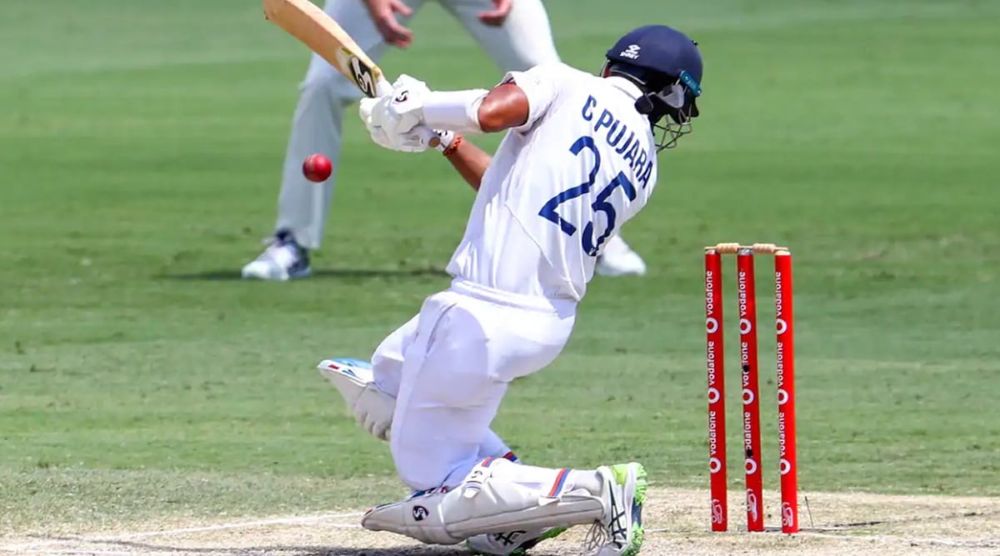
That patience found its greatest stage in Australia, where Pujara’s name is etched into cricketing folklore. Aussies love their BBQs, but in 2018–19 it was Pujara who slow-cooked them for hours, he wasn’t just India’s top scorer with 521 runs but he was Australia’s nightmare. His centuries at Adelaide, Melbourne, and Sydney weren’t mere statistics; they were body blows to a proud bowling attack. And when India scripted the miracle of Gabba in 2021, it was Pujara who absorbed 11 brutal body blows yet refused to flinch, anchoring a chase of 328 that rewrote history. Commentators quipped he didn’t face bowlers, he made bowlers face themselves, and that line summed up his greatness: not flamboyance, but fortitude.
Fortitude alone, though, doesn’t explain his scrapbook of records. His marathon 525-ball vigil in Ranchi in 2017 remains the longest innings ever by an Indian, surpassing even Dravid’s legendary efforts. That same year in Kolkata, he achieved the quirky distinction of batting across all five days of a Test yet finishing with fewer than 75 runs—a feat only someone like Pujara could wear with pride. Add to that his staggering 18 first-class double centuries, the most by any Indian in history, and you see a man who lived to occupy the crease. Much of this steel was built in childhood: his father Arvind Shivlal Pujara rolled soft balls on the ground to perfect his straight bat, while prayer and yoga gave him the mental toughness to shut out the noise whenever he took guard.
Even in the fiery Kohli era, when aggression was India’s calling card, Pujara stood as the perfect counterbalance. Kohli’s dominance came with fire and flair, while Pujara provided the granite base that allowed others to express themselves. Together, they powered India to the No. 1 Test ranking, and Pujara finished with 103 Tests, 7195 runs, 19 centuries, 43+ average and the respect of every dressing room he entered. His final appearance came in the 2023 World Test Championship final, after which younger players were preferred despite his relentless scoring in county and domestic cricket. True to his selfless nature, he stepped aside quietly, even if fans and pundits felt his farewell lacked the grandeur he deserved.
And so, as he bows out, Test cricket loses not just a player but an institution. To borrow a funny but fitting tribute: if Kohli was India’s run-machine, then Pujara was the country’s pause button and oh, how much Test cricket needed him!!
Archan Mehta is a writer dedicated to telling compelling stories about athletes, teams, and the world of cricket