








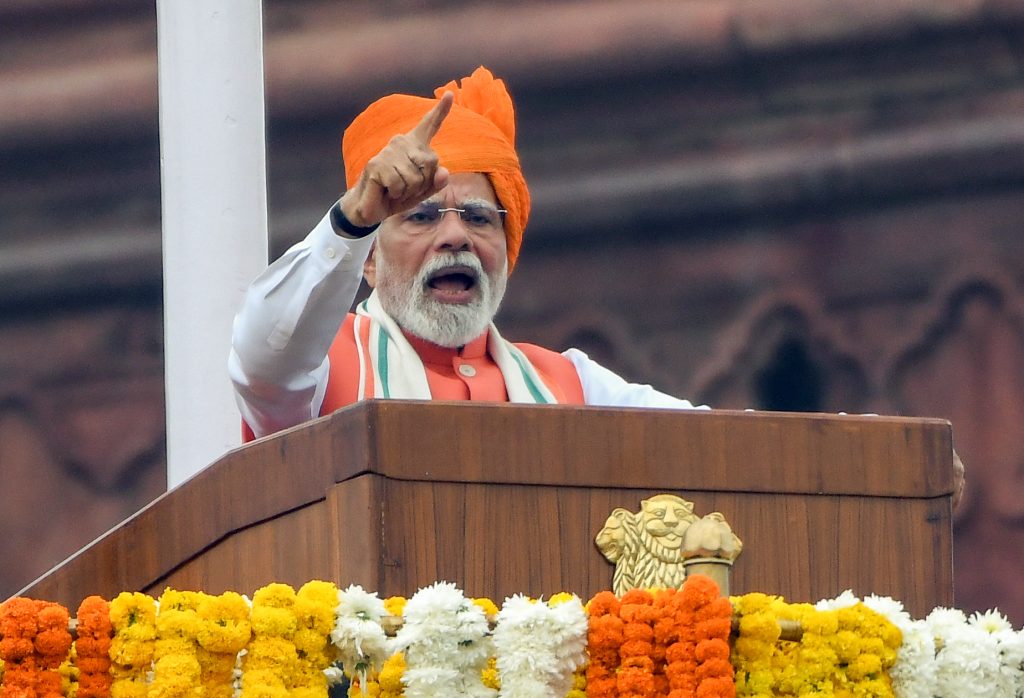
In a record-breaking Independence Day address, PM Modi set out a sweeping vision for a self-reliant India, sending a clear message to the the world that the country would protect its farmers, build its own defences, and shape its destiny on its own terms
Our Bureau
New Delhi
In a record-breaking Independence Day address from the Red Fort, Prime Minister Narendra Modi set out a sweeping vision for a self-reliant India, sending a clear message to the United States and the world that the country would protect its farmers, build its own defences, and shape its destiny on its own terms. The air over Delhi’s old quarter shimmered with the August heat, but the mood in the packed ceremonial grounds was electric. It was Modi’s twelfth consecutive Independence Day address, and expectations had been building for weeks that this would be one of his most consequential speeches.
The Prime Minister appeared in his customary brightly coloured turban, this time in saffron and green, the colours of the national flag. He began by invoking the sacrifices of freedom fighters, then pivoted quickly to his central theme: Atmanirbhar Bharat, or self-reliant India. This, he declared, was the only sure path to a Viksit Bharat — a fully developed nation — by 2047, the centenary of independence.
Stand with Farmers
The speech came against the backdrop of a simmering trade standoff with Washington. The Biden administration, continuing some of the protectionist impulses of Donald Trump’s era, had recently raised tariffs on a range of Indian goods, from steel to textiles, by as much as 25 per cent. At the same time, US negotiators had been pressing India to open its agricultural and dairy markets to American producers — a move that has long been resisted in New Delhi for fear of undercutting millions of small farmers.
Without naming the US, Modi was unmistakably clear in his position. “If any policy is against India’s farmers, fishermen, cattle rearers, Modi is standing like a wall,” he declared, prompting cheers from the audience. The line was a throwback to the nationalist economic arguments that have punctuated his decade in office, but the emphasis was sharper this time. He framed agriculture not just as an economic sector, but as a pillar of national sovereignty — a view that resonated in a country where farming still employs nearly half the workforce.
This wasn’t the first time India had resisted external pressure on agriculture. From the Uruguay Round of the GATT negotiations in the early 1990s to more recent World Trade Organization disputes, New Delhi has consistently defended its ability to maintain minimum support prices and protect its farmers from global market volatility. Modi’s speech situated this latest standoff within that tradition, portraying it as part of a larger struggle for economic self-determination.
The Self-Reliance Doctrine
If agriculture was the emotional heart of the address, defence and technology formed its strategic backbone. In perhaps the most dramatic announcement of the morning, Modi unveiled the Sudarshan Chakra Mission — a decade-long plan to design, develop, and deploy an indigenous air defence system capable of intercepting missiles, drones, and other aerial threats.
Drawing on the imagery of Lord Krishna’s mythic discus, Modi described a shield that could protect both military installations and civilian populations. The parallels to Israel’s Iron Dome and Russia’s S-400 system were obvious, but Modi stressed that this would be “Made in India, for India, by India.” The project would integrate domestic research institutes, defence public sector undertakings, and a network of private aerospace startups. By 2035, he promised, the system would be operational, marking a leap forward in India’s strategic autonomy.
The self-reliance theme extended far beyond defence. Modi announced that the first batch of Made-in-India semiconductor chips would hit the market by the end of 2025, the product of a concerted push to bring high-end manufacturing to Indian soil. He called for domestic development of operating systems, AI solutions, and even social media platforms — warning that dependence on foreign digital infrastructure posed a hidden risk to national security. “When your tools, your data, and your communication channels are controlled elsewhere,” he said, “your independence is an illusion.”
In agriculture, Modi laid out plans to boost domestic fertiliser production, expand irrigation, and develop new storage facilities to reduce post-harvest losses. The Ministry of Commerce, he said, was already working on a blueprint to cut agricultural imports and build reserves of critical staples. “A country unable to feed itself,” he warned, “cannot truly call itself independent.”
Demography, Space, and the Economic Engine
The Prime Minister’s address also ventured into territory that was both strategic and demographic. Announcing a High-Power Demography Mission, he warned of shifts in population patterns along India’s borders that could, if unchecked, create security vulnerabilities. The mission would combine infrastructure development, incentives for settlement, and enhanced security measures to ensure that border regions remain economically vibrant and demographically stable.
He also celebrated India’s advances in space exploration, lauding the return of Group Captain Shubhanshu Shukla from the International Space Station. The applause was loudest when he reaffirmed plans for the Gaganyaan mission — India’s first crewed spaceflight — which he framed as a symbol of the nation’s scientific capabilities. Over 300 Indian startups, he noted, are now working in space technology, from satellite manufacturing to launch services.
Economic policy was never far from the centre of the address. Modi announced the Pradhan Mantri Viksit Bharat Rojgar Yojana, a ₹1 lakh crore employment initiative aimed at creating 3.5 crore jobs. This included a ₹15,000 grant for young people securing their first private-sector role — a measure designed to encourage small and medium enterprises to hire fresh graduates. He also unveiled a Next-Generation Reforms Task Force to modernise laws and regulations, ensuring they align with the realities of a fast-changing global economy.
Symbols and Signals
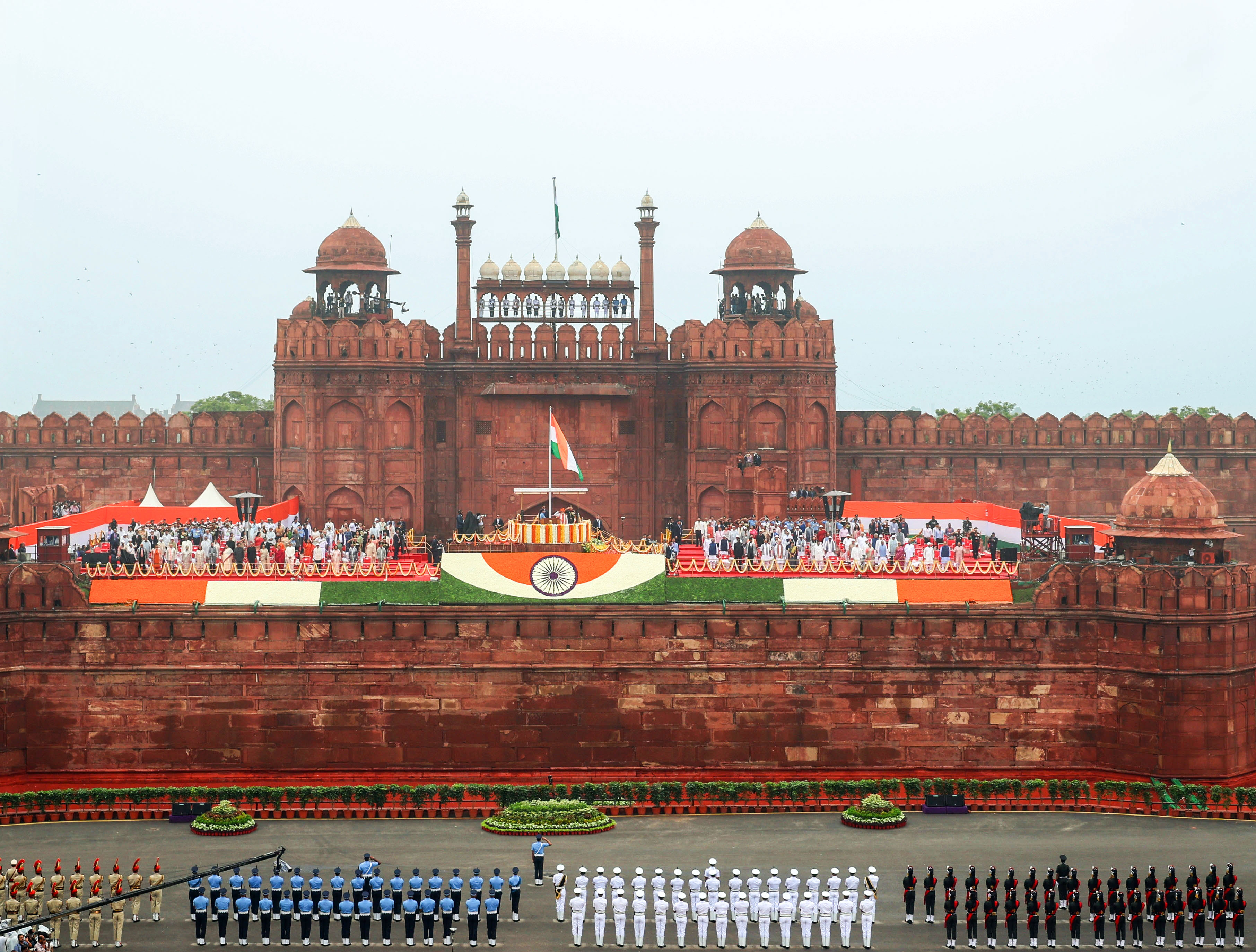
This year’s celebrations were as much about spectacle as substance. The lawns around the Red Fort were filled with 5,000 special guests — farmers, athletes, innovators, and community leaders — handpicked from across the country. The ceremonial guard of honour drew on all three armed services, and the music of 140 military and paramilitary bands carried through the streets of Delhi. Across India, similar performances marked the day, with particular attention paid to the success of Operation Sindoor — a defence mission touted by Modi as a model of self-reliance in action.
The symbolism of the day was not lost on political observers. Every initiative announced, from the Sudarshan Chakra Mission to the AI platforms, carried the implicit message that India would engage with the world, but only on terms it set for itself. Modi’s repeated invocation of “Vocal for Local” tied the economic agenda to a cultural and emotional appeal — urging citizens to choose Indian products not out of compulsion but pride.

By the time the speech drew to a close, the message was unambiguous: India’s path forward lay in building its own capabilities, defending its own interests, and making strategic partnerships without strategic dependence. “Whoever is dependent on others too much,” Modi said in his closing line, “there are big questions raised on one’s independence.” The words hung in the humid August air, as much a warning as a promise.
For Modi, the Independence Day address has always been more than a ceremonial obligation; it is his annual stage to define the national mood and set the tone for the political year ahead. Over twelve speeches from the Red Fort, he has refined a style that blends storytelling with hard policy, symbolism with statistics. Supporters see in him a leader who speaks directly to the people, bypassing bureaucratic caution. Critics argue that his oratory can blur the line between aspiration and deliverable reality. Yet few dispute his ability to command attention, both domestically and abroad. The cadence of his speeches, punctuated by sharp slogans and deliberate pauses, reflects an instinct for theatre honed over decades in politics. This year’s address, delivered in the heat and glare of an unrelenting sun, may well be remembered as one of his most defiant — a declaration that India’s future will not be outsourced.
MODI’S PLAN FOR 2047
In his 12th Independence Day address to the nation, Prime Minister Narendra Modi delivered bold announcements that indicate India is poised to make significant progress into the future.
PM Modi outlined plans for various initiatives, including the production of India’s first semiconductor chip, the development of jet engines, the creation of ₹1 lakh crore in youth employment opportunities, and a tenfold expansion of the nuclear program.
He presented his vision for “Naya Bharat” (New India) and set the goal of transforming India into a developed nation by 2047. Key points from PM Modi’s address included:
1.Semiconductors: From Lost Decades to Mission Mode
Recalling how attempts to set up semiconductor factories 50-60 years ago were “killed at birth” while other nations prospered, PM Modi announced that India is now on mission mode. By the end of this year, the nation will roll out its first Made in India chip.
2.Nuclear Energy Capacity to Grow Tenfold by 2047
Work is underway on 10 new nuclear reactors as part of India’s mission to increase nuclear power generation capacity by over ten times in the next two decades.
3.GST Reforms – A Diwali Gift
Next-generation GST reforms will be unveiled on Diwali, reducing taxes on essential goods and providing relief to MSMEs, local vendors, and consumers.
4.Reform Task Force for a $10 Trillion Bharat
PM Modi announced the creation of a dedicated Reform Task Force to drive next-generation reforms. Its mandate: accelerate economic growth, cut red tape, modernise governance, and prepare Bharat for the demands of a $10 trillion economy by 2047.
5.₹1 Lakh Crore PM Viksit Bharat Rozgar Yojana
PM Modi launched a major employment scheme worth ₹1 lakh crore, under which newly employed youth will receive ₹15,000 per month. The scheme aims to benefit 3 crore young Indians, strengthening the bridge from Swatantra Bharat to Samriddha Bharat.
6.High-Powered Demography Mission
PM Modi highlighted the dangers of demographic imbalance due to infiltration and illegal migration in border areas. He announced the launch of a High-Powered Demography Mission to address this national security challenge, ensuring the unity, integrity, and rights of India’s citizens are safeguarded.
7.Energy Independence – Samudra Manthan Begins
PM Modi pointed out that a large share of India’s budget still goes toward importing petrol, diesel, and gas. He announced the launch of the National Deepwater Exploration Mission to tap ocean resources, alongside major expansions in solar, hydrogen, hydro and nuclear power.
8.Made in India Jet Engines – A National Challenge
PM Modi made a dramatic announcement that just like how we made vaccines during COVID, and UPI for digital payments, we should build our own jet engines too for our jet engines and asked our scientists and youth to take it up as a direct challenge. (ANI)