








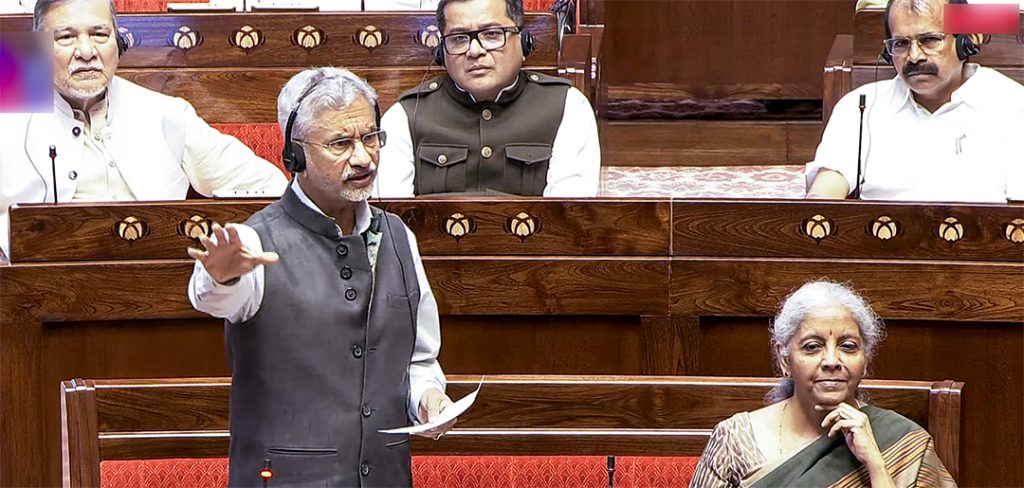
With sharp wit and a command of historical detail, External Affairs Minister S. Jaishankar dismantled Opposition criticism in Parliament, turning the Operation Sindoor debate into a masterclass in political rebuttal
Our Bureau
New Delhi
In a fiery address in Parliament this week, External Affairs Minister S. Jaishankar put the Opposition — particularly the Congress — firmly on the defensive, using a blend of historical references, hard facts, and diplomatic clarity to refute criticism over India’s foreign policy and the government’s handling of Operation Sindoor.
What was expected to be a heated debate on India’s external security posture turned into a rhetorical battlefield — and Jaishankar didn’t miss a single target.
The minister opened his address with a pointed jab at Congress MP Jairam Ramesh, whom he sarcastically dubbed a “China Guru,” referencing Ramesh’s 2007 book Making Sense of Chindia. “There are ‘China Gurus’ whose affection for China is so great, they created a term – Chindia,” Jaishankar said, drawing laughter from the treasury benches.
But the jibe wasn’t just about wordplay. Jaishankar proceeded to dismantle decades of Congress’s handling of China and Pakistan, tracing the roots of their modern military and nuclear collaboration back to decisions made under Congress governments. From the Karakoram highway plan of 1966 to the nuclear agreement of 1976, Jaishankar walked the House through historical developments, implying the Congress had laid the groundwork for today’s geopolitical tensions.
“China and Pakistan didn’t become close overnight. This history has been unfolding since 1962. Some people pretend it all happened in the last five years — maybe they were asleep during history class,” he quipped.
On Operation Sindoor, launched in response to Pakistan’s aggression following the Pahalgam terror attack, Jaishankar was equally forthright. He debunked speculation about foreign interference, especially rumors of backchannel talks between Prime Minister Narendra Modi and then U.S. President Donald Trump. “From April 22 to June 16, there wasn’t a single phone call between the two,” he said emphatically. “Let them hear it clearly: no mediation, no compromise. Pakistan must request a ceasefire through formal military channels — that’s the protocol, and we stuck to it.”
The Operation, now seen as a calibrated yet assertive military response to Pakistani provocation, was defended not just as a success, but as a moment of diplomatic maturity. “When countries reached out to us asking about the seriousness of the situation, we gave the same answer to all: this is bilateral, and mediation is off the table,” Jaishankar said.
Facing allegations from the Congress that the Modi government had mismanaged China relations, Jaishankar offered not just a rebuttal, but a reverse indictment. He reminded Parliament that it was Jawaharlal Nehru’s government that ceded strategic leverage through both rhetoric and treaties. Referencing Nehru’s 1960 remarks on the Indus Water Treaty, Jaishankar quoted him saying the treaty was done “for the interest of Pakistani Punjab” — and pointedly asked why there had been no mention of Indian farmers in Kashmir, Punjab, Rajasthan, or Gujarat.
“The Indus Water Treaty is perhaps the only agreement in the world where a country allows its major rivers to flow into another without asserting rights,” he said. “But we’ve now corrected that historic imbalance.”
That correction, he said, came in the form of the Modi government’s decision to put the Indus Water Treaty in abeyance after the Pahalgam attack — an unprecedented move made in response to Pakistan’s continued support for cross-border terrorism. “Blood and water will not flow together,” he declared.
Throughout the session, Jaishankar’s tone was sharp but measured. He rarely raised his voice, but the impact was unmistakable — even Opposition benches found it difficult to respond without deflecting. When Jairam Ramesh accused the government of giving China a “clean chit” in Ladakh, Jaishankar responded by citing Congress’s own silence on Chinese intrusions during earlier decades, asking, “What exactly did they do when Chinese infrastructure was expanding across our borders in the 1990s and early 2000s?”
Beyond the jabs and history lessons, the minister also highlighted tangible wins under the current government’s diplomacy. Most notably, the designation of The Resistance Front (TRF) — a Pakistan-based terror proxy — as a UN-recognized terrorist organization, thanks to persistent Indian lobbying at the United Nations Security Council. “In the last decade, India’s diplomacy on counterterrorism has seen a transformative leap,” he noted.
In a House that had started the day with protests and chaos, Jaishankar’s speech brought a moment of clarity — and, for the government, a much-needed upper hand. By the end of the session, even some neutral observers in Parliament were calling it one of the most strategically effective rebuttals by any minister in recent memory.
For the BJP, Jaishankar’s speech wasn’t just a defence of government policy — it was a strategic positioning of the Modi administration as historically conscious, diplomatically savvy, and unapologetically assertive. And for the Opposition? It was a reminder that when it comes to foreign policy, history has consequences — and Jaishankar remembers every chapter.