








India’s assertive military response in Operation Sindoor has not only redrawn lines of deterrence with Pakistan but also exposed a growing rift between New Delhi and Washington—one over facts, credit, and control of the geopolitical narrative
Our Bureau
Washington, DC/New Delhi
In the weeks following Operation Sindoor, India’s powerful counterterrorism strike on terror infrastructure in Pakistan, a new conflict has emerged—not in the air or on the border, but across press rooms, social media feeds, and diplomatic briefings. At stake is not just who won the battle, but who controls the story.
At the heart of this narrative clash is the sharp divergence between India and the United States over the origins of the ceasefire that followed the operation. While Washington has repeatedly claimed credit for brokering peace between India and Pakistan—most recently through assertions made by President Donald Trump and senior US officials—India has firmly rejected this version, insisting that the ceasefire was the result of direct military-to-military contact initiated by Pakistan itself.
The divide came into sharp focus during a press briefing where US State Department spokesperson Tammy Bruce suggested that key US figures, including Trump and Secretary Marco Rubio, played a role in averting nuclear escalation. Her remarks—framed in a tone of condescension about “opinions” and “real-time clarity”—were dismissed in New Delhi as misleading and self-serving.
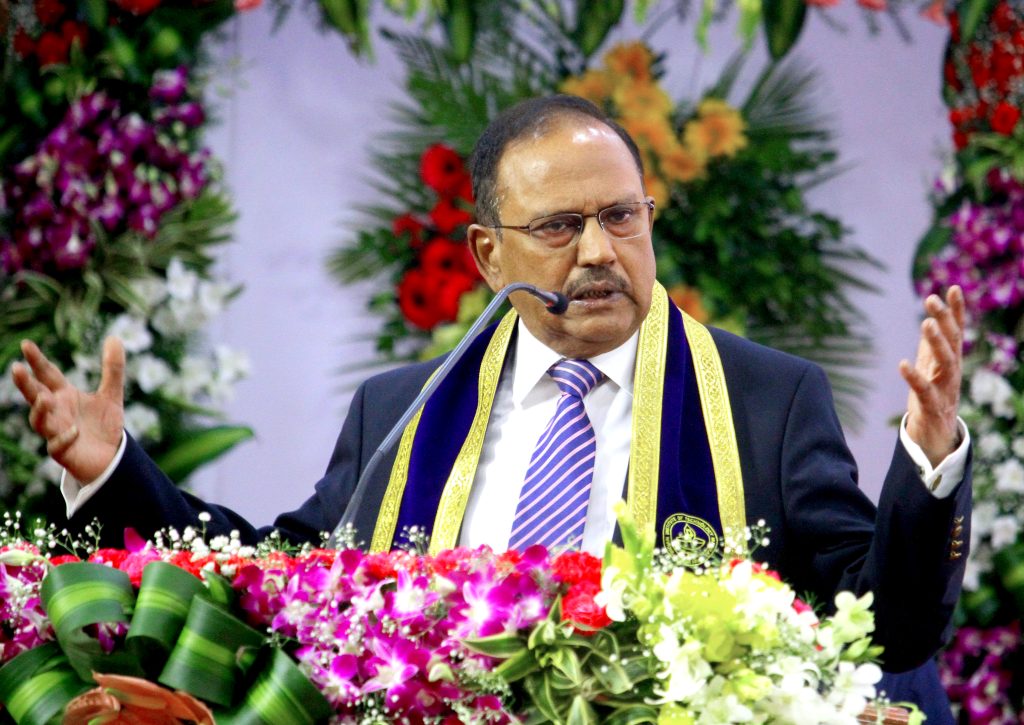
In a blistering speech at IIT Madras, India’s National Security Advisor Ajit Doval took aim not only at Washington’s claims but also at the Western media’s portrayal of Operation Sindoor. Doval challenged global outlets to present even a single image proving Pakistani claims of damage to Indian targets. “You tell me one photograph, one image, showing any Indian infrastructure hit? Even a glass pane?” he asked. By contrast, Doval highlighted satellite imagery released by the same outlets showing extensive damage at 13 Pakistani air bases, including strategic sites like Sargodha and Rahim Yar Khan.
The military details of Operation Sindoor back up Doval’s confidence. Following the April 22 Pahalgam terror attack, which killed 26 civilians and was aimed at reigniting sectarian violence and undermining peace in Kashmir, India launched a precise and time-bound airstrike campaign. Over a 23-minute window, BrahMos and Akash missiles were used to hit nine confirmed terror infrastructure sites deep inside Pakistan and Pakistan-occupied Kashmir. These included air bases, training camps, and command centers linked to groups like Lashkar-e-Taiba and its offshoot, The Resistance Front.
Defence analyst John Spencer called the operation a watershed moment in India’s counterterrorism doctrine. “It was not just retaliation—it was deterrence,” Spencer noted. “India now responds swiftly and clearly, not to escalate, but to prevent future violence.”
Spencer also pointed to Pakistan’s growing vulnerability, both military and political. With a crumbling economy, fractured civil-military relations, and global isolation, Islamabad found itself unable to sustain retaliation. The very groups it once nurtured—LeT and TRF—have become liabilities, especially as Indian-administered Kashmir has stabilized since the revocation of Article 370 in 2019. A record 23 million tourists visited the region last year, making it harder for terror outfits to sustain their grievance-based propaganda.
And yet, as India’s strategic messaging gains clarity, Western media and officials appear reluctant to let go of the old narrative: India as reactive, Pakistan as victim, and Washington as peacemaker. The foreign media’s framing of the conflict has drawn particular ire from New Delhi. Doval accused outlets of “bias” and selective reporting, noting that while they were quick to amplify Pakistani claims, they ignored verifiable damage caused by Indian strikes.
This is not the first time India has had to correct the record. After the 2019 Balakot strikes, global coverage often focused on the downing of an Indian pilot rather than the strategic depth of the operation. Today, India appears more prepared—both militarily and diplomatically—to assert its version of events.
The narrative war also reflects larger geopolitical shifts. As India becomes a more confident regional power, it is increasingly unwilling to be cast in roles written in Western capitals. The Modi government, and officials like Doval, are making it clear: India will define its own victories, set its own red lines, and tell its own story.
The fallout from Operation Sindoor has not just rattled Pakistan—it has unsettled an entire ecosystem that once relied on shaping global opinion through filtered lenses. As Ajit Doval put it, “We are capable. And we are not afraid to show it.”
In the battle for deterrence, Operation Sindoor may have ended in just three days. But the fight for narrative supremacy is far from over.