








Our Bureau
Boston, MA
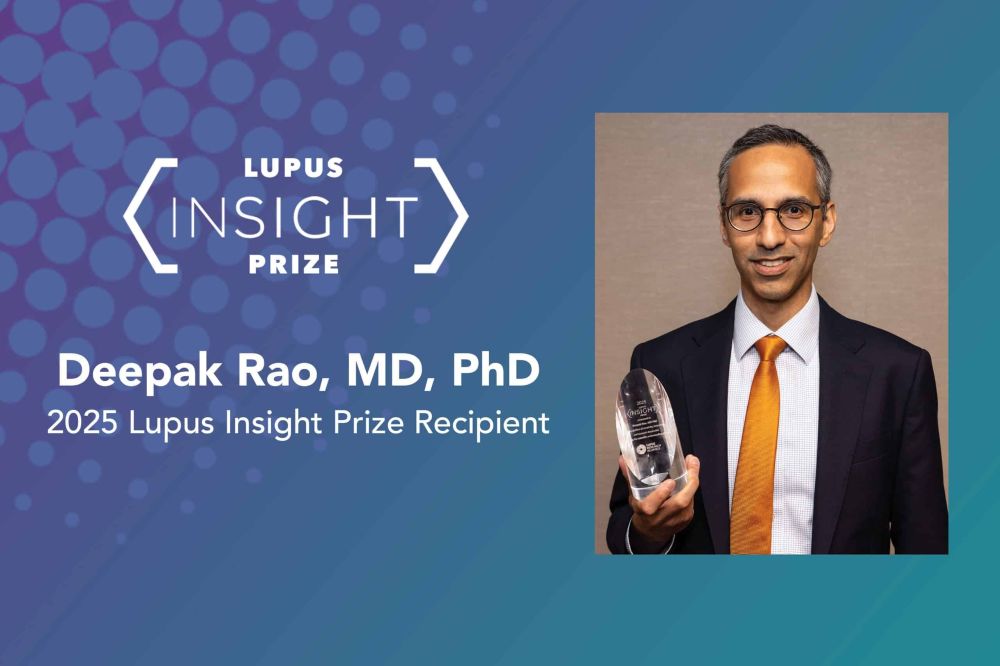
The Lupus Research Alliance (LRA) proudly awarded the 2025 Lupus Insight Prize to highly respected immunologist Deepak Rao, MD, PhD, Brigham and Women’s Hospital and Harvard Medical School. The Prize recognizes Dr. Rao’s pioneering and widely reported findings published in Nature, which reveal a previously unknown imbalance in key immune cells that contribute to lupus. The study sheds light on how this imbalance arises and identifies a potential target for restoring immune system regulation in people with the disease.
Dr. Rao was honored at the Federation of Clinical Immunology Societies (FOCIS) 2025 meeting in Boston, Massachusetts, in a ceremony chaired by Gary Koretzky, MD, PhD, Weill Cornell Medicine, and Co-Chair of the LRA Research Committee of the Board of Directors. The prestigious $100,000 Lupus Insight Prize is presented to outstanding investigators who have made significant scientific breakthroughs in the last five years that advance the understanding of lupus and have the potential to drive new lupus treatments.
“We’re starting to understand the core features of the immune response that gets activated in lupus,” noted Dr. Rao. “The Lupus Insight Prize will allow us to continue to identify key signals and pathways that drive the damaging immune response. We hope to use this knowledge to design new strategies to rebalance the immune system in patients with lupus to suppress damaging pathways and promote protective ones.”
Lupus is driven by an overactive immune system that mistakenly targets a person’s own cells and tissues. Dr. Rao’s research focuses on two types of immune cells—T peripheral helper (Tph) and T follicular helper (Tfh) cells—that help B cells produce antibodies. In close collaborative work between Dr. Rao and Dr. Jaehyuk Choi, MD PhD, a dermatologist and immunologist at UT Southwestern, Drs. Rao and Choi found that in lupus, these B-helper T cells are abnormally abundant, while another type of T cell, called Th22, is reduced. This imbalance contributes to excessive B cell activation and inflammation.
Their research identified a key factor behind this shift: a regulatory pathway involving the proteins AHR and JUN. Normally, AHR and JUN help maintain a balance between these T cell types, preventing excessive immune activation. However, in lupus, inflammatory signals—particularly from interferons—disrupt this regulation, reducing the number of protective Th22 cells and allowing harmful B-helper T cells to dominate.
By pinpointing this mechanism, the study results suggest that restoring AHR-JUN signaling could help rebalance the immune system and reduce lupus-related inflammation. This discovery provides a promising new direction for therapeutic development.
“The Lupus Insight Prize recognizes discoveries that have the power to change the course of lupus research,” said Teodora Staeva, PhD, Chief Scientific Officer at the LRA. “Dr. Rao’s work has uncovered a critical piece of the immune system’s dysfunction in lupus, bringing us one step closer to targeted therapies that can restore balance.”