








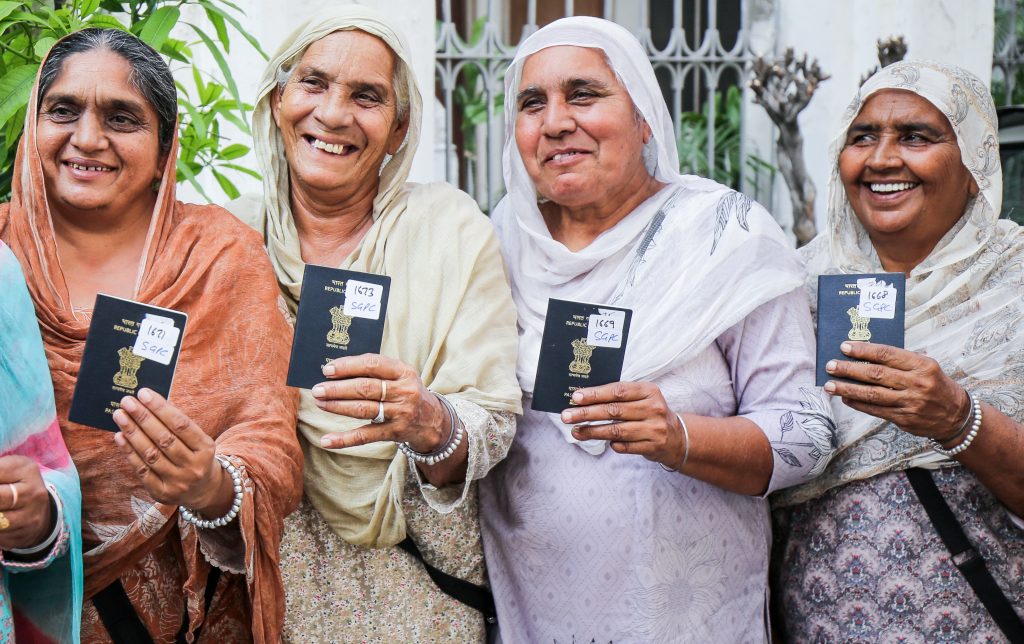
The Centre says a passport has never been conclusive proof of citizenship, but the clarification has triggered sharp political questions over how Indians establish their nationality.
Our Bureau
New Delhi
The Central government’s clarification that an Indian passport is not, by itself, proof of citizenship has ignited a fresh political controversy, with opposition leaders accusing the Centre of creating uncertainty over one of the most fundamental aspects of citizenship, while the government insists it has merely reiterated a long-established legal position.
The debate began after the Ministry of External Affairs (MEA), during a detailed media briefing, stated that an Indian passport is primarily a travel document and should not be treated as definitive proof of citizenship. The remarks immediately prompted criticism from opposition leaders, who questioned what documents ordinary citizens should rely upon to establish their nationality.
Seeking to quell the controversy, the government clarified on Thursday that it had neither introduced a new policy nor altered existing law.
According to the Centre, a passport has never been regarded as conclusive proof of citizenship, either recently or during the past 12 years. The government pointed to Section 20 of the Passports Act, 1967, which expressly allows the Central Government, in exceptional cases and in the public interest, to issue a passport or travel document to a person who is not an Indian citizen. It also cited a 2013 Bombay High Court judgment holding that possession of a passport does not, by itself, establish citizenship.
The clarification emphasized that the legal position has remained unchanged for decades and is rooted both in statute and judicial interpretation.
Nevertheless, the statement quickly snowballed into a wider political debate.
Rajya Sabha MP Kapil Sibal questioned the government’s messaging, asking what document ordinary Indians should now treat as proof of citizenship. In a post on X, Sibal wrote: “MEA June 24, 2026: ‘A passport is a travel document, and not a document of citizenship.’ Which document then is proof of citizenship? BLO can doubt my citizenship. Deprive me of my vote. Result BJP wins the election. Over to Supreme Court!”
His comments reflected concerns among opposition leaders that uncertainty over citizenship documentation could eventually affect electoral rolls or voter rights, although the government has made no announcement suggesting any such change.
The Bharatiya Janata Party rejected suggestions that the MEA’s statement represented a policy shift.
BJP IT Department head Amit Malviya argued that the Ministry had simply restated a settled legal principle already recognised by courts. “The MEA has not announced a new policy. It has merely reiterated a settled legal position,” Malviya wrote on X.
He noted that citizenship in India flows from the Constitution and the Citizenship Act, 1955, rather than from possession of any single government-issued document.
According to Malviya, Indian courts have consistently held that citizenship is determined through eligibility under the Citizenship Act and a range of supporting evidence rather than a single document. He said records such as birth certificates, parents’ citizenship records where applicable, school certificates, electoral rolls, government service records, land and residence documents and passports together may help establish citizenship.
“A passport is an important identity and travel document. It is evidence that may support a claim of citizenship. But citizenship itself flows from the Constitution and the Citizenship Act, not from the possession of any single government-issued document,” he wrote.
The issue has also drawn criticism from AIMIM president Asaduddin Owaisi, who accused the government of creating uncertainty over the citizenship status of ordinary Indians.
Speaking in Hyderabad, Owaisi questioned why citizens born in India should now face doubts regarding their nationality. “I am by birth and by choice, an Indian citizen. My generations and my grandfather’s grandfather was born over here. I feel that the government wants to retain the control to randomly ask any person, are you an Indian?” he said.
Owaisi also disputed the government’s interpretation of the Passports Act, arguing that passports are issued only after detailed police verification and therefore carry significant evidentiary value regarding citizenship.
“If you read the Passport Act 1967, it clearly says that a passport is not given to a non-Indian citizen and a passport is given only after a thorough police verification,” he said.
The controversy has revived memories of earlier nationwide debates over citizenship documentation during discussions surrounding the Citizenship Amendment Act (CAA) and the proposed National Register of Citizens (NRC). Although the present clarification relates specifically to the legal status of passports under the Passports Act, opposition parties fear it could fuel broader uncertainty over documentation requirements.
Legal experts have long distinguished between proof of identity, proof of nationality and proof of citizenship. A passport is internationally accepted as a travel document issued by a sovereign state, but in Indian law it has never been treated as the sole determinant of citizenship. Courts have consistently held that citizenship questions must be decided under the Citizenship Act using all relevant evidence rather than relying exclusively on one document.