








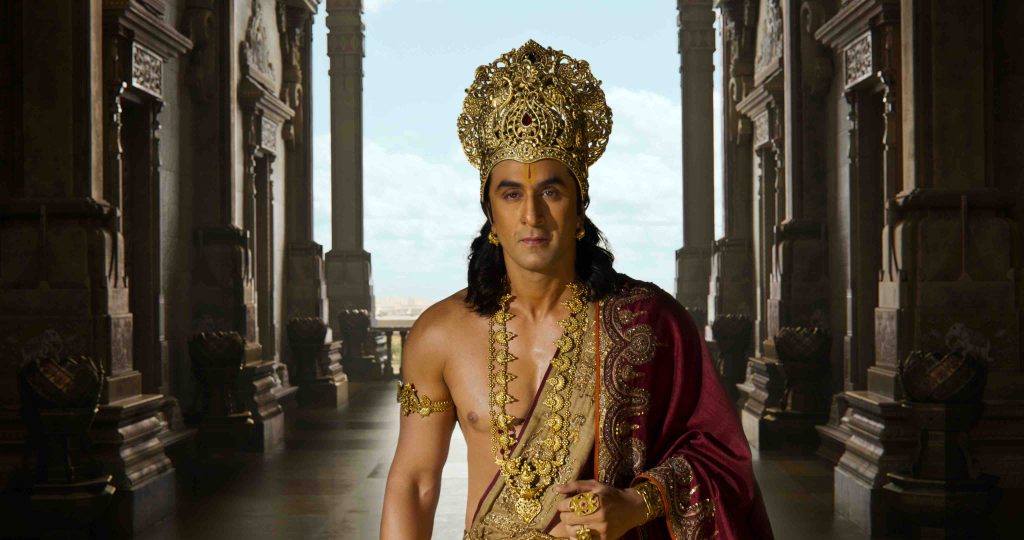
With a star-studded cast, unprecedented scale and a story deeply rooted in Indian culture, Nitesh Tiwari’s epic could become the biggest Indian film ever made.
Our Bureau
Mumbai
Indian cinema has always been drawn to mythology, but few projects have generated the kind of anticipation surrounding Nitesh Tiwari’s upcoming epic “Ramayana.” Even before its release, the two-part saga is being spoken of as a potential record-breaker capable of surpassing some of the biggest commercial successes in Indian film history.
The expectations are enormous. The film stars Ranbir Kapoor as Lord Rama, Sai Pallavi as Sita, Yash as Ravana, Sunny Deol as Hanuman and Ravie Dubey as Lakshman. Produced by Namit Malhotra’s Prime Focus Studios and DNEG, the project is reportedly being mounted on a combined budget of around Rs 4,000 crore, making it one of the most ambitious productions ever attempted in Indian cinema.
The first installment is scheduled for release during the Diwali holiday season on November 6, 2026, while the second part is expected to arrive a year later. Adding to the scale of the project is a music score by Oscar-winning composer Hans Zimmer alongside A.R. Rahman, a collaboration that has further heightened audience curiosity.
Trade analyst and exhibitor Vishek Chauhan believes the film possesses all the ingredients needed to achieve unprecedented box-office success. Speaking about the phenomenal performance of Aditya Dhar’s “Dhurandhar” franchise, which reportedly grossed more than Rs 3,300 crore worldwide, Chauhan argued that “Ramayana” could go even further.
“The buzz is very good, it is a subject very close to people’s hearts. The way Ranbir is looking and the kind of star cast the film has – including Sunny Deol, Yash, the director is also good. So, I have no doubt that the film will break records,” Chauhan said.
His confidence stems from more than just the cast. He believes the story itself gives the film an advantage few productions can match.
“And if that film is able to land, you’ll see that it will smash Dhurandhar’s record. The range of that film is crazy. People will come to the cinemas from everywhere, even from villages,” he added.
The potential audience for “Ramayana” is unusually broad. Unlike many modern blockbusters that primarily target urban multiplex viewers, the story of Rama, Sita, Lakshman and Hanuman is familiar across generations, regions and languages. The Ramayana is not merely a literary work; it is one of the foundational narratives of Indian civilization, retold through television serials, theatre, folk traditions and religious festivals for decades.
That cultural connection could become the film’s greatest strength.
Actor Ravie Dubey, who plays Lakshman, highlighted the deep bond between the epic and Indian society. “Bharat aur Ramayana ek dusre se alag nahi hai… they are one,” he said while discussing the project.Dubey described the Ramayana as India’s heritage and said the filmmakers are striving to do justice to the material. “Yeh hamara itihaas hai, darohar hai… and the more we can work on it, the more we will try to do justice to it within our abilities. It has been an amazing experience,” he said.
The challenge, however, is not simply attracting viewers but meeting their expectations.
Recent history offers both encouragement and caution. Mythological and historical spectacles have demonstrated enormous commercial potential in India. Films such as “Baahubali 2: The Conclusion,” “RRR,” “Kalki 2898 AD” and “Dangal” showed that Indian audiences are willing to support large-scale cinematic events when storytelling, emotion and spectacle come together.
At the same time, audiences have become increasingly demanding when it comes to adaptations of revered cultural texts. Chauhan pointed to “Adipurush” as an example. Despite generating significant pre-release excitement and a strong opening, the film struggled to maintain momentum because many viewers felt it failed to connect emotionally with the source material.
“It just has to land properly and connect with the audience. Like Adipurush couldn’t connect with people. It missed the mark,” Chauhan said.
Yet even that experience reinforces his optimism. “But still, it had an amazing opening,” he noted, arguing that the appetite for stories from the Ramayana remains enormous.
The filmmakers appear aware of those expectations. Dubey stressed that the project is being approached with sincerity rather than simply commercial ambition.
“We are making the film with faith. You wait with faith,” he said.
Ultimately, the box-office fate of “Ramayana” may depend on a simple question: can it combine technological excellence with emotional authenticity?
If it succeeds, the film could attract family audiences, religious viewers, young moviegoers and international Indian diaspora communities on a scale rarely seen before. The combination of cultural resonance, star power, visual spectacle and nationwide appeal gives it a unique opportunity to transcend traditional box-office boundaries.
As Chauhan put it, “Sky is the limit with Ramayana.”
For Indian cinema, that may prove less a prediction than a possibility.