

From arguing his own case to targeting institutions, AAP chief reasserts political relevance amid legal scrutiny.
Our Bureau
NEW DELHI
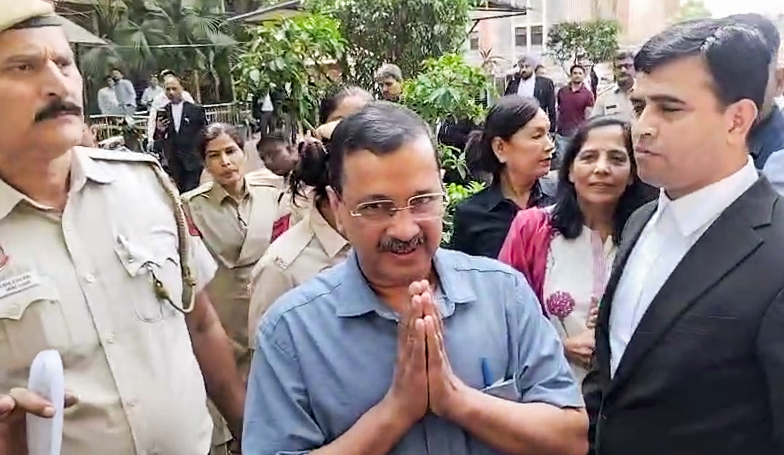
At a time when legal challenges and political confrontations are intensifying, Arvind Kejriwal has thrust himself back into the national spotlight, blending courtroom strategy with sharp political messaging to reclaim centre stage in India’s political discourse.
The immediate trigger has been the high-profile proceedings in the Delhi excise policy case, where Kejriwal has taken the unusual step of appearing in person before the Delhi High Court to argue a plea seeking recusal of Justice Swarana Kanta Sharma. The move has not only elevated the legal battle into a political spectacle but also signalled a shift in Kejriwal’s approach — from defensive positioning to direct engagement.
In court, Kejriwal maintained that he had followed due procedure in filing the recusal application, even as he pointed out “procedural limitations for litigants appearing in person in e-filing.” His decision to argue the matter himself has drawn attention, reinforcing an image of personal stake and direct accountability in a case that has significant political implications.
However, the response from investigators has been equally forceful. The Central Bureau of Investigation (CBI) has opposed the plea, calling it “frivolous, vexatious and baseless” and warning that such attempts could undermine the dignity of the judiciary. It argued that the application was based on “conjectures and surmises” and did not meet the threshold required to question judicial impartiality, adding that entertaining such pleas could encourage “bench hunting” and erode judicial independence.
The courtroom exchanges have thus become a key arena where Kejriwal is reasserting his presence. By directly engaging with the legal process — rather than relying solely on counsel — he has transformed a procedural dispute into a public narrative about fairness, process and institutional accountability.
This is not without risk. Solicitor General Tushar Mehta, appearing for the CBI, sharply criticised the move, stating that the plea was “frivolous” and based on vexatious allegations. He cautioned that the courtroom is “not a forum for theatrics,” adding that if Kejriwal wished to argue in person, he must first discharge his counsel. Such remarks reflect the institutional pushback against what is being seen as an attempt to politicise judicial proceedings.
Yet, politically, the optics work in Kejriwal’s favour. In an environment where legal battles often unfold behind closed doors, his visible participation creates a perception of confrontation with powerful institutions — a narrative that has historically resonated with his political base.
Parallel to the courtroom strategy, Kejriwal has sharpened his political messaging. In a strongly worded public statement, he targeted the Election Commission of India (ECI), suggesting that there was no longer any need to state that the poll body was “working under the BJP.” “This is now out in the open and extremely unfortunate,” he said, while also cautioning against publicly tarnishing the reputation of such an institution.
The convergence of legal and political fronts is central to understanding Kejriwal’s renewed visibility. The excise policy case — involving alleged irregularities in the now-scrapped Delhi Excise Policy 2021-22 — has already drawn in several leaders of the Aam Aadmi Party (AAP), including former Deputy Chief Minister Manish Sisodia. The stakes, therefore, extend beyond individual accountability to the credibility of the party itself.
The CBI has underscored this by emphasising the need for expeditious handling of cases involving elected representatives, citing the importance of maintaining public confidence in democratic institutions. It argued that interim observations by courts are tentative and cannot be construed as bias, rejecting the basis of the recusal plea.
Even as the legal arguments unfold, the political narrative continues to evolve. By appearing in court and simultaneously launching public critiques, Kejriwal is effectively bridging two arenas — law and politics — to sustain visibility. The strategy ensures that the case remains not just a legal matter but a subject of public debate.
There is also a tactical dimension to this approach. The High Court has allowed other parties to file similar recusal pleas and directed the CBI to respond within a short timeline, ensuring that the issue remains in active consideration. Meanwhile, earlier attempts to transfer the case were declined, with the Chief Justice noting that any decision on recusal rests with the concerned judge. This keeps the focus squarely on the ongoing proceedings — and by extension, on Kejriwal himself.
In effect, what might have remained a technical legal dispute has been amplified into a high-visibility confrontation. The combination of personal courtroom advocacy, institutional critique and sustained political messaging has brought Kejriwal back into the limelight at a critical juncture.