








Voter-approved process will speed up affordable housing development in neighborhoods that have produced the least.
Our Bureau
New York, NY
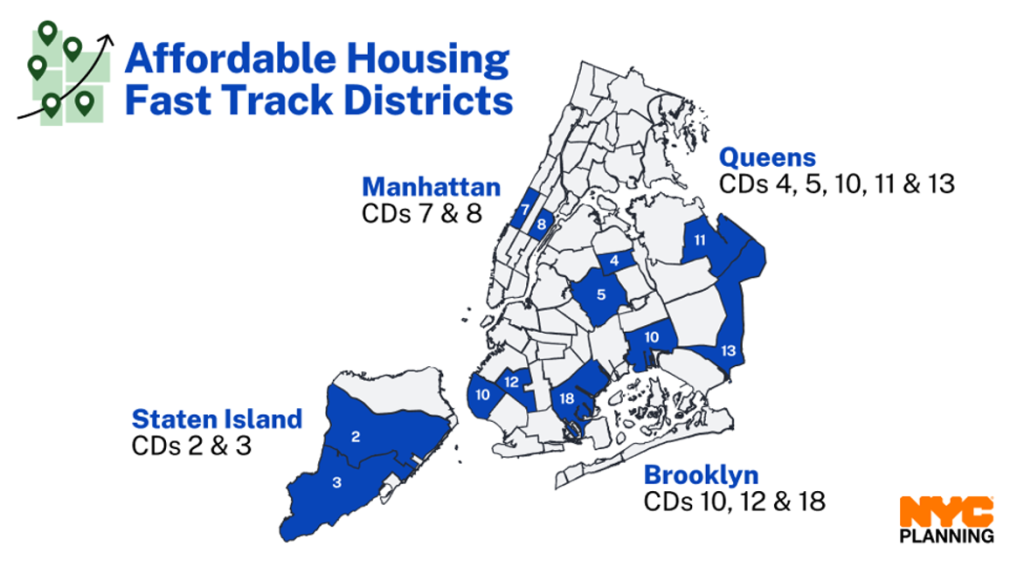
The Mamdani administration is putting 12 New York City neighborhoods on a fast track for affordable housing, moving to speed up development in communities that have produced the least amount of affordable housing in recent years.
Mayor Zohran Kwame Mamdani and Department of City Planning (DCP) Director Sideya Sherman announced the 12 community districts where the voter-approved Affordable Housing Fast Track will take effect in January 2027, bringing the city one step closer to a housing system where every neighborhood does its part to meet the needs of New Yorkers.
The 12 districts are Brooklyn Community District 10, covering Bay Ridge and Dyker Heights; Brooklyn Community District 12, covering Borough Park and Kensington; Brooklyn Community District 18, covering Canarsie and Flatlands; Manhattan Community District 7, covering the Upper West Side; and Manhattan Community District 8, covering the Upper East Side and Roosevelt Island.
The list also includes Queens Community District 4, covering Corona and Elmhurst; Queens Community District 5, covering Ridgewood, Maspeth and Middle Village; Queens Community District 10, covering South Ozone Park and Howard Beach; Queens Community District 11, covering Auburndale, Bayside and Douglaston; and Queens Community District 13, covering Queens Village, Bellerose and Rosedale. Staten Island is represented by Community District 2, covering Mid-Island, and Community District 3, covering the South Shore.
The 12 Fast Track districts represent roughly one-fifth of New York City’s 59 community districts but produced just 883 of 63,870 new affordable homes over the past five years, or 1.1 per cent of the citywide total. On average, the districts produced just 12 affordable homes per district per year.
The four lowest-producing community districts each produced fewer than 10 affordable homes over five years. The highest-producing district created eight times as many affordable homes as all 12 Fast Track districts combined. The AHFT summary dataset is available here.
“For too long, affordable housing production has been concentrated in a small number of neighborhoods, while other communities have produced little or none,” Mamdani said. “The 12 Fast Track districts represent roughly one-fifth of New York City’s 59 community districts but produced just 883 of 63,870 new affordable homes over the past five years — 1.1% of the citywide total.”
“New York’s housing crisis is not going to be solved by asking the same neighborhoods to do all the building,” said Mayor Mamdani. “Every New Yorker deserves a home they can afford, and every neighborhood must be part of delivering it. The Affordable Housing Fast Track gives us a new tool to cut through red tape and make sure our housing growth is shared more fairly across all five boroughs. We are going to build – block by block, neighborhood by neighborhood — at the scale this crisis demands.”
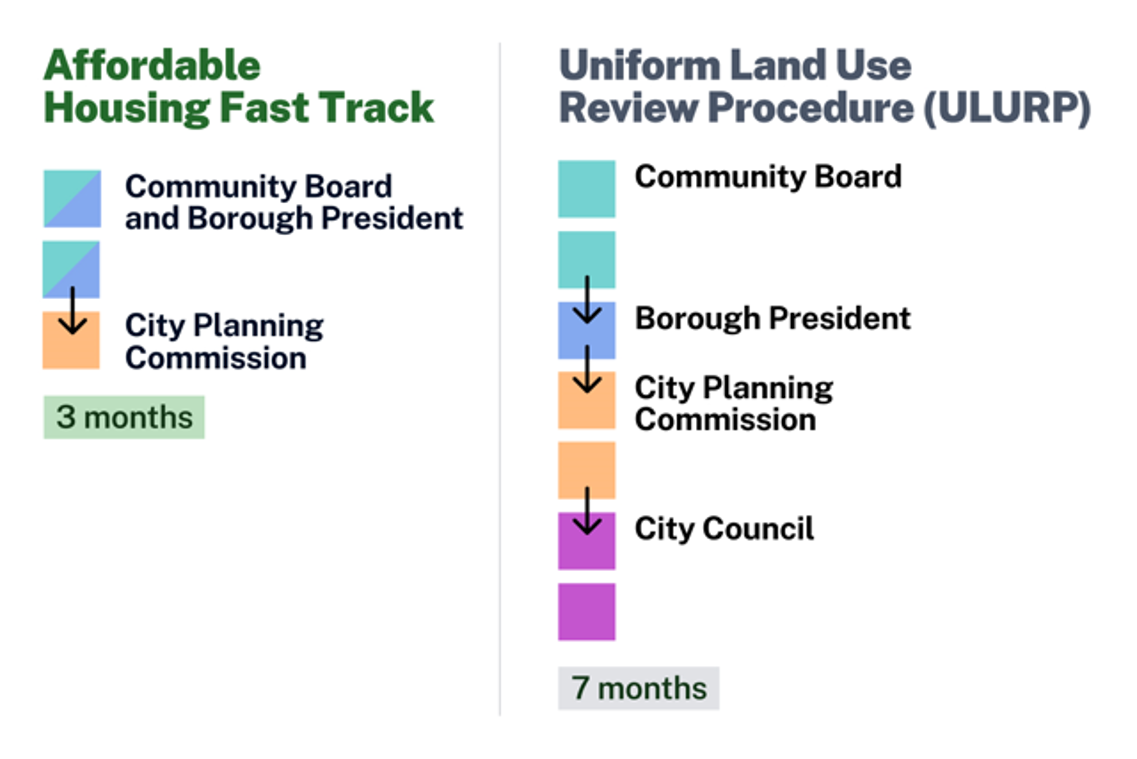
The initiative follows a vote in November 2025, when New York City voters approved changes to the City Charter to address the uneven distribution of affordable housing. Beginning January 1, 2027, eligible rezoning proposals that create affordable housing in the 12 designated districts will use a streamlined 90-day public review process, cutting roughly four months from the traditional Uniform Land Use Review Procedure, or ULURP.
The Fast Track preserves Community Board and Borough President review and opportunities for public input. It does not change environmental review requirements or landmark protections.
“Last November, New Yorkers went to the polls and delivered a mandate for affordability. We’ve moved quickly to implement these new tools like the Affordable Housing Fast Track, with clear criteria for where it will apply. Soon, it will be easier to build affordable housing in the districts that have added the least — an important step in our work to deliver the housing options in every neighborhood that New Yorkers deserve,” said Leila Bozorg, Deputy Mayor for Housing and Planning.
The Mamdani administration moved quickly to put the Fast Track into action, adopting a clear and consistent methodology in April to measure affordable housing production relative to each community district’s existing housing stock. The 12 districts will be recalculated every five years based on updated affordable housing production, with the next list issued in October 2031.
“For too long, affordable housing production has been deeply uneven across New York City, leaving too many New Yorkers with too few choices about where they can live,” said DCP Director Sideya Sherman. “The Affordable Housing Fast Track gives us a new tool to help change this by making it easier to advance permanently affordable housing in communities that have produced the least. We look forward to using this tool to expand housing opportunities across these 12 districts and bring meaningful housing relief to New Yorkers.”
Housing Preservation and Development Commissioner Dina Levy said the initiative would give every neighborhood a role in addressing the city’s affordability problems.