








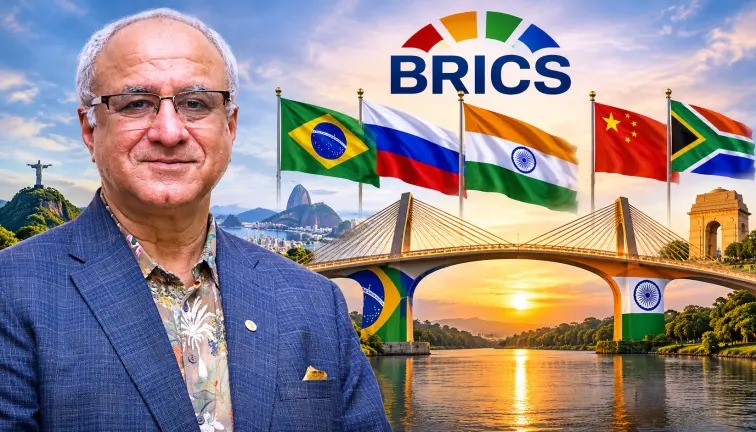
In an interview with Indian journalist Shobhan Saxena, the New Delhi-based political commentator highlights the alignment between Lula and Modi, the strengthening of BRICS and plans to launch a Global South Institute hub in India.
The rise of emerging economies and the restructuring of the international geopolitical order have made any world order that excludes developing countries untenable. This is the assessment of Indian journalist, political commentator and community leader Munish Gupta, the inaugural guest on the Global South Podcast — the first English-language programme produced in Brazil by TV 247 in partnership with the Global South Institute, an initiative conceived by journalist Leonardo Attuch.
Speaking directly from New Delhi, Gupta spoke with Indian journalist Shobhan Saxena, a Brasil 247 columnist based in São Paulo who hosts the programme. During the interview, the analyst highlighted that Global South nations represent around two-thirds of the world’s population and now have sufficient economic, demographic and technological weight to demand an active voice in global decision-making, breaking away from the old paternalistic approach of Western powers.
“Global South countries account for almost two-thirds of the world, and without these two-thirds, there can be no good world order in any sense. The voices of the Global South, led by the original founders of IBSA — India, Brazil and South Africa — are not only relevant but vital for the Global North itself to look at its future, because if they exclude us from their future, they will have no future,” Gupta said.
Crisis of Western institutions and the role of IBSA and BRICS
According to Munish Gupta, traditional Western-led forums such as the G7, as well as the UN Security Council itself, are facing a crisis of legitimacy and effectiveness because of decision-making paralysis and their refusal to incorporate emerging powers such as India — the world’s largest democracy and most populous country — and Brazil, Latin America’s largest economy and democracy.
Against this institutional vacuum, the commentator stressed that IBSA (India, Brazil and South Africa) remains the strategic core that drove the creation and recent expansion of BRICS — now enlarged to 11 full members and dozens of partner countries. According to him, the bloc has consolidated itself as the main platform for Global South coordination to promote shared prosperity, inclusive development and the peaceful resolution of international conflicts.
Lula-Modi alignment drives Brazil-India partnership
Analysing bilateral relations between Brasília and New Delhi, Gupta emphasised the strong political and personal rapport between President Luiz Inácio Lula da Silva and Prime Minister Narendra Modi, reinforced by reciprocal visits in recent years and Lula’s recent re-election — welcomed enthusiastically in India as a guarantee of continuity and stability in Global South cooperation.
In the analyst’s view, trade between Brazil and India has the potential to double in the coming years, moving beyond the traditional commodities agenda to advance cooperation in high technology, defence, aviation — including partnerships involving Embraer —, energy, agriculture, university exchanges and financial integration, an area in which both countries are global references with systems such as Brazil’s PIX and India’s UPI.
Gupta also highlighted the geographical and strategic complementarity between the two giants: while Brazil serves as a natural gateway for India into South America and Latin America, India acts as a privileged bridge for Brazil’s engagement with Asia and ASEAN countries.
Building their own narrative and expanding the Global South Institute
A veteran of the communications industry with experience in India, the United States and the international arena, Munish Gupta pointed out that consolidating a new multipolar order also requires emerging countries’ media outlets to build their own narratives, moving beyond stereotypes propagated by mainstream Northern media.
In this regard, he praised Leonardo Attuch’s creation of the Global South Institute as an enabling platform capable of connecting universities, think tanks, policymakers and journalists across Latin America, Asia and Africa. Gupta revealed that he is already holding advanced discussions with diplomats and research centres in New Delhi to establish a base for the institute in India in the coming months, with plans to expand the network to South Africa as well, identifying 2027 as a decisive year for consolidating this international movement.