








Updated financial plan projects $683 million in additional savings over two fiscal years, with investments in public health, safety and emergency response
Our Bureau
New York, NY
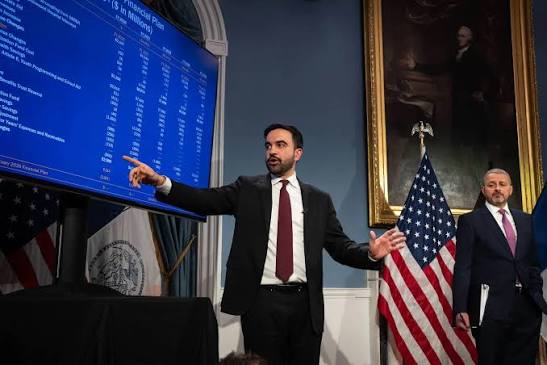
New York City Mayor Zohran Kwame Mamdani on Friday released an updated financial plan that reduces the projected Fiscal Year 2028 budget gap by $257 million and identifies $683 million in additional savings over the next two fiscal years, while maintaining investments in essential public services.
The November 2026 Financial Plan Update reflects increased revenue collections, savings across city agencies and targeted spending on public health, safety, emergency response and government efficiency. It also addresses the impact of federal funding cuts.
The administration said it was committed to tackling the city’s structural budget challenges without balancing the books through cuts to services relied upon by working New Yorkers.
Upon taking office, Mamdani faced one of the largest structural budget crises in modern city history, driven by years of underbudgeting for core services and long-term obligations. His administration has since focused on identifying savings, securing new revenue sources through a partnership with Albany and reversing longstanding budget cuts and funding shifts. It has also worked with the City Council to reduce the Unincorporated Business Tax credit for high-income New Yorkers.
“New Yorkers deserve a government that works as hard as they do, and that is as careful with their money as they are,” Mamdani said. “Our budget proves that fiscal responsibility and public excellence go hand in hand.”
The mayor said the administration was investing in essential services while pursuing an aggressive savings programme to strengthen the city’s financial position.
The Fiscal Year 2027 (FY27) budget now stands at $129.2 billion, an increase of $3.3 billion from the adopted budget. Of this increase, approximately $1.15 billion comes from city funds, $1.48 billion from federal funds and $635 million from state funds. The administration said the increase in non-city funding largely reflected routine budget adjustments normally recognised at this stage of the fiscal year.
The projected FY28 budget gap has fallen to $6.2 billion, down $257 million since the FY27 budget was adopted in June. The gaps for FY29 and FY30 stand at $8.7 billion and $9 billion, respectively.
The financial plan also factors in an additional $965 million in FY27 tax revenue, driven by higher collections since the June budget adoption and strong performance on Wall Street.
The city’s FY27 reserves total $7.8 billion. The administration is also developing a formal methodology for calculating annual deposits into the Rainy Day Fund, following the approval of Proposal 5 from the Mayor’s Commission on Government Efficiency (COGE), which received almost 73 per cent of the vote.
Mamdani has made agency-level savings a central part of his fiscal strategy. Within his first month in office, he issued an executive order directing every city agency to appoint a Chief Savings Officer to improve efficiency, streamline services and ensure responsible use of taxpayer money.
During the administration’s first budget cycle, the officers identified $1.77 billion in savings across FY26 and FY27. In July 2026, the mayor announced another round of savings targets, directing agencies to identify savings of 2.5 per cent in FY27 and FY28, as well as in subsequent fiscal years.
The November financial plan identifies $683 million in debt service and agency savings across FY27 and FY28. Measures include consolidating city office space, reducing dependence on outside consultants, bringing services in-house, improving grant claims and revising contract spending projections.
The administration said it would provide a further update on its savings efforts in the FY28 Preliminary Budget. It has also made an $845 million prepayment towards FY28 obligations, drawing on savings, higher revenue collections and continued fiscal discipline.
Among the new investments is $25.2 million in FY27 to strengthen the city’s Code Blue response to extreme weather. The funding will support additional outreach teams, nurses and vehicles, while expanding warming-site capacity to connect homeless New Yorkers with shelter and other assistance. The allocation will rise to $25.9 million by FY30.
The city will also spend $600,000 in FY27 to add 10 full-time and five part-time citywide incident coordinators to strengthen emergency response. They will be among the first city representatives deployed to emergency scenes and coordinate field operations with City Hall, the Emergency Operations Center and agency leadership. The annual allocation will increase to $1.2 million from FY28.
Other investments include $48.3 million in FY27 to improve operations and conditions at the Crossroad and Horizon juvenile detention facilities, strengthen alternatives to detention and reduce recidivism. The funding is projected to increase to $70.2 million by FY30.
The plan also allocates $500,000 in FY27 to strengthen the city’s detection, enforcement and response efforts against Legionella bacteria in cooling towers. The investment follows community clusters on the Upper East Side and in the South Bronx earlier this summer and will support additional laboratory staff to accelerate testing.
A further $7.2 million in FY27 will support public health services, including operations at the new Central Harlem Sexual Health Express Clinic, additional community health workers and other public health clinic operations. The allocation will decline to $6.1 million annually from FY28.