








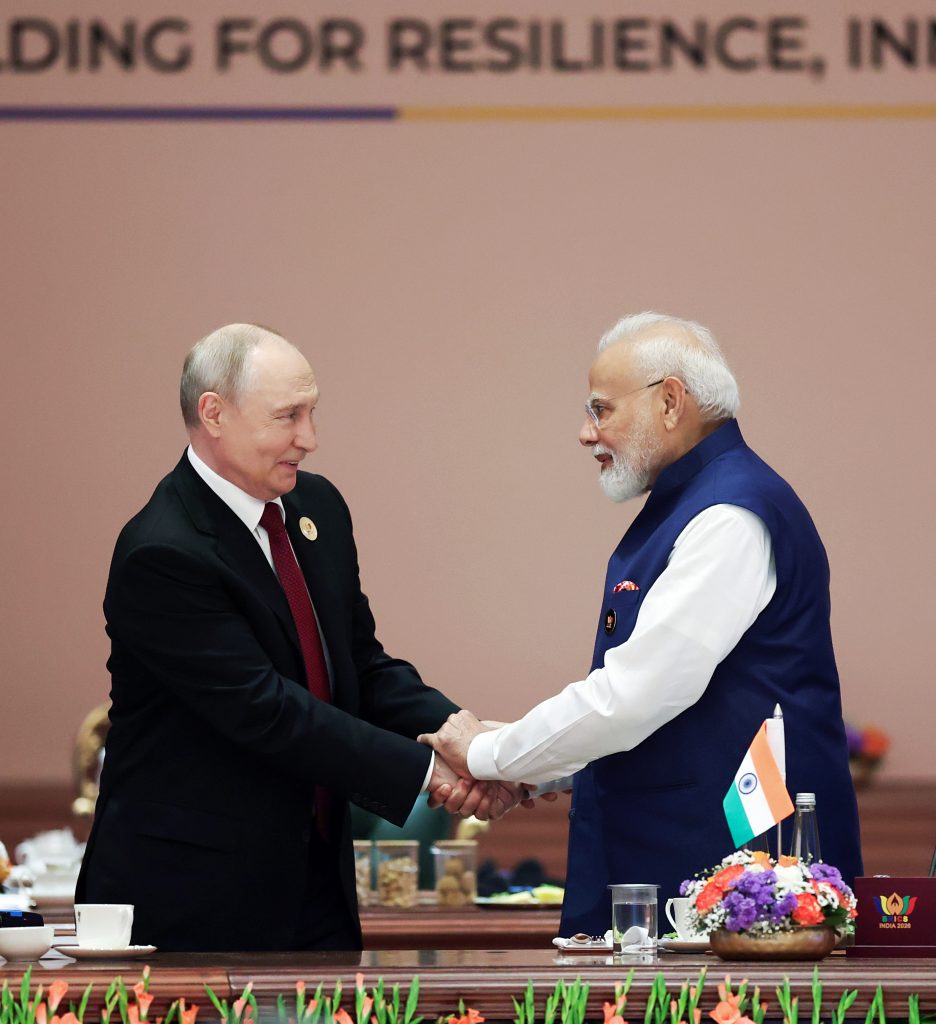
Washington’s push to penalise countries buying Russian energy raises a larger question: can pressure on India weaken Moscow without imposing wider costs on global energy security and the India-US relationship?
Our Bureau
Washington, DC / New Delhi
NEW DELHI — The debate over Russian oil has moved from geopolitics to a difficult question of economic statecraft: should countries such as India be penalised for buying Russian crude, or should the focus remain on reducing Russia’s energy revenues without forcing major consumers into abrupt changes in supply?
The question has gained urgency after the US Congress advanced legislation giving President Donald Trump authority to impose tariffs of up to 100 per cent on countries continuing to purchase Russian petroleum or natural gas. Former US National Security Adviser Lt Gen HR McMaster has argued that Washington should use such economic pressure to raise the cost of Russia’s continuing war in Ukraine.
But India is not a European country with the same geographical relationship to the Russia-Ukraine conflict. Its energy requirements are enormous, while its crude oil production remains insufficient to meet domestic demand. For New Delhi, therefore, Russian crude is part of a wider strategy of securing supplies from multiple sources and keeping energy available at affordable prices.
Former diplomat Ashok Sajjanhar told reporters that India’s overriding concern would remain energy security and that Russian crude had become an important component of its supplies. He noted that Russian oil, which accounted for relatively little of India’s imports before February 2022, subsequently rose substantially, reaching about 45 per cent in July and August according to his assessment.
This creates the central contradiction in the sanctions debate.
Washington wants to make Russian energy exports less profitable. India wants to ensure that 1.4 billion people have reliable access to energy at reasonable prices. Both objectives can be understood as legitimate national interests, but they do not necessarily point in the same direction.
There is also a question about what happens to the global oil market if large quantities of Russian crude are suddenly removed from international trade. Sajjanhar warned that a substantial reduction in Russian supplies could push up international energy prices, including refined petroleum products.
That possibility complicates the argument that sanctions automatically produce the desired result. If Russian barrels disappear from the market, prices could rise. Higher prices could increase the cost of transport, manufacturing and food production well beyond Russia and potentially create inflationary pressure in economies that are themselves trying to reduce dependence on fossil fuels.
There is another issue: India’s relationship with Russia extends well beyond oil.
Russia remains an important Indian defence partner, with longstanding cooperation involving military platforms, technology, engines, spare parts and components. McMaster himself acknowledged this complexity. While supporting tougher measures against major buyers of Russian energy, he said Washington should have “sympathy” for India’s circumstances and questioned whether the US really wanted to alienate Russia at a time when India faces security challenges involving both China and Pakistan.
His comments expose an important tension within the American approach. Washington wants to increase pressure on Moscow, but it also wants India to remain a major strategic partner in the Indo-Pacific. McMaster explicitly argued that the US should not pressure India to take sides against Russia or abandon groupings such as BRICS.
There is also the question of Western consistency.
McMaster criticised continued US reliance on Russian uranium, calling it “nuts”, while acknowledging that supply-chain realities could lead to waivers for critical dependencies. That admission illustrates the difficulty of designing sanctions that are simultaneously comprehensive, enforceable and economically sustainable.
For India, the issue is therefore not simply whether Russian oil should be bought. It is about who bears the cost of changing that policy and how quickly it can be done.
India can continue diversifying its energy sources, including supplies from the United States and the Middle East, while maintaining its stated priority of energy security. Washington, meanwhile, faces a choice between applying maximum economic pressure on every major Russian-energy buyer and pursuing a more differentiated strategy that takes individual countries’ circumstances into account.
The effectiveness of sanctions ultimately depends not only on their severity but also on their ability to change behaviour without producing consequences that undermine wider strategic objectives.
For the United States, the challenge is to pressure Russia without unnecessarily damaging relations with India. For India, the challenge is to protect energy security while managing the geopolitical consequences of its Russian purchases.
The Russia oil debate, therefore, is bigger than oil. It is a test of whether economic pressure can be calibrated to the realities of an increasingly multipolar world — and whether strategic partnerships can survive when national interests do not always align.