








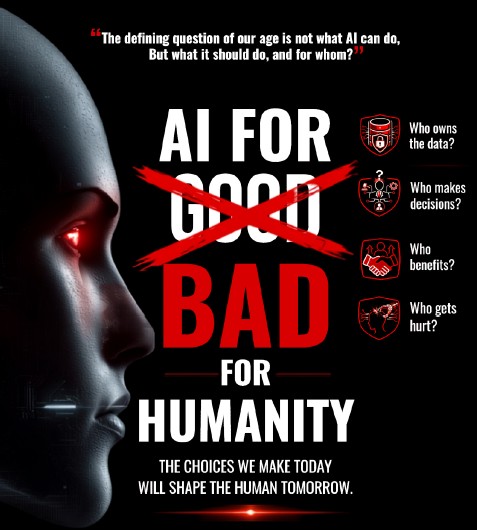
AI for Bad: The Darker Side of Artificial Intelligence turns out to be a landmark book that stands out for its intellectual rigor, balance and commitment to evidence in the heated debate over artificial intelligence.
Professor N K Goyal and Dr. Govind Pathak, the authors, argue that Artificial Intelligence is no longer a futuristic abstraction but a gigantic force shaping our economies, our relationships, and even our sense of self. The book’s foreword is written by Ravi Sharma, President, IIT Alumni Council.
The book refuses to take the easy route of either hype or hysteria. Instead, it delivers a challenge: the harms of AI are now too specific, too well-documented, and too consequential to be dismissed as mere side effects of progress, inviting readers to engage in a more nuanced and structured public conversation.
The Evidence Is In: Harms Are Real, Not Hypothetical
With a methodical and transparent approach, the book organizes the AI debate into six domains of harm—criminal misuse, algorithmic dehumanization, psychological dependence, job displacement, accountability voids, and the economics of the AI boom, based on peer-reviewed research, incident databases, litigation records and regulatory filings.
- Criminal misuse—AI is powering deepfakes, scams, and extremist content at a scale and speed previously unimaginable. Tools like FraudGPT and DarkGPT are not science fiction; they are subscription services for cybercrime.
- Algorithmic dehumanization—People are reduced to data points, with AI systems reinforcing stereotypes and stripping away agency, often without transparency or recourse.
- Psychological dependence—AI companions and chatbots foster addiction, overreliance, and even delusional thinking, with tragic cases linking chatbot interactions to suicide, especially among youth and people with mental health conditions.
- Job displacement—AI is not eliminating jobs wholesale, but it is erasing the entry-level jobs that once allowed young workers to climb the career ladder, threatening long-term economic mobility.
- Accountability void—When harm occurs, responsibility is diffused across developers, deployers, and users, leaving AI largely without accountability, so the human cost becomes an unavoidable consequence.
- Unsustainable investment—With more than 5 trillion dollars in projected infrastructure buildout, AI is outpacing demonstrated returns and raising the specter of a financial bubble whose costs may ultimately fall on workers, consumers, and the public.
The Benefits Are Real—But So Is the Responsibility
The book does not call for a ban on AI. It acknowledges genuine advances: productivity gains, medical breakthroughs, accessibility improvements and scientific discoveries. But it insists that these benefits do not cancel out the harms. Instead, the authors raise the stakes: if AI is here to stay, humans must decide what kind of AI to build, and what AI owes society in return.
The Core Question: Who Decides, Who Benefits, Who Pays?
The defining question is not what AI can do, but what it should do, for whom and at whose expense. The evidence shows that harms concentrate on the most vulnerable: children, isolated individuals, entry-level workers, primarily those with the least power to shape how AI is deployed. Meanwhile, the benefits and wealth generated by AI risk being captured by a small number of institutions and investors, a concentration that may prove unsustainable once future revenues fail to match today’s projections.
What Needs to Change—Now
- Shared accountability—Developers, deployers, regulators, investors, workers, and users must all take responsibility. No more passing the buck.
- Regulation that keeps pace—Reactive, litigation-driven responses are not enough. We need proactive, risk-tiered regulation that anticipates harm and enforces real standards, especially for products reaching minors and vulnerable groups.
- Transparency in decision-making—Black-box systems must be opened to scrutiny. If a system can’t be explained, it shouldn’t be making consequential decisions about people’s lives.
- Economic justice—AI-generated wealth must be more broadly shared and AI must help entry-level job aspirants to create an enterprise.
- Global perspective—AI’s harms and benefits are not distributed evenly across regions or languages of the world. Policy must reflect this regional diversity and socio-economic deviations and refrain from imposing a universal template.
The Debate Humans Need
AI for Bad does not offer a final verdict. Instead, it provides a framework for structured, evidence-based debate. It is “built to be argued with” and that is precisely what we humans need. What it demands is a willingness to confront both realities, quantified harms and real benefits, before acting decisively. The only unacceptable response is inaction.
The choices we make today will shape whether AI becomes humanity’s greatest ally or its unintended adversary. Let Human Goodness be the guiding force behind the AI, aptly put forward by Ravi Sharma.