








The BJP’s outreach to reservation opponents reflects a delicate political balancing act as it tries to retain upper-caste support without alienating the Dalit and OBC voters central to its electoral coalition
Our Bureau
New Delhi
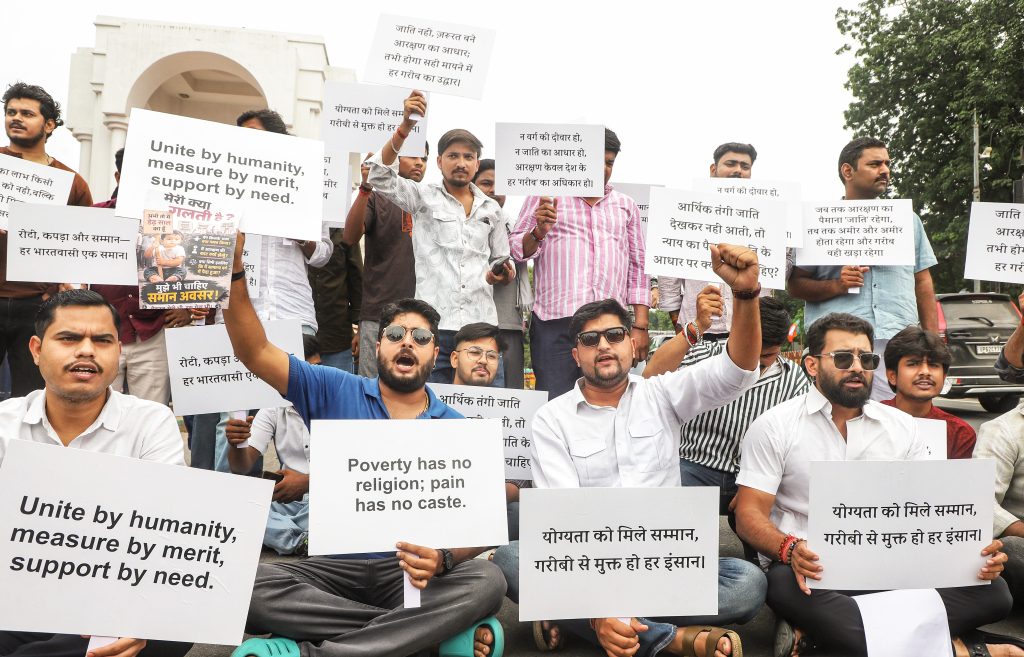
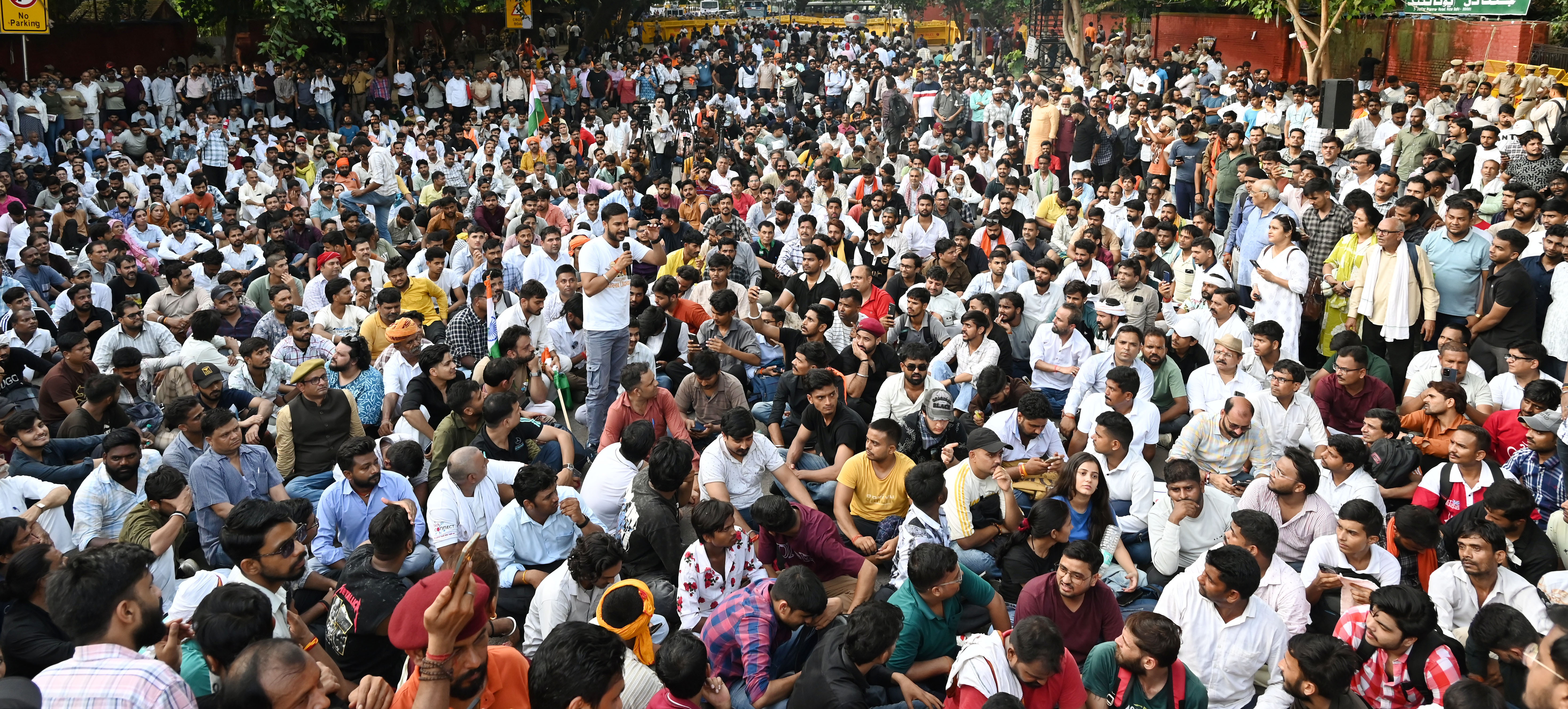
The meeting between Union Minister J.P. Nadda and representatives of the Reservation Hatao Andolan (RHA) comes at a politically sensitive moment for the Bharatiya Janata Party, particularly as caste remains one of the most consequential factors shaping electoral politics in Uttar Pradesh. Nadda’s decision to engage with activists who organized the August 21 demonstration at Jantar Mantar does not mean that the BJP is moving towards supporting the abolition of reservation. Rather, it reflects the party’s attempt to understand and contain a growing sentiment among sections of young, largely upper-caste Indians who believe that the existing system needs substantial reform.
Nadda said on Thursday that he had held “cordial discussions” with Harsh Dubey, Ran Bahadur Singh Chauhan and Mrityunjay Pathak, members of the team associated with the movement, and added that “we will meet again soon.” The meeting followed a protest under the banner of Reservation Hatao Andolan, where demonstrators demanded a review of caste-based reservations and argued that quotas in education and employment should be determined by income rather than caste. They also called for a “one family, one reservation” policy and demanded the withdrawal of the UGC’s 2026 caste-equity directives.
The BJP’s willingness to talk to the protesters is significant because the anger behind the movement cannot simply be dismissed as an isolated upper-caste reaction. It taps into a longstanding grievance among sections of young Indians who are competing for a limited number of government jobs and seats in educational institutions and who believe that caste-based quotas disadvantage them regardless of their economic circumstances. The movement is attempting to translate that frustration into a broader argument about equal opportunity. Harsh Dubey, after his meeting with Nadda, stressed that “our objective is not against any section,” but was to “democratically and peacefully present our views for equal opportunities, a just system, and necessary reforms in the national interest.”
That language is important because it represents an effort to make the anti-reservation argument more politically acceptable. Instead of presenting the issue purely as a conflict between upper castes and reserved communities, the activists are framing it around income, merit and equal opportunity.
Yet this is precisely where the BJP’s dilemma begins. The party can listen to the anti-reservation constituency, but it cannot afford to endorse a demand for abolishing reservation. Union Minister Chirag Paswan made the government’s position explicit after the Jantar Mantar demonstration. “Is reservation something that can be abolished simply because someone says so? It is a constitutional right,” he said. “Reservation is not charity handed out to anyone; it is a constitutional right, and no power on earth can abolish it.”
Paswan’s intervention is especially significant because reservation is not merely an electoral issue for Dalit politics; it is closely associated with the constitutional promise of social justice. He argued that the social conditions that produced the demand for affirmative action have not disappeared. Referring to continuing instances of caste discrimination, he said, “Even today, a Dalit youth is stopped from riding a horse; a Dalit boy is prevented from taking out a wedding procession.” He also referred to instances where temple premises are allegedly purified after visits by Dalit leaders, asking, “So, this discrimination persists, doesn’t it?”
His argument strikes at the central premise of the RHA movement. If caste discrimination remains embedded in Indian society, reservation supporters argue, replacing caste with income as the primary criterion would fail to address the social disadvantage that affirmative action was designed to correct. Economic deprivation and caste discrimination can overlap, but they are not identical forms of disadvantage.
This debate assumes particular importance in Uttar Pradesh, where the BJP has spent more than a decade constructing one of the most successful caste coalitions in contemporary Indian politics. The party’s rise in the state was not based solely on its traditional upper-caste support. It expanded aggressively among non-Yadav OBC communities and sections of non-Jatav Dalits, creating a broad social coalition that helped it dominate state and national elections.
That coalition, however, requires constant political management. The BJP needs its upper-caste base, which remains an important part of the party’s organizational and electoral strength, but it also needs OBC and Dalit voters who have become central to its electoral strategy. Reservation sits directly in the middle of that equation. A party that appears too sympathetic to anti-reservation demands risks alienating Dalit and OBC voters, while a party that completely ignores opposition to the existing system risks allowing dissatisfaction among sections of upper-caste youth to harden into an organized political movement.
This explains the significance of Nadda’s meeting. It gives the BJP a way to acknowledge the grievances without accepting the protesters’ most fundamental demand. Dialogue allows the party to keep the issue within a political framework where possible reforms can be discussed, while statements such as Paswan’s make clear that abolition is not the government’s position.
The rise of the Reservation Hatao Andolan is also part of a broader transformation in how political movements are organized. According to the material supplied, the RHA’s official Instagram page has 5.6 million followers and has rapidly gained traction by adopting mobilization tactics associated with the Cockroach Janta Party, or CJP. This digital infrastructure is important because it allows political anger to move much faster than conventional party organizations can respond. A movement does not necessarily need a traditional cadre, office network or established political leadership to build a large following when social media can provide a direct channel to millions of young people.
The CJP itself illustrates the emergence of a new form of youth politics. Its announcement of a September 5 peaceful march in New Delhi, involving families of deceased NEET victims, victims of alleged police brutality, students and youth organizations, shows how different grievances can be brought together under a generational political narrative. The CJP has accused the government of failing to honor commitments made to young people and said, “Our patience cannot be mistaken for weakness. Our good faith cannot become an opportunity for the Government to betray the young people of this country.”
The significance of this new politics lies in its ability to move beyond traditional caste mobilization. Reservation can become one component of a much wider narrative involving unemployment, education, competitive examinations, government recruitment and perceptions of unequal opportunity. If such issues begin to converge, political movements can acquire a constituency that is not confined to one caste or one policy question.
The Opposition, meanwhile, is attempting to exploit the other side of the reservation debate. Congress president Mallikarjun Kharge has accused the Modi government of attempting to end reservations “through the back door”, pointing to vacant government posts and the growth of contractual employment. “To end reservations, it’s not necessary to amend the Constitution — just eliminating jobs with reservations is enough,” Kharge said, arguing that vacancies and the decline of permanent employment undermine the practical value of reservation.
Congress MP Manickam Tagore has also attacked the Centre over its position on the Supreme Court’s March 11, 2026 verdict concerning OBC creamy-layer criteria, alleging that the government is attempting to delay implementation and deny benefits to eligible OBC candidates. These arguments allow the Opposition to present the BJP as being caught between an increasingly vocal anti-reservation constituency and the constitutional beneficiaries of affirmative action.
For the BJP, therefore, the challenge is not simply whether reservation should exist. It is how the party manages competing expectations within the social coalition that has powered its electoral success. There is clearly political space for discussing reform, including questions surrounding the creamy layer, the distribution of benefits and whether the poorest sections within reserved communities receive adequate access. There is also political space for discussing economic disadvantage and the concerns of young people who feel excluded from opportunities.
A demand to abolish reservation, however, occupies an entirely different political category. It would risk reopening the deepest fault lines in India’s caste politics and could provide the Opposition with a powerful mobilization issue among SC, ST and OBC voters. For the BJP, particularly in Uttar Pradesh, that would be an unnecessary political gamble.
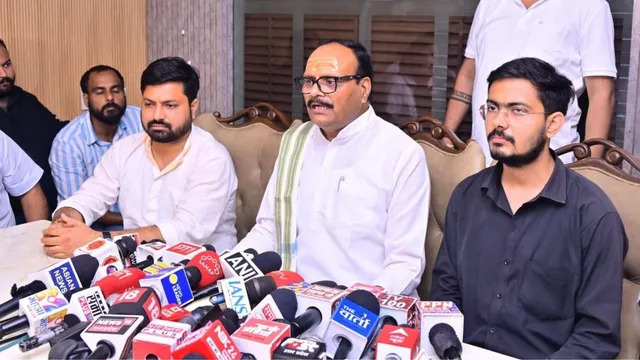
The more likely strategy, therefore, is engagement without endorsement. Nadda can meet the activists and hear their grievances, while leaders such as Paswan can reassure reserved communities that their constitutional protections will not be dismantled. This dual approach allows the BJP to keep communication open with upper-caste and youth constituencies without surrendering the broader social coalition it has spent years building.
The larger political question is whether movements such as the RHA and CJP can convert social-media popularity into sustained organization and electoral influence. If they succeed, they could introduce a new dimension into Indian politics in which caste remains important but is increasingly intertwined with questions of merit, employment, economic disadvantage and access to opportunity.
For the BJP, that possibility makes the anti-reservation movement impossible to ignore. But its electoral arithmetic also makes it impossible to embrace the demand to abolish reservation.