








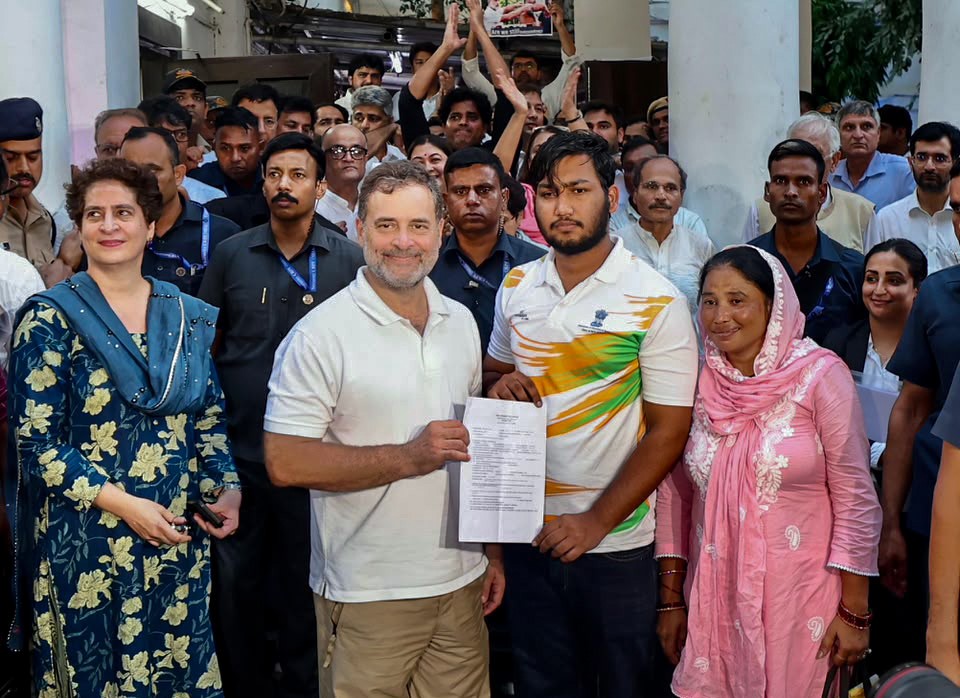
By sitting at a police station for nearly eight hours, Rahul Gandhi turned a demand for an FIR into a larger political confrontation — and reinforced his emerging image as an opposition leader willing to take the fight to the street
Our Bureau
NEW DELHI
Rahul Gandhi appears to have discovered a political language that suits him increasingly well: confrontation.
On Friday, the Leader of the Opposition in the Lok Sabha walked into the Parliament Street Police Station with student protester Sahil Lochav and several Congress leaders. He stayed there for nearly eight hours, refusing to leave until Delhi Police registered an FIR over Lochav’s allegation that pellet guns were used against him during a July 20 protest.
When the FIR was finally registered, Gandhi described it as “the first step towards justice.”
“It has been a month since he was hit by that bullet. Pellets are still lodged in his body; three are in his eye, and he cannot see out of it. Three or four are near his heart. A grave injustice has been done to this young man,” Gandhi said.
The episode captures a changing Rahul Gandhi. Increasingly, he is not content with raising an issue in Parliament or holding a press conference. He is prepared to physically enter the arena of confrontation and remain there until he gets a response.
That is the street-fighter side of Gandhi.
“We have been here all this time — it is now nearly a quarter to seven — and only now has the FIR been filed,” he said, questioning why a process that should have been straightforward had taken so long.
Gandhi went further, alleging that the delay was coming from the top.
“The final approval — the ultimate ‘okay’ — had to come from the Home Secretary and Amit Shah himself. Only then was the FIR finally issued. So, you can understand who was holding up the FIR,” he alleged.
“These police officers wanted to register it; the others wanted to do it too, but the brakes on justice were being applied from the top,” Gandhi said.
The Congress immediately turned the protest into a symbol of resistance.
Congress president Mallikarjun Kharge asked, “What exactly is Amit Shah hiding?” He alleged that the government had failed to explain who ordered the alleged use of pellet guns against students.
Jairam Ramesh called it a victory for persistence, saying it was Gandhi’s “sheer persistence and perseverance” during his dharna that led to the FIR being registered. Congress leader Supriya Shrinate was even more emphatic: “Jhukti hai duniya, jhukane wala chahiye.”
The symbolism matters for Gandhi.
For much of his political career, he was portrayed by opponents as a politician who lacked the aggression and staying power necessary for India’s rough-and-tumble politics. His latest actions suggest that he is consciously trying to shed that image.
His supporters see the change as political maturity. Omar Abdullah said Gandhi was “doing exactly what the people of the country expect from him,” arguing that the Leader of the Opposition’s job is “to hold the government accountable and make the government answerable.”
Lochav’s own account strengthened that narrative. “Let’s meet tomorrow; I will go and get your FIR filed,” he quoted Gandhi as telling him after learning that his complaint had not been registered. Lochav said the FIR might not have been registered without Gandhi’s intervention.
But the BJP sees precisely the opposite. Union Minister JP Nadda called the demonstration “cheap, attention-seeking politics” and “camera-centric drama,” arguing that the Supreme Court had already constituted a five-member committee to investigate the July 20 incident.
BJP leader Ravi Shankar Prasad accused Gandhi of “politics of anarchy”, while Giriraj Singh said the Congress leader was attempting to “take the law into their own hands.”
The criticism highlights the political gamble Gandhi is taking. A street protest can create immediacy and emotional connection, but opponents can portray the same action as theatre.
Yet Gandhi appears willing to take that risk. The larger investigation will determine what actually happened during the July 20 protest. The Supreme Court has appointed a five-member High-Powered Expert Committee to examine allegations of excessive force by police and violence by protesters, including claims concerning the treatment of women protesters. Politically, however, Gandhi seems to have already made his point. In doing so, Rahul Gandhi is slowly building a new political identity — not simply as Parliament’s leading critic of the government, but as a politician prepared to take the battle outside Parliament and stand with those who believe the system has failed them.