








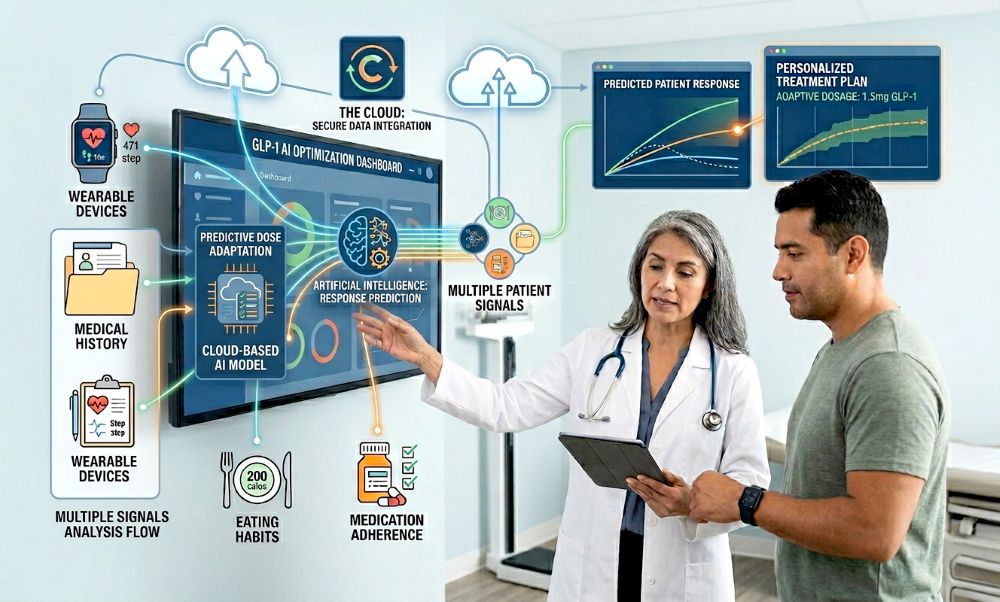
Moving past one-size-fits-all treatments with cloud systems that predict and optimize patient response.
By Shivam Gupta and Shivai


Weight loss drugs like GLP-1 medications have changed how doctors treat obesity, but they come with a major challenge. Not everyone responds to them in the same way. Some people lose significant weight quickly, while others see slower or limited results. The question now is not just whether these drugs work, but who they work best for and why.
This is where artificial intelligence and cloud computing are starting to play an important role. Instead of looking at a patient in isolation, AI systems can analyse many signals at once, such as changes in body weight over time, eating habits, activity levels from wearable devices, medical history, and even how consistently someone takes their medication. By combining all of this information, AI can help predict how a person might respond to a specific treatment.
Cloud computing makes this possible at scale. Health data is generated in many places, hospitals, pharmacies, mobile apps, and fitness devices. The cloud brings all of this information together securely so it can be analysed in real time. This allows doctors and health systems to monitor progress continuously rather than relying on occasional checkups.
Shivam Gupta a software developer and expert in ML, explains this shift as moving toward predictive healthcare systems, where cloud-based AI helps anticipate how patients will respond before treatment is fully adjusted. Shivai Gupta an expert in digital biotechnology, highlights the importance of using biomedical data and machine learning together to better understand how the body reacts to these medications.
However, the goal is not to replace doctors. Instead, it is to give them better tools. AI can highlight patterns that are difficult to see manually, such as early signs that a drug is not working well or that a patient may experience side effects.
There are still challenges. Health data is often incomplete, inconsistent, and sensitive. Protecting patient privacy and ensuring fairness across different populations is critical. There is also the risk of over-relying on data trends without understanding individual human differences.
Even with these challenges, the direction is clear. Healthcare is slowly shifting from a “one-size-fits-all” approach to a more personalized system, where treatments are continuously refined based on real-world data.
AI and cloud computing are becoming the foundation of this change, helping make weight loss treatment more precise, adaptive, and effective for more people.
About Writers:
Shivam Gupta is a Software Development Engineer at AWS, specializing in distributed systems, cloud infrastructure, backend engineering, and applied AI. He focuses on building reliable, scalable, and observable large-scale production systems.
He holds a Master’s in Computer Science from the University of Florida, where he researched machine learning and generative AI using HiPerGator supercomputing infrastructure. Previously, he built cloud-native backend systems and financial data platforms at Barclays. Shivam is also an active researcher and keynote speaker at international conferences covering AI, cybersecurity, and distributed systems.
Shivai is a biotechnology professional with a PhD in Biomedical Sciences (Immunology), specializing in life sciences, data engineering, and AI-driven R&D transformation. Currently a Scientific & Digital Solutions Consultant at Genedata (Danaher), she helps global pharma and biotech companies optimize enterprise platforms and data pipelines for biologics and bioprocess R&D using SQL and Python. Previously, at the University of Florida, she led machine learning and in-silico screening research for autoimmune disease therapies, contributing to multiple first-author publications.
She bridges scientific depth with digital fluency to build scalable, analytics-driven frameworks for biopharma innovation.