








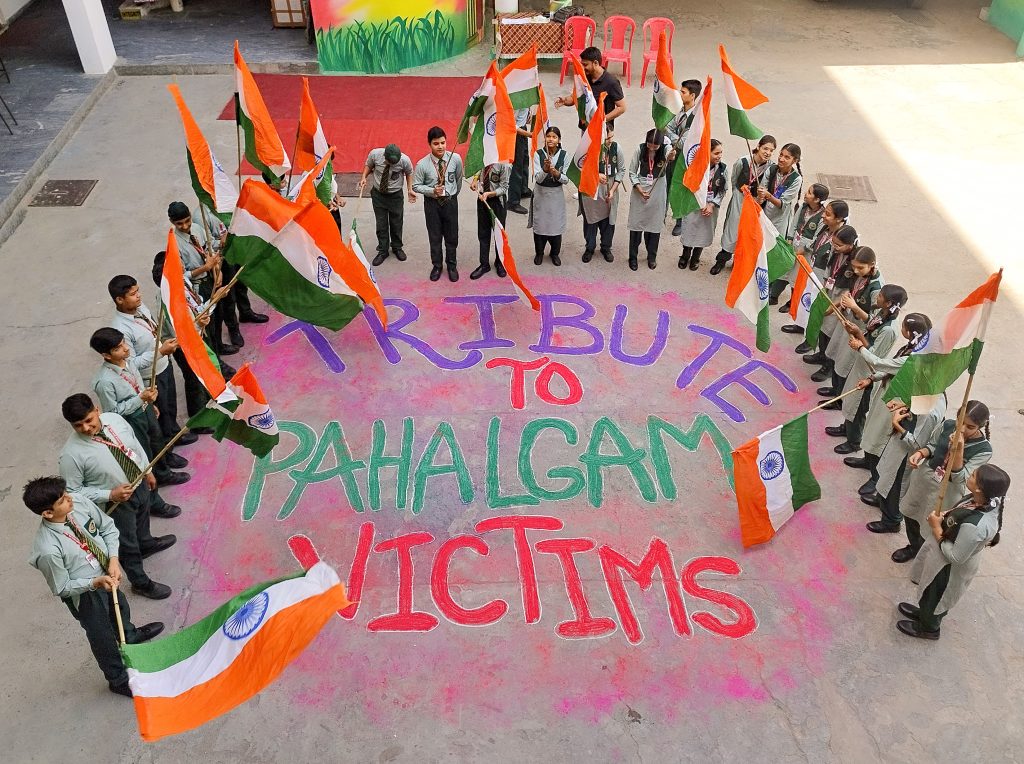
From political leaders to citizens, the nation speaks in one voice of grief, resolve and defiance against terrorism.
Our Bureau
Washington, DC / New Delhi
India on Tuesday marked the first anniversary of the 2025 Pahalgam terror attack with a powerful display of unity, as political leaders across party lines, citizens, and the global Indian community came together to condemn terrorism and honour the 26 lives lost in one of the country’s most shocking attacks in recent years.
On April 22, 2025, terrorists struck the tourist town of Pahalgam, killing 26 civilians in a targeted assault that left the nation in grief. A year later, the memory of the attack continues to resonate deeply, with leaders emphasising that such acts have only strengthened India’s resolve to combat terrorism.
Prime Minister Narendra Modi led the tributes, remembering the victims and reaffirming the country’s firm stance. “Remembering the innocent lives lost in the gruesome Pahalgam terror attack on this day last year. They will never be forgotten,” he said, adding, “As a nation, we stand united in grief and resolve. India will never bow to any form of terror. The heinous designs of terrorists will never succeed.”
Echoing similar sentiments, President Droupadi Murmu said the tragedy “remains etched in our collective memory” and stressed that “such acts of terror cannot deter our unwavering commitment to peace and unity.” She added that the entire nation stands with the bereaved families and remains “resolute in our determination to defeat terrorism everywhere in all its forms.”
The unity extended across the political spectrum. Leader of the Opposition Rahul Gandhi paid tribute to the victims, asserting that “India will never forget their sacrifice and the pain of their families, nor will it ever forgive those responsible for this dastardly act.” Congress President Mallikarjun Kharge described the nation as “united, resilient, and determined against terrorism,” while Priyanka Gandhi Vadra called the attack a “crime against humanity,” adding that “India will neither forget it nor forgive the criminals.”
Vice President C. P. Radhakrishnan also paid homage, reaffirming the country’s collective resolve to fight terrorism in all its forms. The chorus of voices from across political divides underscored a rare moment of unanimity in condemning terror and standing with victims’ families.
Beyond political statements, public participation reflected the depth of national sentiment. In Tangdhar, around 2,000 students and members of civil society took out solidarity marches, holding placards reading “Stop terror attack,” “We condemn attack on tourists,” and “We stand for innocent tourists.” Students from Shiksha Niketan High School gathered to pay tribute, with one student recalling how “several families lost their loved ones” on that day when Kashmir, often called “heaven on earth,” was struck by violence.
Internationally, India’s message found resonance as well. Speaking in Washington, Ambassador Vinay Mohan Kwatra described terrorism as a “scourge on humanity” and said the anniversary “weighs very heavily on India and the rest of the world.” Referring to the attack, he said, “acts like Pahalgam and other terrorist acts are acts of cowardice against humanity,” stressing the need for collective global resolve to defeat terrorism.
While the nation mourned, it also reflected on its response. In the aftermath of the attack, India launched the military operation Operation Sindoor on May 7, 2025, targeting terror infrastructure in Pakistan and Pakistan-occupied Jammu and Kashmir. According to official details, the operation destroyed nine major terror launchpads linked to Lashkar-e-Taiba, Jaish-e-Mohammed, and Hizbul Mujahideen, and eliminated over 100 terrorists.
The operation was followed by a brief but intense escalation, including drone attacks and cross-border shelling, before a ceasefire was reached after high-level military talks. The Indian Army has since reiterated its strong stance, warning of assured retaliation against any future acts of terror.
Back home, the Valley itself offered a contrasting image of resilience and recovery. In Srinagar, tourists reported feeling safe and welcomed, highlighting a return to normalcy nearly a year after the attack. Visitors from Gujarat described the atmosphere as reassuring, with one tourist, Sureshbhai Patel, saying, “It felt like home. People should come here and enjoy.”
Another visitor, Dr Piyush Panchal, noted, “We do not feel any fear here; it feels good. People should come here for a visit.” Their experiences reflect growing confidence in security arrangements, with forces maintaining a tight vigil across key areas.
The steady flow of tourists is being seen as a sign of resilience—not just of the region, but of the country’s collective spirit. Even as the scars of the attack remain, the message from both citizens and leaders is clear: terrorism will not dictate India’s future.
One year on, the Pahalgam attack has become more than a memory of tragedy—it has emerged as a symbol of unity. From government leaders to students, from grieving families to international voices, India’s response has been marked by a shared determination to stand together, honour the victims, and ensure that such acts of terror are met with unwavering resistance.