

As parties clash ahead of polling, Assam’s election has become a contest of sharply divergent political storytelling
Our Bureau
Guwahati / New Delhi
With polling for all 126 Assembly constituencies scheduled for April 9, Assam is witnessing not just a political contest but a battle of narratives—each party framing the state’s past, present and future in starkly different ways. From development claims to allegations of fear and discrimination, the campaign rhetoric reveals how the Bharatiya Janata Party (BJP)-led NDA, the Congress, and smaller players are attempting to define the electoral choice before voters.
At the centre of the BJP’s narrative is a decade-long claim of transformation. Prime Minister Narendra Modi has framed the last ten years as an “era of service and good governance,” positioning the upcoming election as a referendum on progress. Addressing rallies, he asserted that “Assam has witnessed a new era of service and good governance in the past 10 years,” adding that “this time, a hat-trick for the BJP-NDA government is certain.”
The BJP’s messaging ties development to identity and governance. Modi accused the Congress of being “anti-development” and “the root of corruption in independent India,” alleging that it “played with Assam’s identity, pride, and security” and “compromised Assamese identity for the sake of power.” He also linked past policies to demographic concerns, stating that Congress’s “biggest wrongdoings has been integrating illegal infiltrators into the mainstream.”
Alongside these attacks, the BJP is projecting a forward-looking agenda. Modi highlighted infrastructure gains, saying that where people were once “stunned to see the state’s backwardness,” they are now “filled with joy” at improved connectivity. He also pointed to ongoing efforts to address floods and land erosion, with “schemes worth hundreds of crores” and an additional Rs 18,000 crore planned. Promises such as implementing the Uniform Civil Code and “saving Assam’s identity” further reinforce the party’s dual plank of development and cultural protection.
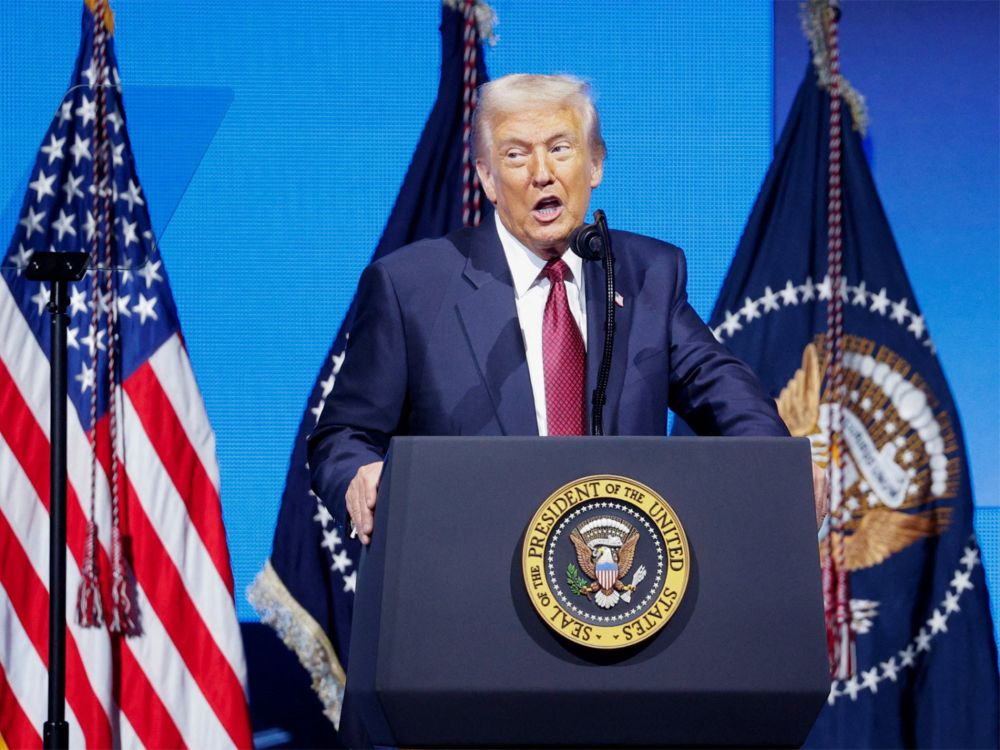
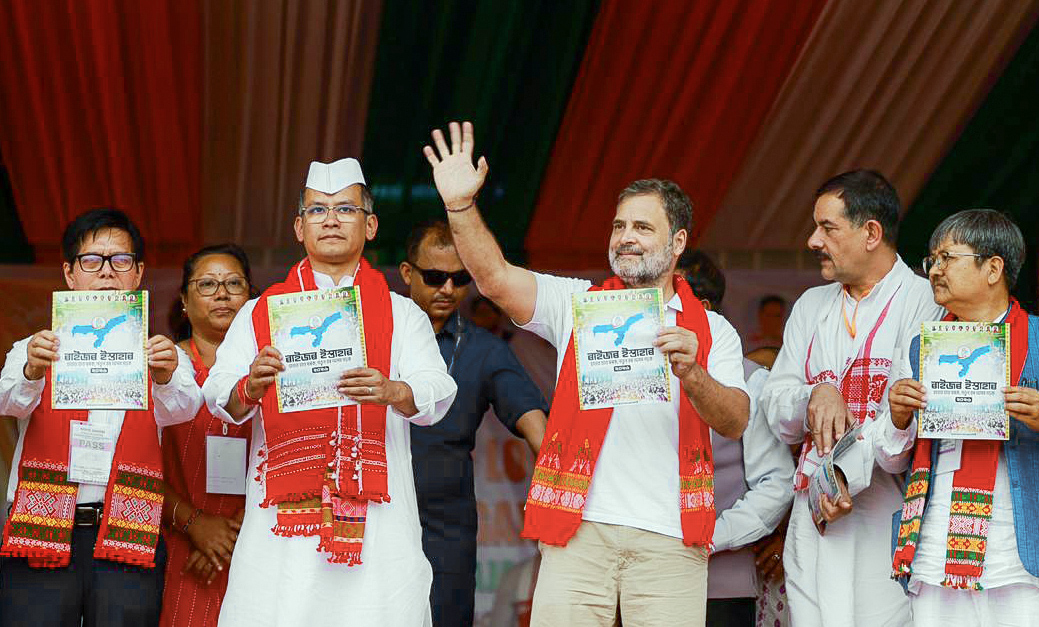
In contrast, the Congress is building a narrative centred on power, control and fear. Leader of Opposition Rahul Gandhi has sought to reframe the leadership dynamic itself, alleging that Modi is controlled by former US President Donald Trump. “Donald Trump controls Narendra Modi,” Gandhi said, adding that “if Trump tells Modi to jump, Narendra Modi will ask how long and will start jumping.”
He extended this argument to the state level, claiming that “the way Trump controls Modi, similarly, Modi controls your CM,” referring to Assam Chief Minister Himanta Biswa Sarma. According to Gandhi, Modi’s influence stems from his awareness of the Chief Minister’s “corruption and crimes,” enabling him to “make your CM do whatever he wants.”
Beyond leadership critiques, Gandhi accused the state government of undermining Assam’s cultural ethos. Invoking figures like Shankar Dev, Bhupen Hazarika and Tarun Gogoi, he argued that the “very soul of Assam” is rooted in unity and respect. “However, today, the Chief Minister of Assam is spreading hatred and intimidating the people. This is not Assam’s culture,” he said.
Congress leader Priyanka Gandhi Vadra reinforced this line of attack, recasting the BJP’s “double-engine government” as a “government of double-slavery.” She alleged that Modi “has become a slave to America” and that Sarma is “Modi ji’s slave,” warning that such a system seeks to “make the people of this… state of Assam slaves, keep them suppressed.”
Her appeal focused on governance and public welfare, contrasting what she described as a government that “doesn’t scare you, doesn’t threaten you” with one driven by “selfish interests.” She urged voters to reject “the politics of fear,” framing the election as a choice between intimidation and empowerment.
Other opposition voices are attempting to carve out distinct spaces within this crowded narrative landscape. Jharkhand Chief Minister Hemant Soren questioned the BJP’s development claims by pointing to ground realities. “The Prime Minister talks about providing pucca houses to everyone, but how many people have actually received pucca houses?” he asked, highlighting concerns about “electricity, water, roads, and hospitals” and the “condition of the labourers in the tea gardens.”
Meanwhile, AIMIM chief Asaduddin Owaisi has focused on minority rights, alleging “unconstitutional and unlawful discrimination” by the BJP government. He claimed that “more than 50,000 Muslims’ houses have been demolished, leaving them homeless,” and criticised the Congress for lacking “the courage to speak out.” Positioning the AIUDF as an alternative, he appealed to voters to ensure “your voice is heard in the assembly.”
Together, these competing narratives reveal an election defined by contrasting visions.
As Assam heads to the polls, the outcome may well depend on which of these narratives resonates most strongly with voters: a story of transformation and stability, or one of control, fear and unmet promises.