









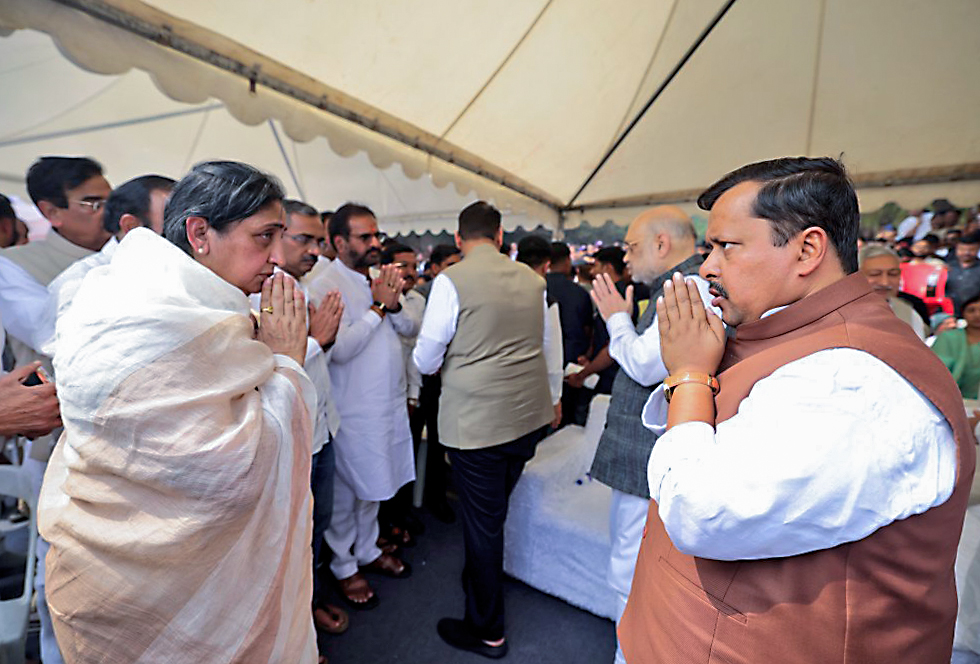
The sudden demise of Deputy Chief Minister Ajit Pawar has unsettled Maharashtra’s political balance, triggering intense speculation, demands for transparency and a scramble for succession across party lines.
Our Bureau
Mumbai / Baramati
The untimely death of Maharashtra Deputy Chief Minister Ajit Pawar in a plane crash has plunged the state into a rare political vacuum, unsettling alliances, exposing fault lines within parties and giving rise to conspiracy theories that now swirl alongside public grief. As tributes pour in and investigations get underway, Pawar’s absence is being felt not just as a personal loss but as a destabilising moment for Maharashtra’s power structure.
Union Home Minister Amit Shah, who paid his last respects to Pawar, captured the prevailing sentiment when he described the loss as a void in Maharashtra’s politics that would be “impossible to fill for a long time.” Pawar, 66, died on Wednesday morning when the chartered aircraft he was travelling in crash-landed near the runway while attempting to land at Baramati airport in Pune district. The accident, which occurred around 8.48 am, killed all five people on board, including Pawar’s personal security officer, a flight attendant and two pilots. He was en route from Mumbai to Baramati to campaign for the Zilla Panchayat elections.
The scale of the mourning was evident at his last rites, held with full state honours at the Vidya Pratishthan ground in Baramati. Senior leaders cutting across political divides — including Chief Minister Devendra Fadnavis, Union Minister Nitin Gadkari, NCP (Sharadchandra Pawar) chief Sharad Pawar and actor Riteish Deshmukh — gathered alongside thousands of supporters. Pawar’s sons, Parth and Jay, lit the funeral pyre, while his wife Sunetra Pawar, a Rajya Sabha MP, stood by amid visible public grief.
Yet even as Maharashtra mourns, the political ramifications are unfolding rapidly. Ajit Pawar was not merely a Deputy Chief Minister; he was a seasoned power broker, a mass leader with deep roots in western Maharashtra and a figure who often held the key to government stability. His ability to straddle factions, manage organisational machinery and deliver electoral outcomes made him indispensable in a state known for complex coalition politics.
That indispensability now raises uncomfortable questions: who fills the vacuum, and at what cost? Within the Nationalist Congress Party, already fractured by past splits, Pawar’s absence reopens unresolved succession debates. Fauzia Khan, NCP-SCP MP and a long-time associate, described him as “the elder brother of Maharashtra” and a skilled organiser who could balance ideology, relationships and governance. Her words underline a reality that many in the party privately acknowledge — Pawar was often the glue holding competing ambitions together.
Beyond party equations, the manner of his death has fuelled speculation and conspiracy theories, amplified by social media and political rhetoric. Shiv Sena (UBT) leader Sanjay Raut has openly questioned whether the crash was the result of technical failures, radar issues or airport-related lapses, insisting that condolences alone are not enough. Drawing parallels with previous chartered flight accidents, Raut demanded that the truth be placed before the public to prevent future tragedies.
Such statements reflect a broader undercurrent of mistrust, particularly in a politically charged environment where high-profile deaths rarely escape scrutiny. While there is no evidence of foul play, the demand for transparency has grown louder, partly because of Pawar’s stature and partly because of the frequency of aviation accidents involving chartered aircraft.
The government has moved swiftly to address these concerns. Civil Aviation Minister Rammohan Naidu Kinjarapu informed Chief Minister Fadnavis that the Aircraft Accident Investigation Bureau (AAIB) has initiated a formal probe. The aircraft’s black box has been secured, and officials have confirmed that both the voice recorder and flight data recorder have been recovered. A time-bound and transparent investigation, conducted under the Aircraft Accident and Incident Rules, has been promised. The Pune Rural Police have also registered an Accidental Death Report and begun parallel inquiries.
Despite these assurances, the political impact of Pawar’s death is already visible. His absence comes at a sensitive moment, with local body elections underway and broader realignments expected in the coming months. As a leader who could mobilise cadres and influence rural and cooperative networks, Pawar played a crucial role in electoral arithmetic. His death may alter campaign dynamics, especially in regions where his personal influence outweighed party labels.
There is also the question of governance. As Deputy Chief Minister, Pawar handled key portfolios and acted as a bridge between the state leadership and grassroots networks. Replacing such institutional memory is not easy, and any transition risks creating friction within the ruling setup. Political observers note that Maharashtra has often seen instability when strong personalities exit abruptly, whether through defeat, defection or death.
For now, the state stands at an uneasy crossroads — united in grief but divided by uncertainty. The investigation into the crash will be closely watched, not only for answers about the tragedy but also for reassurance in an atmosphere thick with suspicion. At the same time, parties will quietly begin recalibrating strategies, even as they publicly mourn.



Ajit death will have no effect . India is full of great people and thinkers . His corrupt practices were not exposed as Indian voters are backward and not well informed .
India under BJP leadership is taking a turn from bad to good .
To bring change in billion voters will need time .
I am sure this 21 century era of information belongs to India .