

From museum retrospectives to political interventions and market dominance, Anish Kapoor stood as India’s most powerful artistic presence worldwide in 2025.
In 2025, Anish Kapoor occupied a position few artists—Indian or otherwise—can claim: simultaneously shaping global conversations on art, politics, and perception while maintaining formidable market strength. At a time when contemporary art is increasingly fragmented between activism, spectacle, and commerce, Kapoor managed to operate convincingly across all three, reaffirming his status as the most internationally significant Indian artist of the year.
The most striking moment of Kapoor’s 2025 practice came in August, when he partnered with Greenpeace for BUTCHERED, a large-scale installation mounted on a Shell gas platform. The work consisted of a massive canvas drenched in a blood-like substance, confronting viewers with the violence embedded in continued fossil fuel extraction. It was a visceral intervention, deliberately staged far from the white cube, and emblematic of Kapoor’s refusal to separate aesthetics from ethical urgency. As noted by Ocula, the project reinforced his long-standing engagement with power, violence, and moral responsibility.
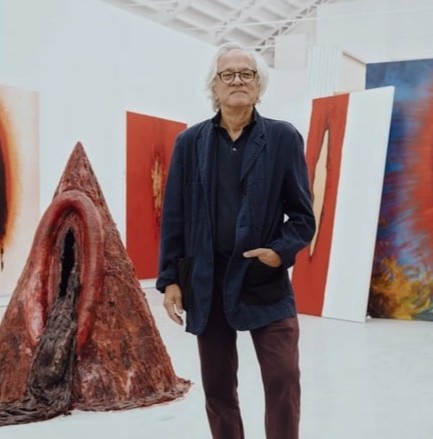
This activist turn did not replace Kapoor’s institutional presence; it amplified it. In October, The Jewish Museum in New York opened Anish Kapoor: Early Works, the first U.S. museum exhibition devoted to his formative pigment sculptures and early works on paper. Running through February 2026, the show traced the origins of Kapoor’s lifelong preoccupation with material, void, and perception. The raw pigment pieces—powdered forms that seem both bodily and immaterial—reminded audiences that Kapoor’s global fame rests on a rigorously experimental foundation laid decades earlier.
Simultaneously, Anish Kapoor: Dissolving Margins opened at the Jordan Schnitzer Museum of Art at Washington State University, focusing on his printmaking practice. Often overshadowed by his monumental public works, Kapoor’s prints revealed another dimension of his thinking: quieter, more intimate, yet equally concerned with thresholds, depth, and the instability of form. Together, these exhibitions confirmed that Kapoor’s relevance in 2025 was not retrospective nostalgia, but an ongoing re-examination of a living oeuvre.
Kapoor’s public visibility also extended into controversy. In one widely reported episode, he considered legal action after U.S. border agents posed with his iconic Cloud Gate sculpture in Chicago, an act he condemned as emblematic of what he termed “fascist America.” The incident reignited debates about public art, state power, and the ownership of symbols. Once again, Kapoor found himself at the center of cultural friction, unwilling to let his work be neutralized or co-opted.
Crucially, this intellectual and political prominence was matched by sustained market strength. In the first half of 2025, Kapoor’s works performed strongly at major auction houses. Sotheby’s sold Untitled (2011) for over $480,000, while Mirror Glow (Spanish Gold) (2017) fetched $482,600 at Phillips, far exceeding its estimate. These results underscored consistent demand for his mirror and stainless-steel works, which continue to anchor the upper-mid-range contemporary art market.
Kapoor’s market presence extended beyond auctions into carefully curated collaborations. His partnership with Rémy Martin resulted in a limited-edition XO cognac decanter and accompanying artwork titled Pagan Gold. Rather than diluting his artistic identity, the collaboration reinforced it, connecting his exploration of material depth and luminosity with craftsmanship and heritage. In 2025, Kapoor demonstrated how an artist could navigate the luxury world without surrendering conceptual seriousness.
This balance between experimentation, activism, and commerce is central to understanding Kapoor’s dominance. While many artists excel in one arena, Kapoor moved fluently across all of them. He remained a fixture in museum programming, a force in political art, and a reliable presence in the global art market. The Hurun India Art List’s ranking of Kapoor as the top-selling Indian artist of 2025 merely formalized what was already evident across institutions and markets worldwide.
Underlying all this activity was a remarkable continuity of vision. Kapoor continued to explore perception, the body, absence, and the void—whether through raw pigment, reflective steel, or politically charged gestures. His use of materials such as Vantablack, alongside older sculptural vocabularies, signalled an artist still testing the limits of seeing and meaning rather than settling into reputation.
By the end of 2025, Anish Kapoor’s position was unambiguous. He was not simply India’s most visible artist on the global stage, but one of the few contemporary figures capable of shaping discourse across continents. In a year defined by uncertainty and confrontation, Kapoor’s work insisted that art remain a space of intensity, risk, and moral engagement—and that insistence is what made him the top Indian artist globally in 2025.