

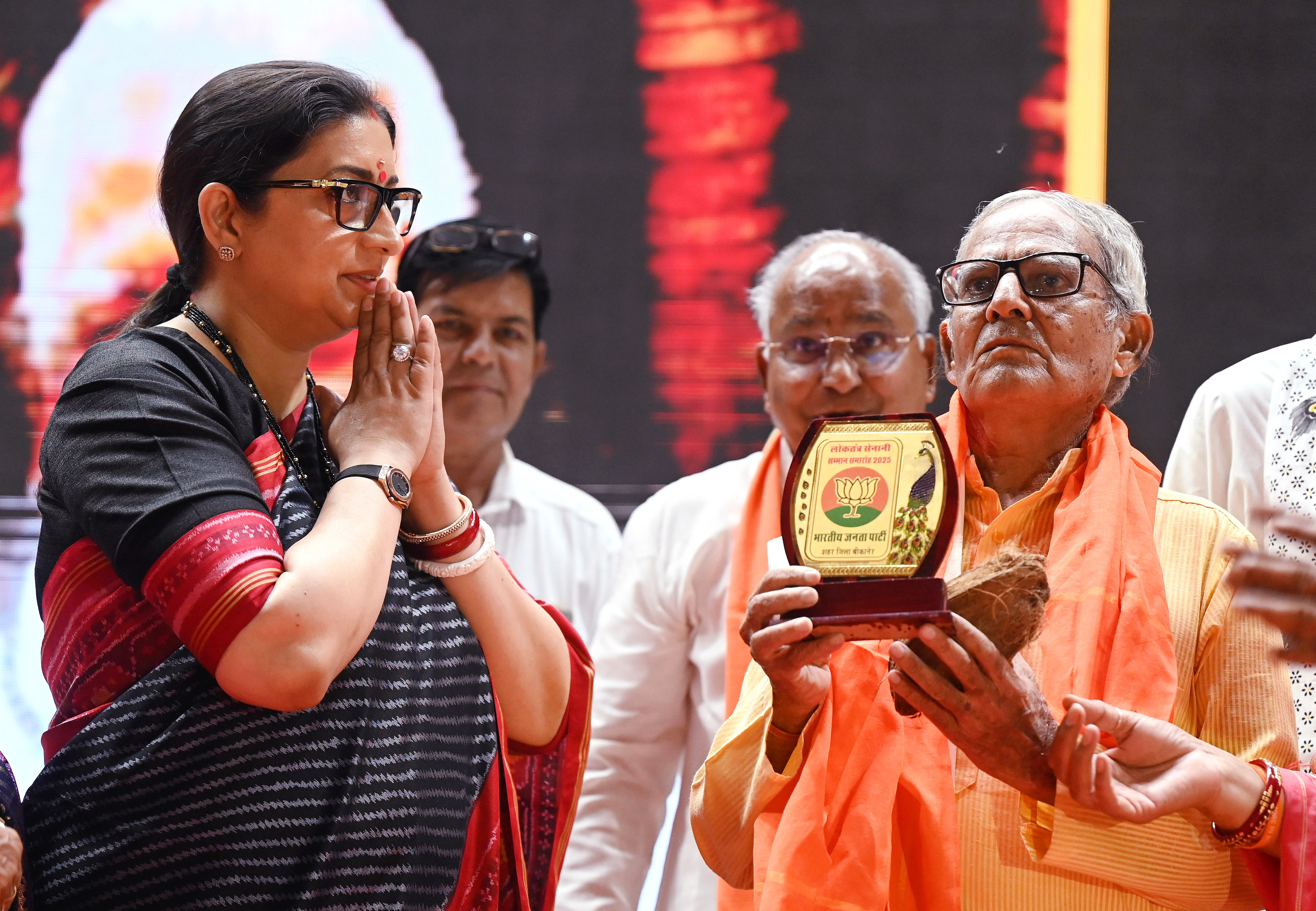
Balancing public life and popular culture, Smriti Irani in 2025 re-emerged as both a key BJP organizer and a television icon, redefining what a political comeback can look like.
In 2025, Smriti Irani occupied a space few Indian public figures have ever managed to straddle with such visibility and confidence. A year after her electoral defeat in Amethi, Irani returned to the small screen as a prime-time television star even as she remained deeply embedded in the Bharatiya Janata Party’s organizational and ideological work. The result was a rare dual identity: a politician without a parliamentary seat but with national influence, and an actor reclaiming a cultural role that once defined Indian television.
Her return to acting was nothing short of historic. In July 2025, Irani reprised the role of Tulsi Virani in Kyunki Saas Bhi Kabhi Bahu Thi 2, a 150-episode reboot of the show that had made her a household name in the early 2000s. Produced by Ektaa Kapoor and premiering on Star Plus on July 29, the series reunited Irani with original co-star Amar Upadhyay, who returned as Mihir. The nostalgia-driven reboot quickly became one of the most-watched shows on Indian television, reportedly drawing close to five crore viewers every month.
The comeback was also commercially unprecedented. Irani became the highest-paid actor in the history of Indian television, earning a reported ₹14 lakh per episode. In an industry often marked by pay disparities and opaque contracts, the figure itself became part of the story—symbolizing not just her star power, but the leverage of a performer returning after two decades with an unbroken emotional connect to audiences.
Yet Irani was careful to define the terms of her return. Even at the height of the show’s success, she repeatedly described acting as a “side project,” insisting that she remained a “full-time politician and part-time actor.” The clarification was more than rhetorical. Throughout 2025, Irani maintained an active schedule within the BJP, working largely behind the scenes as an organizer, strategist and public advocate.
Her political role after the 2024 loss evolved rather than diminished. In Delhi, Irani became deeply involved in the BJP’s membership drive, supervising district-level units and strengthening grassroots structures. Her relocation to a new residence in South Delhi triggered speculation about a possible Chief Ministerial role ahead of the 2025 Delhi Assembly elections, speculation she neither confirmed nor dismissed. Instead, she emphasized her availability for any responsibility the party assigned.
Nationally, Irani remained a visible face of the BJP’s organizational discipline. She publicly stated her readiness to take on assignments in upcoming state elections, including Bihar, signaling that electoral defeat had not reduced her standing within the party’s central leadership. For Irani, 2025 was less about personal electoral ambition and more about institutional relevance.
Her influence also extended beyond domestic politics. In international forums, Irani continued to position herself as a global advocate on issues of gender equity and leadership. She represented India at the World Economic Forum in Davos, where she helped establish a partnership network of around 10,000 international companies focused on advancing gender inclusion in the workplace. These engagements reinforced her transition from a ministerial administrator to a broader political communicator on the global stage.
Public engagement remained a defining feature of her year. In November 2025, Irani participated in the Sahitya Aajtak session titled “Kyunki Smriti Lekhak Bhi Hai”, where she spoke candidly about women’s struggles in balancing family responsibilities with professional ambition. The session highlighted a lesser-known aspect of her public persona—that of a writer and reflective thinker—adding depth to her otherwise polarizing image.
She also made headlines for her outspoken cultural interventions. When Aditya Dhar’s film Dhurandhar faced online backlash, Irani publicly defended the film, praising its depiction of sacrifice and realism. The gesture reinforced her long-standing position that art and storytelling should not be judged solely through political filters.
Irani’s personal reflections in 2025 carried a sharper edge of self-definition. Speaking at various summits in March, she underlined that her political journey did not begin in 2014 and would not be confined to electoral outcomes. “I existed before 2014,” she remarked, framing her career as one of constant reinvention rather than linear ascent. The statement resonated as both a defense and a declaration—of continuity, resilience and ambition.
By the end of 2025, Smriti Irani had reasserted control over her public narrative. She was no longer just a former Union minister or a defeated MP, nor merely a television star returning for nostalgia’s sake. Instead, she emerged as a figure comfortable with contradiction: a politician thriving outside electoral office, and an actor commanding prime time while insisting that power, for her, still lay elsewhere.
In a year defined by reinvention, Smriti Irani proved that relevance in Indian public life can take many forms—and that stepping away from one stage can sometimes make room for an even larger one.