

In 2025, Group Captain Shubhanshu Shukla became India’s second astronaut and the first Indian to travel to the International Space Station, turning a historic mission into a springboard for India’s future in human spaceflight.
When Group Captain Shubhanshu Shukla lifted off aboard a SpaceX Dragon spacecraft on June 25, 2025, he was not merely embarking on a personal journey into orbit. He was carrying with him the weight of national expectation and the promise of India’s next chapter in space exploration. Nearly four decades after Rakesh Sharma became the first Indian in space, Shukla emerged as India’s second astronaut — and the first to visit the International Space Station (ISS) — marking a decisive shift from symbolic presence to sustained participation in global human spaceflight.
An Indian Air Force pilot and a trained astronaut with the Indian Space Research Organization (ISRO), Shukla served as Mission Pilot on Axiom Mission 4 (Ax-4), a commercial yet deeply strategic mission conducted in partnership with NASA, Axiom Space, and SpaceX. The 18-day mission, which concluded with his return to Earth on July 15, 2025, placed India squarely inside the most advanced orbiting laboratory in human history.
Shukla’s journey to the ISS was the culmination of years of preparation. In the months leading up to the mission, he underwent intensive training in the United States, mastering spacecraft systems, emergency protocols, and scientific operations in microgravity. This phase of training, conducted in collaboration with international partners, reflected a new model for India’s space ambitions — one rooted in cooperation, precision, and readiness for long-duration human missions.
The launch itself was watched closely back home. As the Dragon spacecraft docked with the ISS two days later, on June 27, India crossed a milestone that had long remained aspirational. For the first time, an Indian astronaut was working aboard the ISS, contributing directly to cutting-edge scientific research rather than observing from the sidelines.
During his stay aboard the station, Shukla was involved in a series of carefully selected microgravity experiments with direct relevance to life on Earth and future space missions. These included studies on muscle regeneration and degradation in zero gravity, research into crop viability and seed behavior in space-like conditions, and experiments examining cognitive performance in astronauts during extended exposure to microgravity. Each experiment was designed not only to advance scientific knowledge but also to inform India’s own human spaceflight program.
Beyond the lab work, Shukla became a visible and relatable face of Indian science in orbit. Through ham radio interactions, he spoke with students across India, answering questions, sharing observations, and demystifying life aboard the ISS. These interactions were widely seen as one of the mission’s most powerful soft outcomes — inspiring a generation of students to see space not as a distant dream, but as an attainable frontier.
The mission concluded successfully on July 15, when Shukla and his crewmates returned safely to Earth. The technical success of the mission was matched by its symbolic resonance. In August 2025, Shukla returned to India, where he underwent post-mission rehabilitation and was formally welcomed by the nation’s leadership. His meeting with Prime Minister Narendra Modi underscored the political and strategic importance attached to the mission, particularly in the context of India’s upcoming Gaganyaan human spaceflight program.
In public interactions following his return, Shukla struck a notably understated tone. Addressing an Indian Air Force event on August 24, he spoke candidly about his “shy” past and the long road from cockpit to cosmos. The remarks resonated widely, reinforcing the sense that his achievement was built on discipline, persistence, and quiet confidence rather than spectacle.
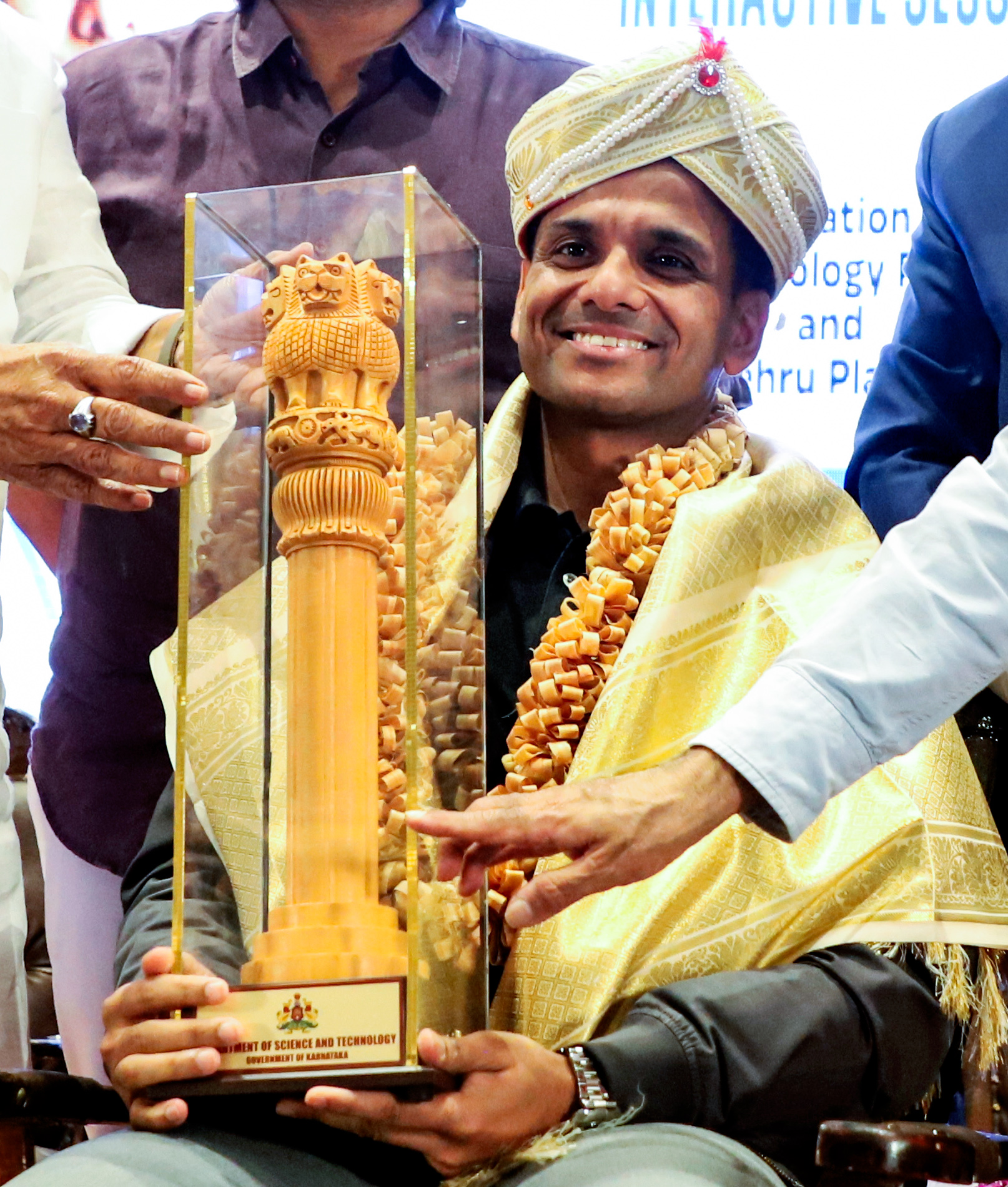
Later in the year, at SAITED 2025, Shukla delivered an address that placed his personal journey within a broader national narrative. He spoke of India’s growing space ambitions, the importance of scientific self-reliance, and the responsibility that comes with being among the first. His message was forward-looking: the ISS mission, he emphasized, was not an endpoint but a rehearsal for more complex and demanding missions ahead.
The significance of Shubhanshu Shukla’s flight extends far beyond its duration. As the first Indian to visit the ISS, he bridged a historical gap between India’s early space achievements and its aspirations as a full-spectrum space power. The mission provided ISRO with invaluable operational experience in human spaceflight, international coordination, and long-duration mission planning — all critical inputs for Gaganyaan.
Equally important is what Shukla represents. Unlike India’s first spaceflight in 1984, which was largely symbolic, his mission was embedded in a larger strategic framework. It demonstrated that Indian astronauts are not just passengers in space, but contributors to global science and exploration.
In that sense, Shubhanshu Shukla’s place in history is secure. As India’s second astronaut, he has helped redefine what it means for the country to be present in space — not as a guest, but as a participant with long-term intent. His quiet, methodical journey to the ISS may well be remembered as the moment India truly prepared itself for a sustained human presence beyond Earth.